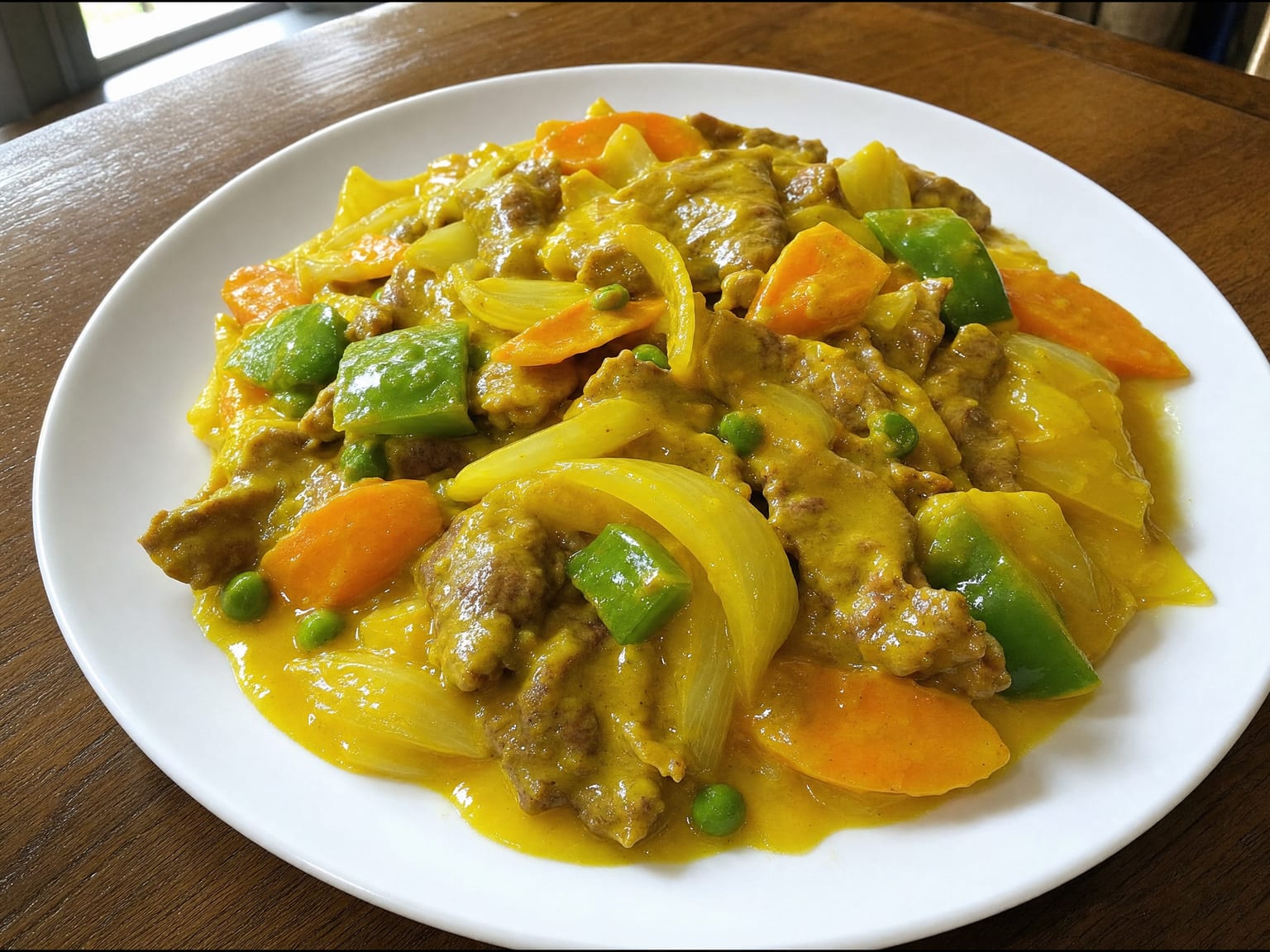
Main Chinese restaurant-style Chinese Dairy-free Nut-free
Chinese Curry Stir-Fry
The mild yellow curry that turns up on Chinese menus as curried beef, chicken or prawns, thickened to a glossy gravy rather than simmered like an Indian curry. Curry powder and turmeric are fried in oil with the aromatics before any liquid arrives, which is the whole difference between a fragrant sauce and one that tastes of raw spice powder stirred into stock.
Prep25 min
Cook12 min
Rest30 min
Servings2
Christoph's version of the mild yellow curry on Chinese restaurant menus, the spices bloomed in oil and the sauce thickened with cornflour rather than simmered.
Ingredients
Written for a 30 cm pan
Units
Temperature
Servings
Beef and marinade
- 400 g flank or rump steak, sliced thinly against the grain rounded
- 15 ml water rounded
- 1 g bicarbonate of soda, tenderiser; rinse off after 30 minutes rounded
- 8 g cornflour rounded
- 10 ml light soy sauce rounded
Curry sauce
- 40 ml neutral oil rounded
- 12 g mild curry powder, Madras style rounded
- 2 g ground turmeric, for colour rounded
- 3 garlic cloves, minced rounded
- 10 g fresh ginger, minced rounded
- 300 ml chicken stock rounded
- 15 ml light soy sauce rounded
- 10 g sugar rounded
- 16 g cornflour, slaked in a little cold water rounded
- 60 ml coconut milk, optional, for a rounder sauce (optional) rounded
Vegetables
- 1 onion, cut into wedges rounded
- 150 g carrot, sliced on an angle rounded
- 1 green pepper, cut into squares rounded
- 100 g frozen peas (optional) rounded
Dietary labels are a guide, not a guarantee. If you have an allergy, read the ingredients yourself.
Method
- Tenderise the beef. Water and bicarbonate of soda, 30 minutes, rinse thoroughly, pat dry, toss with cornflour and soy sauce.
- Sear the beef and remove it. Very hot wok, a third of the oil, one layer, 60 to 90 seconds, out while slightly underdone.
- Bloom the spices. Turn the heat to medium, add the rest of the oil, then the curry powder and turmeric. Stir for 30 to 45 seconds until the oil turns deep yellow and the kitchen smells of curry rather than of dust. Watch it closely, because spice powder in hot oil burns in seconds and burnt curry powder is bitter beyond rescue.
- Add the aromatics and onion. Garlic and ginger for 20 seconds, then the onion wedges for 2 minutes, then the carrot for 2 minutes.
- Add the liquid. Pour in the stock, soy sauce and sugar, bring to a simmer and cook 3 to 4 minutes until the carrot is just tender.
- Thicken to a gravy. Stir the slaked cornflour again and pour it in while stirring, and let it boil for a minute until glossy and thick enough to coat. Stir in the coconut milk if using.
- Finish. Add the pepper and peas for 1 minute, return the beef with its juices, toss and serve with rice.
Variations
- Curried prawns. 400 g peeled prawns, no bicarbonate of soda, seared 60 to 90 seconds and returned at the end.
- Curried chicken. 400 g sliced thigh, velveted without bicarbonate of soda. This is the version most often served over rice as curried chicken rice.
- Curried tofu or vegetables. 400 g pressed torn tofu fried crisp separately, or simply 700 g of mixed vegetables. Use vegetable stock.
- Singapore-style heat. Add a teaspoon of chilli flakes with the curry powder for a version closer to the spicier Malaysian-influenced restaurant curries.
Notes
- Bloom the spices, do not stir them into liquid. This is the single technique that separates a Chinese restaurant curry from a bowl of yellow gravy, and it takes forty-five seconds.
- This is thickened, not simmered. Unlike an Indian curry there is no long cooking and no onion base cooked down for an hour. The sauce is stock, spice and cornflour, glossy and clinging, and it is finished in ten minutes.
- The book has the battered cousin. Shanghai-style crispy chicken curry puts the same family of sauce beside deep-fried battered chicken, which is a different and very good dish.
- Mild curry powder only. This should be fragrant, not fiery; the heat on a Chinese menu comes from chilli added separately.
Ingredient substitutions
- Mild curry powder is a supermarket staple in both Germany and Canada. Do not substitute garam masala, which is a finishing spice with no turmeric and will give neither the colour nor the flavour.
- Coconut milk is optional and not traditional in most Cantonese restaurant curries, but it rounds the sauce nicely. Evaporated milk does a similar job and is what some restaurants actually use.
Good with
From Christoph Mayer