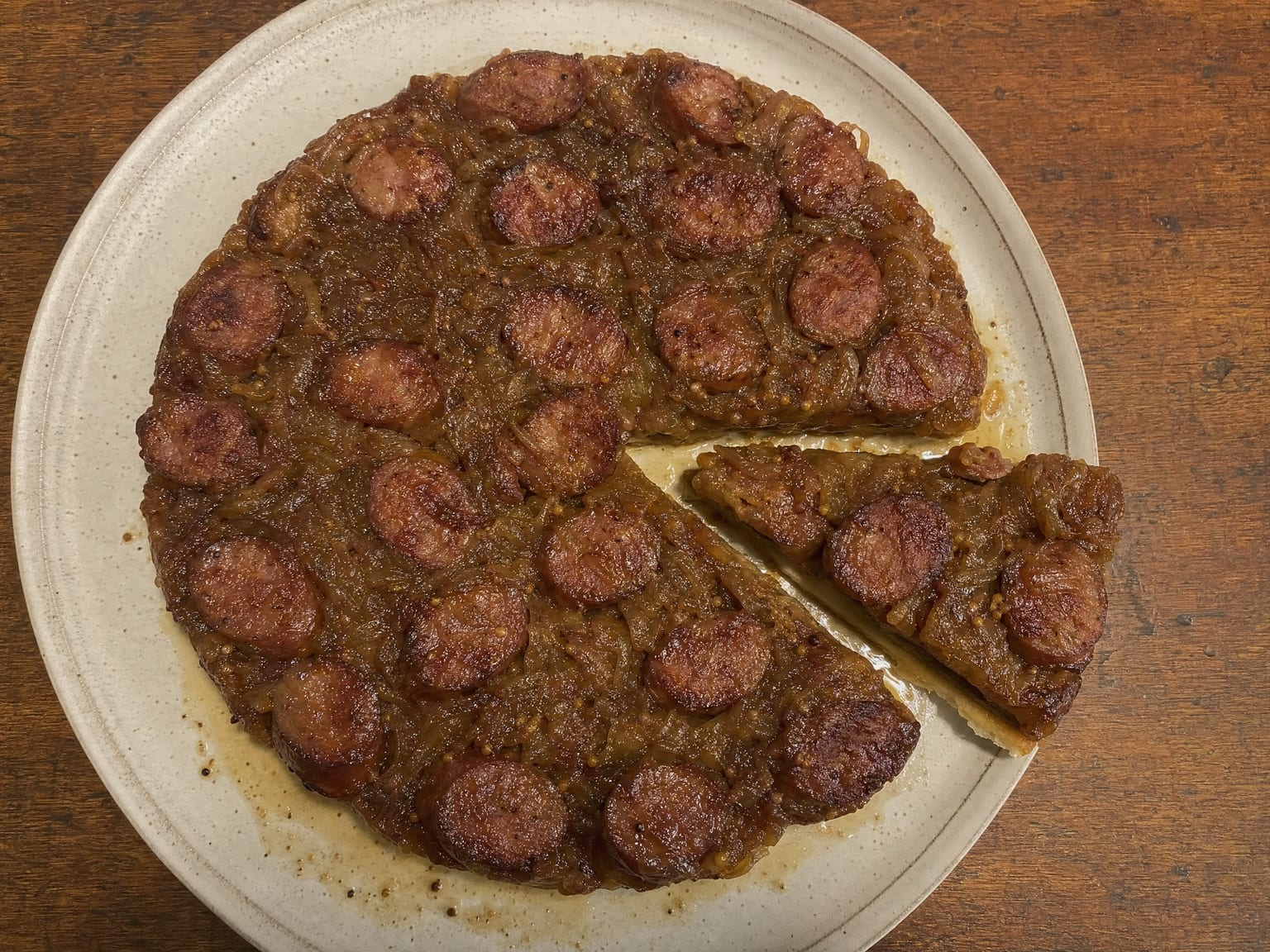
Sausage and onion tarte tatin
A savory tarte tatin built the other way round: sausages browned first in the pan, then a big pile of onions sweated in the same fat, bound with mustard and starch, and topped with puff pastry before the whole thing is baked and flipped.
Prep15 min
Cook45 min
Rest10 min
Oven200°C
Servings6
Adapted from the sausage-and-onion tarte tatin technique that's become a popular one-pan format online: sausages browned first, onions sweated in the same fat, bound with mustard and a little starch, then topped with puff pastry and flipped after baking.
Ingredients
Written for a 25 cm pan
Units
Temperature
Servings
Sausages and onions
- 8 good pork sausages, chipolata-size, or larger sausages twisted in half rounded
- 15 ml neutral oil rounded
- 600 g onions, thinly sliced rounded
- 40 g butter rounded
- 6 g fresh thyme leaves rounded
To bind
- 10 g cornstarch rounded
- 10 g potato starch, cornstarch alone works if this isn't on hand rounded
- 20 g Dijon mustard rounded
- 3 g fine salt rounded
- 2 g black pepper rounded
Pastry
- 320 g all-butter puff pastry, cold, one sheet rounded
- 1 egg, beaten, for brushing the pastry before baking rounded
Dietary labels are a guide, not a guarantee. If you have an allergy, read the ingredients yourself.
Method
- Heat the oil in an ovenproof 24-26cm skillet over medium heat. Add the sausages and brown them all over, turning occasionally, until deeply coloured and cooked all the way through, 12 to 15 minutes depending on their thickness. Transfer to a plate.
- Add the butter to the same pan, still over medium heat, and tip in the sliced onions and thyme. Cook, stirring occasionally, until they’re soft, glossy, and lightly golden at the edges, 12 to 15 minutes. Scrape up any browned bits from the sausages as you go; that’s flavour, not mess.
- Off the heat, sprinkle the cornstarch and potato starch evenly over the onions and stir through. Stir in the mustard, salt, and pepper until the onions are evenly coated and glossy.
- Nestle the browned sausages back into the onions in one even layer, packing them fairly close together.
- Heat the oven to 200°C (400°F). Lay the cold, pricked puff pastry round over the top, tucking the edge down into the gap between the filling and the side of the pan rather than leaving it resting on top. Brush the pastry with the beaten egg.
- Bake for 25 to 30 minutes, until the pastry is deep golden brown, crisp, and well risen.
- Rest for 5 minutes, run a knife around the inside edge of the pan, then invert onto a plate with a lip, since a little buttery onion liquid will run out. Serve warm, cut into wedges.
Notes
- This is best warm, the same day. Leftovers keep, loosely covered, in the fridge for up to 2 days; reheat gently in a low oven to recrisp the pastry rather than in the microwave.
- Browning the sausages first and building the onions in the same fat is most of the flavour here; don’t wipe out the pan between the two steps.
- The starch does real work. Onions release a fair amount of liquid as they cook down, and without something to bind it, that liquid soaks straight into the pastry from below and leaves you with a soggy base once flipped.
- Good pork sausages with a coarse, well-seasoned filling hold up best here. A very lean or finely emulsified sausage gives a blander result.
Ingredient substitutions
- All-butter puff pastry is the traditional and preferred choice here: it browns more evenly, tastes richer, and has more distinct lamination than pastry made with vegetable shortening.
- In Germany, refrigerated Blätterteig from the chilled section is usually all-butter already and a good default. In the US and Canada, most supermarket puff pastry (Pepperidge Farm included) uses vegetable shortening, so look specifically for an all-butter brand such as Dufour.
- Homemade rough puff pastry is a reasonable middle ground if you want to make the pastry yourself without committing to full classic lamination, which buys little here since the pastry ends up as a flat lid, not a laminated showpiece.
- The pastry needs to go on cold, straight from the fridge, or it won’t puff properly and may shrink or slide as it bakes.
- Potato starch can be left out entirely and replaced with an equal amount of cornstarch; the two do the same binding job, and having both on hand is a nicety, not a requirement.
Sources consulted
Good with
Sources consulted
From Christoph Mayer