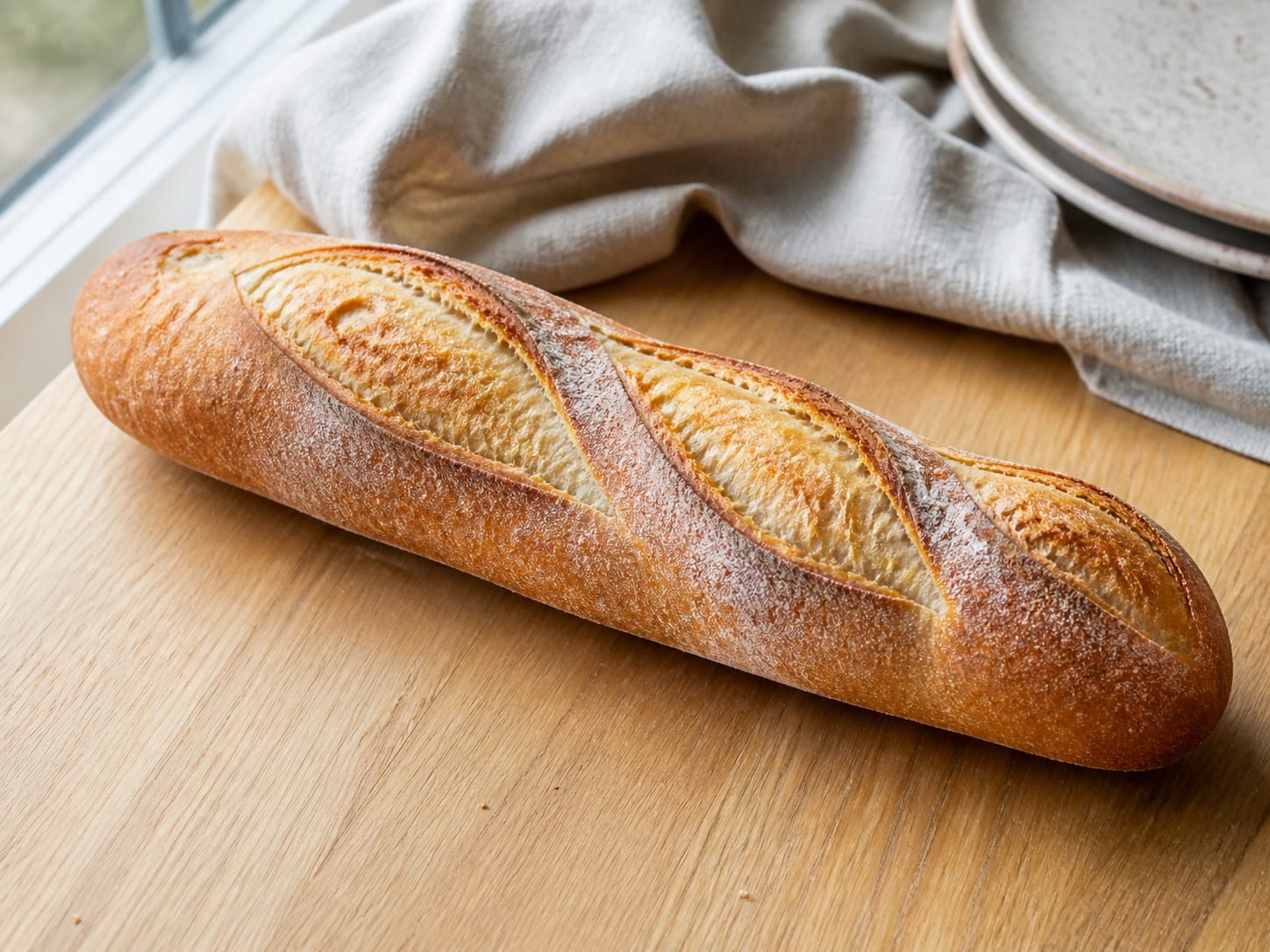
Baguette
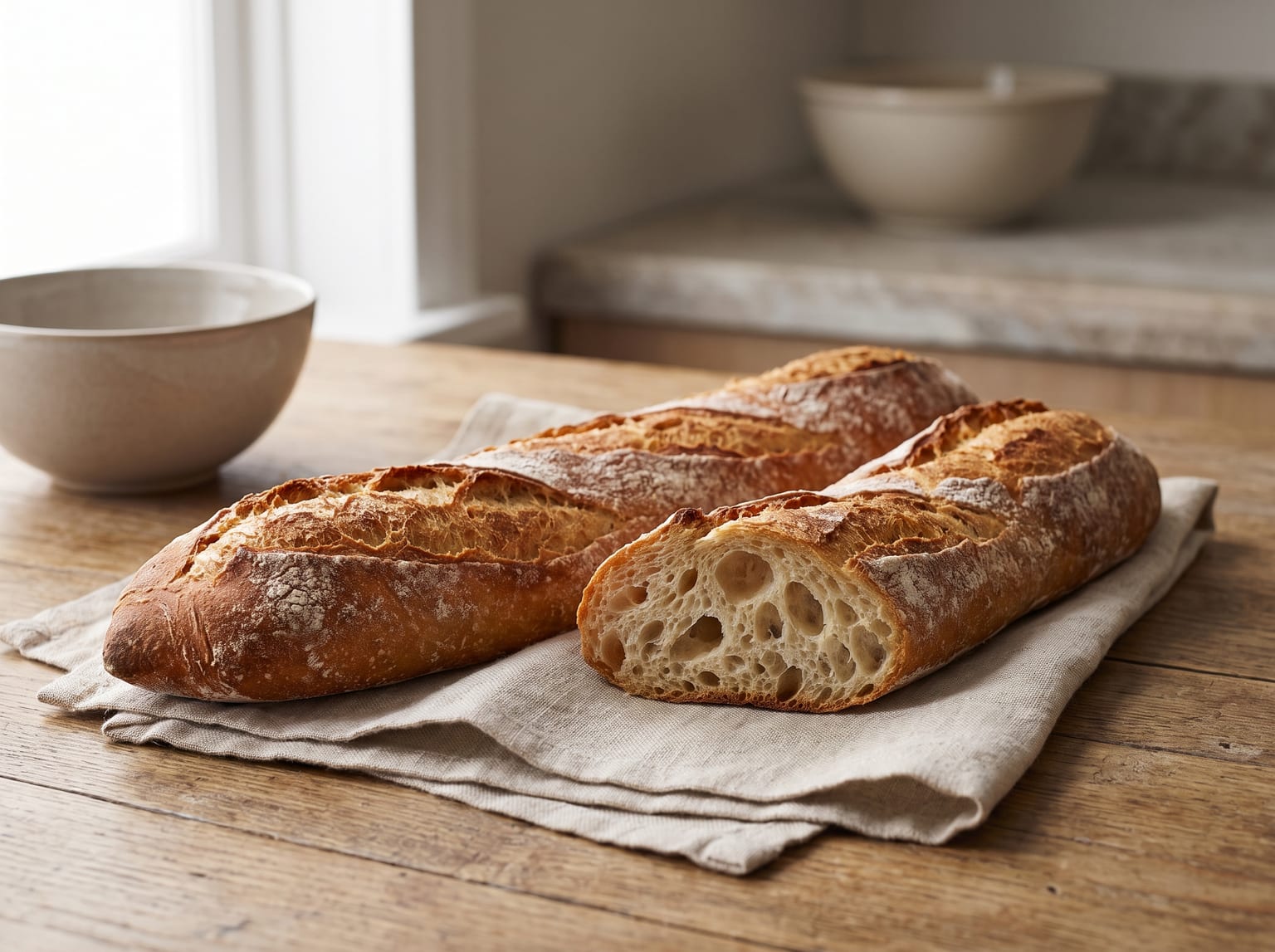
A classic French baguette built on a long, cool overnight ferment rather than yeast quantity, which is what gives it an open, irregular crumb and a real crust instead of a soft, tight-crumbed roll shaped like one. The dough is slack and a little frustrating to shape; that is normal, not a sign of failure.
Prep30 min
Cook25 min
Rest990 min
Oven240°C
Servings3
Christoph's baguette, built on a long cool ferment to get an open crumb without needing a starter or special flour.
Ingredients
Units
Temperature
Servings
Dough
- 500 g bread flour rounded
- 350 ml cold water rounded
- 3 g instant dried yeast, a small pinch is correct; this is a slow, cool overnight rise rounded
- 10 g fine salt rounded
Dietary labels are a guide, not a guarantee. If you have an allergy, read the ingredients yourself.
Method
- Mix the flour, cold water and yeast together in a large bowl until no dry flour remains, a shaggy, sticky mass. Cover and let sit for 30 minutes; this rest lets the flour hydrate fully before the salt goes in.
- Sprinkle the salt over and mix it in, squeezing and folding the dough in the bowl for about 2 minutes until it comes together. It will feel wet and slack; do not add extra flour to fix that.
- Cover and leave at room temperature for 1 hour, then fold: with wet hands, lift one side of the dough and fold it over the middle, turn the bowl a quarter turn, and repeat 4 times. This builds structure without kneading. Repeat this fold twice more at 30 minute intervals.
- Cover tightly and refrigerate overnight, 8 to 12 hours. The dough will roughly double and develop a yeasty, slightly sour smell; this slow cold rise is what builds the flavour and the open crumb.
- Turn the dough onto a well-floured surface and divide into 3 equal pieces. Handle it gently; knocking out all the air here flattens the crumb you just spent all night building.
- Shape each piece into a rough rectangle, fold the long edges into the middle, then roll from one end into a tight log about 35 cm long, pinching the seam shut. Place seam-down on a floured couche or tea towel, pleated between loaves to hold their shape, and cover.
- Prove for 45 to 60 minutes, until visibly puffy but not doubled; baguette dough overproofs quickly at this stage.
- Heat the oven to 240°C with a baking sheet inside and a shallow pan on the oven floor. Slash each loaf 3 to 4 times diagonally with a sharp blade, one confident cut each, then slide onto the hot sheet. Pour a cup of water into the pan below for steam and shut the door immediately.
- Bake 22 to 25 minutes, until deep golden brown and hollow-sounding when tapped. Cool on a rack for at least 20 minutes before slicing; the crumb is still setting.
Method in the Thermomix
Written for a TM5 or TM6, 2.2 litre bowl.
- Flour, water and yeast into the bowl. Mix 10 sec / speed 6, then let stand 30 min in the bowl, lid on, no setting.
- Add the salt. Knead 3 min / dough mode. The dough will still look and feel slack and sticky; that is correct, do not add flour to compensate.
- Tip into an oiled bowl and continue from step 3 of the hand method: folds, overnight cold ferment, shaping and baking are all the same.
Notes
- Resist the urge to add flour to a wet dough. A slack, sticky dough is what makes an open, irregular crumb; a stiff, easy-to-handle dough bakes into a tight, dense one instead.
- The overnight cold ferment is not optional. It is where nearly all of the flavour and the crumb structure come from; a same-day version made with more yeast will taste flat and bake dense by comparison.
- Steam in the first minutes of baking is what gives a thin, crackling crust. Without it the crust sets too fast and stays thick and tough.
- Baguettes are best eaten within a few hours of baking. They do not keep well; if needed, wrap and freeze whole, then re-crisp from frozen in a hot oven for 8 minutes.
Ingredient substitutions
- Bread flour gives the best structure; all-purpose flour works but the crumb will be slightly less open.
- A pinch more yeast speeds up the overnight rise if your kitchen is very cold, but the flavour is better the slower it goes.
- A pizza stone in place of the baking sheet gives an even better crust if you have one; preheat it for at least 30 minutes.
From Christoph Mayer