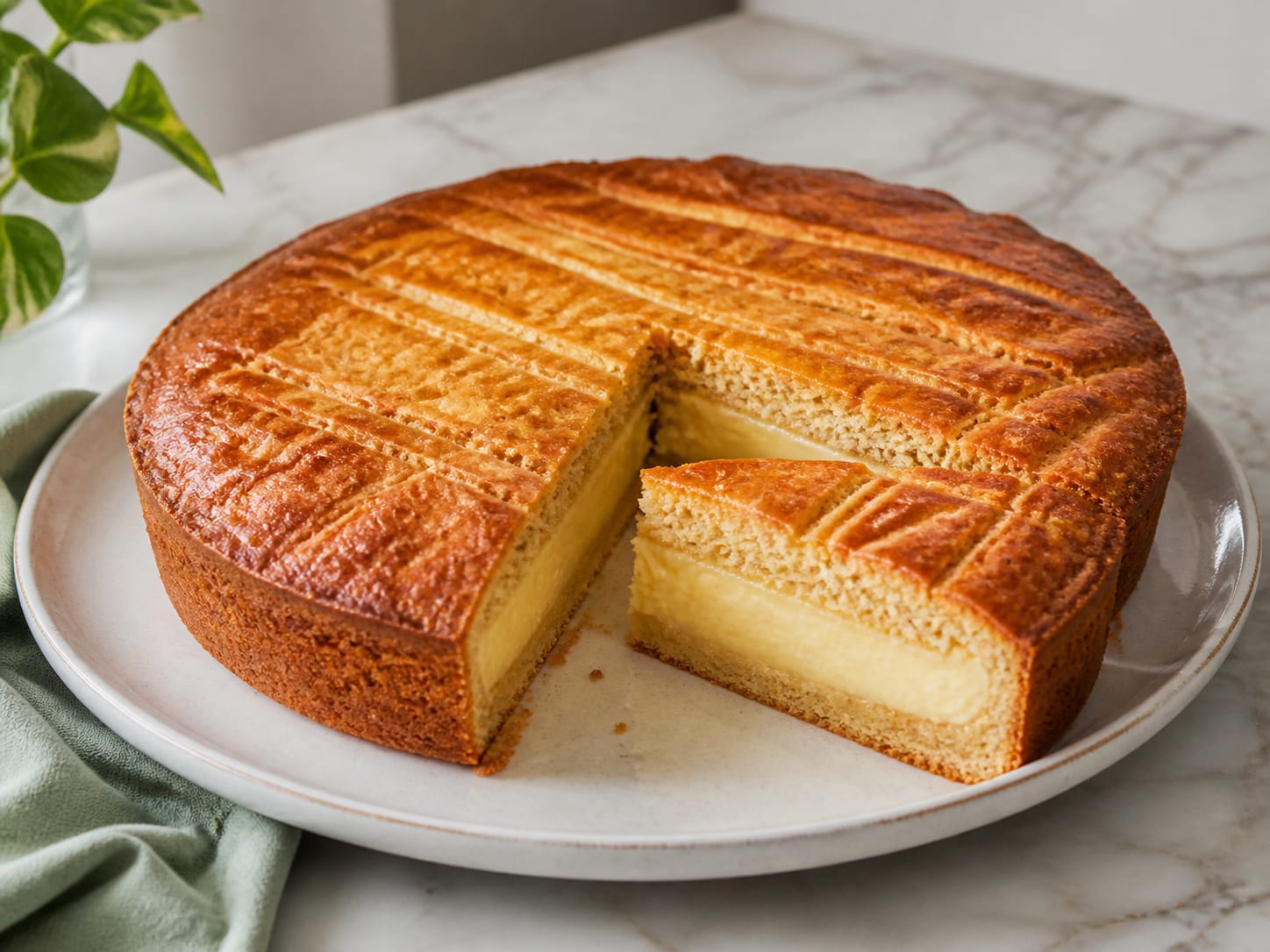
Baskenkuchen (Gâteau basque)
The French Basque original, a cookie-like almond dough rather than a shortcrust, sandwiching a thick vanilla pastry cream between two layers and baked until the outside is deeply golden and the inside stays soft. The dough is closer to a rich sablé than pastry, and needs to be chilled hard to be workable at all.
Prep45 min
Cook45 min
Rest60 min
Oven180°C
Servings12
Christoph's Gâteau basque, keeping the rich, cookie-like dough that separates it from an ordinary shortcrust jam or custard tart.
Ingredients
Written for a 22 cm round tin
Units
Temperature
Servings
Pastry cream
- 350 ml whole milk rounded
- 3 egg yolks rounded
- 60 g sugar rounded
- 30 g cornstarch rounded
- 10 ml rum (optional) rounded
- 5 ml vanilla extract rounded
Dough
- 350 g flour rounded
- 8 g baking powder rounded
- 1 g fine salt rounded
- 220 g butter, softened rounded
- 160 g sugar rounded
- 2 eggs rounded
- 1 lemon, zest only rounded
- 1 egg, beaten, for glazing rounded
Dietary labels are a guide, not a guarantee. If you have an allergy, read the ingredients yourself.
Method
- Whisk the egg yolks, sugar and cornstarch into a little of the cold milk until smooth. Heat the rest of the milk until steaming, then whisk it in. Return to the pan and cook over low heat, whisking constantly, until it thickens to a stiff pastry cream, about 5 minutes. Stir in the rum, if using, and vanilla. Press cling film onto the surface and chill completely, at least 1 hour.
- Whisk the flour, baking powder and salt together. Beat the softened butter and sugar together until pale and fluffy, then beat in the eggs one at a time, followed by the lemon zest. Fold in the flour mixture just until combined; the dough will be soft. Divide into two portions, one slightly larger, wrap, and chill for at least 1 hour.
- Roll the larger portion between baking paper to fit a 22 cm cake tin, pressing it into the base and up the sides. Spread the chilled pastry cream evenly over it.
- Roll the second portion into a disc to fit the top and lay it over the filling, pinching the edges together to seal.
- Brush the top with the beaten egg and score a crosshatch pattern into the surface with the back of a knife.
- Bake at 180°C for 40 to 45 minutes, until deep golden brown and firm to the touch. Cool completely in the tin before releasing; it slices best once fully cool.
Method in the Thermomix
Written for a TM5 or TM6, 2.2 litre bowl. This covers the pastry cream; the dough and baking are the same as the hand method.
- Milk, egg yolks, sugar and cornstarch into the bowl. Cook 6 min / 90 °C / speed 3, until thickened to a stiff pastry cream.
- Stir in the rum and vanilla. Mix 5 sec / speed 2. Press cling film onto the surface and chill as in the hand method.
Notes
- The dough must be properly chilled to handle at all. It is closer to a cookie dough than pastry, softer and stickier, and rolling it warm tears rather than stretching.
- Chill the pastry cream fully before it goes into the cake. Spread warm, it soaks into the dough instead of sitting as a distinct layer.
- Do not expect a dry skewer test. The pastry cream inside stays soft even when the cake is fully baked; judge doneness by the colour and firmness of the crust instead.
- It keeps for 4 days in the fridge, covered, and is traditionally eaten at room temperature rather than cold.
Ingredient substitutions
- Rum can be left out entirely, or replaced with a few drops of almond extract for a different, equally traditional flavour.
- A layer of black cherry jam spread thinly under the pastry cream is a well-known regional variation.
- Lemon zest can be orange zest for a slightly different citrus note.
- For a nuttier crust, replace 40 g of the flour in the dough with 40 g of ground almonds.
From Christoph Mayer