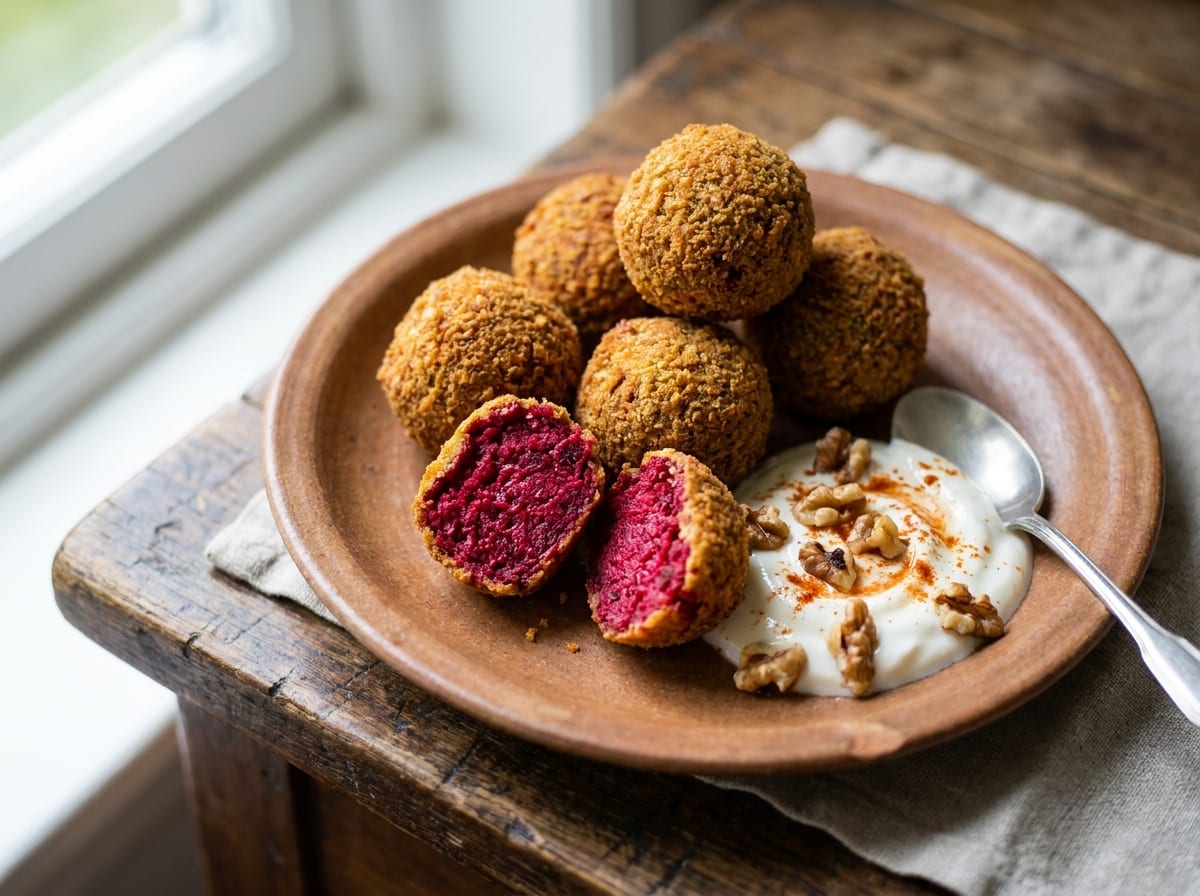
Beetroot Falafel
The classic chickpea dough with roasted beetroot folded through it, which does more than colour the falafel a vivid magenta-red all the way through, it brings a mellow, earthy sweetness that pulls this away from the cumin-forward original and toward something closer to a vegetable fritter with falafel's texture. Roasting the beetroot rather than using it raw is what keeps the dough from turning watery and refusing to hold together in the oil.
Prep45 min
Cook60 min
Rest750 min
Oven200°C
Servings6
A classic chickpea falafel dough with roasted beetroot folded through for colour and a mellow, earthy sweetness.
Ingredients
Written for a 3 L pot
Units
Temperature
Servings
Falafel
- 250 g beetroot, about 2 medium, unpeeled rounded
- 280 g dried chickpeas, soaked in plenty of cold water for 12 to 24 hours, never cooked or tinned rounded
- 50 g yellow onion, roughly chopped rounded
- 3 garlic cloves rounded
- 20 g fresh flat-leaf parsley rounded
- 6 g ground cumin rounded
- 3 g ground coriander rounded
- 10 g fine salt rounded
- 3 g baking soda rounded
- 30 g chickpea flour, as needed, to firm a mixture loosened by the beetroot rounded
- to taste neutral oil, for deep frying rounded
Dietary labels are a guide, not a guarantee. If you have an allergy, read the ingredients yourself.
Method
- Heat the oven to 200°C. Wrap the beetroot in foil and roast for 45 to 60 minutes, until a knife slides in easily. Cool, then peel and roughly chop; roasting concentrates the beetroot’s flavour and drives off moisture that raw or boiled beetroot would bring straight into the dough.
- Drain the soaked chickpeas very well and spread them on a clean towel to dry.
- Pulse the chickpeas, roasted beetroot, onion, garlic, parsley, cumin, coriander and salt in a food processor. Scrape down the sides several times. Stop when the mixture is coarse and holds together when squeezed.
- If the mixture feels loose or wet, work in the chickpea flour a little at a time until it holds its shape. Beetroot brings more moisture into the dough than the plain version, so don’t skip checking this.
- Cover and refrigerate the mixture for at least 30 minutes, up to overnight.
- Fold in the baking soda just before frying.
- Heat the oil to 175 to 190°C in a deep, heavy pot. Shape the mixture into 4 cm balls, about 30 g each.
- Fry in small batches, without crowding the pot, for 3 to 4 minutes, turning once, until deep golden brown and crisp all over.
- Lift out with a slotted spoon onto a paper-towel-lined tray. Serve hot.
Notes
- Roast the beetroot, don’t boil it or use it raw. Boiled or raw beetroot adds too much water straight into the dough, exactly the moisture that makes falafel fall apart in the oil; roasting drives that off and concentrates the flavour instead of diluting it.
- This is a genuinely different eating experience from the classic, not just a colour trick. Beetroot’s earthy sweetness pulls the balance away from cumin and toward something closer to a savoury vegetable fritter that happens to have falafel’s crisp shell and texture.
- Check the mixture’s texture before shaping, every time. Beets vary in moisture even after roasting, so the amount of chickpea flour needed will shift batch to batch; add it gradually rather than all at once.
- The interior colour is the tell for doneness here, since the beetroot makes the classic golden-brown cue less useful on its own; look for a vivid, uniform magenta rather than any darker, muddy patches, which usually mean the centre is still underdone.
Ingredient substitutions
- Golden beetroot, for a milder flavour and a warm yellow-orange interior instead of red.
- A splash of orange zest in the mixture plays well against the beetroot’s sweetness.
- Serve over a bed of yogurt or labneh with a scatter of toasted walnuts, which leans into the vegetable-fritter character rather than fighting it.
Sources consulted
Good with
Sources consulted
From Christoph Mayer