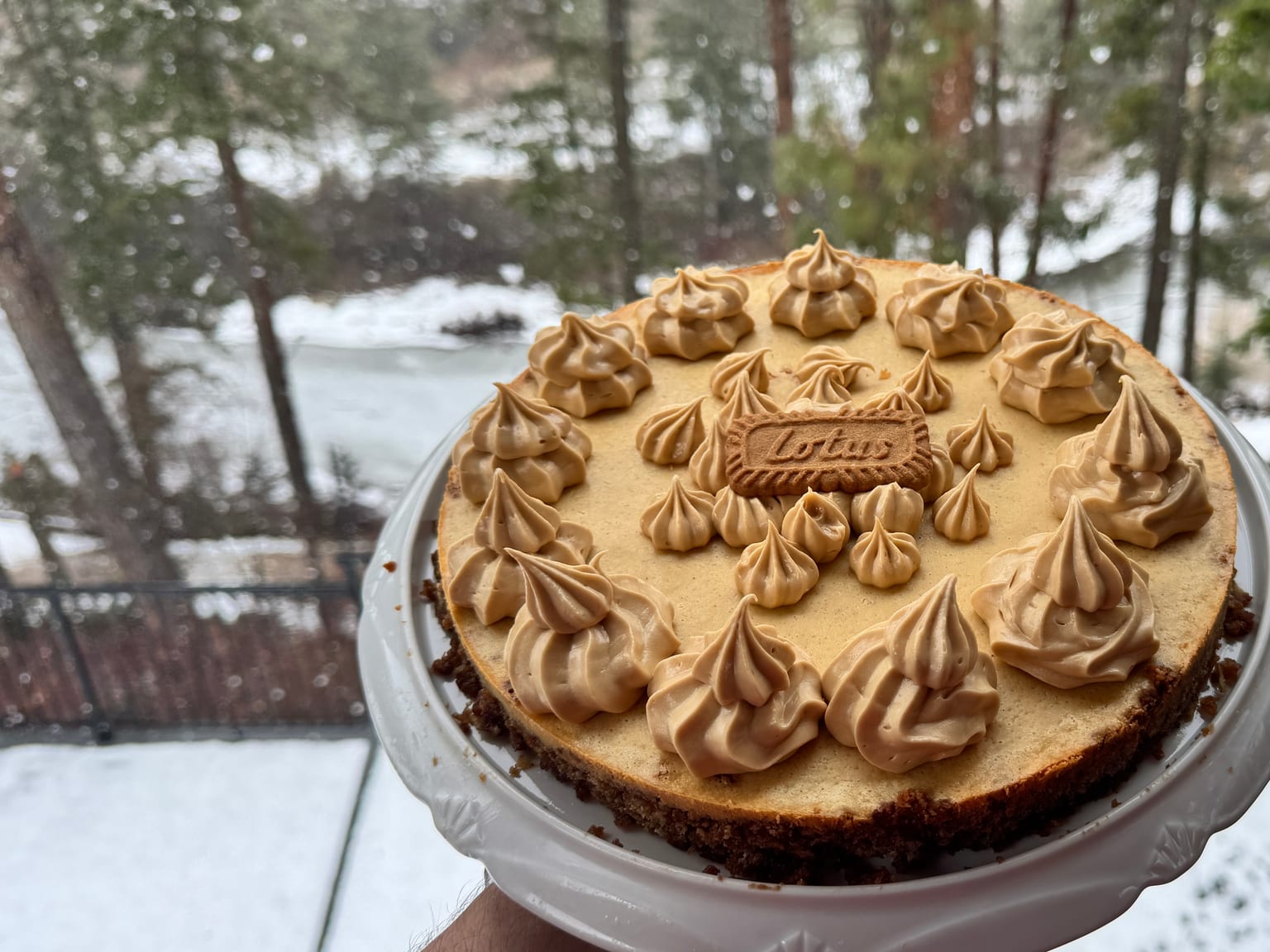
Biscoff cheesecake
A baked cheesecake built entirely on Lotus biscuits, crushed for the base, whipped into the batter, and folded into the cream piped around the rim. Spiced and caramel-dark rather than sweet, and better on the second day than the first.
Reconstructed from Christoph's cheesecake, standard baked New York method with the biscuit worked into all three layers
Ingredients
Written for a 23 cm round tin
Units
Temperature
Servings
Base
- 250 g Lotus Biscoff biscuits, about 32 biscuits, crushed to a coarse sand rounded
- 110 g unsalted butter, melted rounded
- 1 g fine salt rounded
Filling
- 900 g full-fat cream cheese, at room temperature, or it will stay lumpy rounded
- 180 g granulated sugar rounded
- 160 g smooth Biscoff spread, warmed for 20 seconds so it pours rounded
- 200 g sour cream rounded
- 20 g cornstarch rounded
- 10 ml vanilla extract rounded
- 2 g ground cinnamon rounded
- 2 g fine salt rounded
- 3 eggs, room temperature, added last and beaten as little as possible rounded
- 1 egg yolk rounded
Biscoff cream and finish
- 300 ml whipping cream, well chilled rounded
- 120 g smooth Biscoff spread, at room temperature, not warm, or the cream will slacken rounded
- 30 g icing sugar rounded
- 1 Lotus Biscoff biscuit, whole, for the centre rounded
Dietary labels are a guide, not a guarantee. If you have an allergy, read the ingredients yourself.

Method
- Line the tin properly. Butter a 23 cm springform and line the base with parchment. Then wrap the outside in two sheets of wide foil, right up the sides. This cheesecake bakes in a water bath and a springform is not watertight; one seam of foil is one seam too few.
- Base. Crush the biscuits to a coarse sand: a bag and a rolling pin is fine, and a food processor is faster. Stir in the melted butter and salt until it looks like wet sand, then press it firmly into the base and about 2 cm up the sides. Use the flat bottom of a glass. Bake at 160°C for 10 minutes and let it cool while you make the filling.
- Beat the cheese smooth first. Cream cheese, sugar, cornstarch, cinnamon and salt on low with a paddle until completely smooth, scraping the bowl twice. Do this before anything wet goes in. Lumps that survive this stage survive the bake.
- Beat in the Biscoff spread, then the sour cream and vanilla. Still on low.
- Eggs last, barely. Add the eggs and the yolk one at a time on the lowest speed, stopping the moment each disappears. Air beaten in here is what makes a cheesecake climb, split, and sink. The batter should pour like thick cream, not like mousse.
- Bake in a water bath. Pour into the cooled base, tap the tin twice on the counter to release trapped air, and set it in a roasting tin. Pour boiling water into the outer tin to come halfway up. Bake at 160°C for 60 to 70 minutes.
- Stop before it looks done. It is ready when the outer 5 cm is set and the middle still wobbles as one piece, about 68°C in the centre. Turn the oven off, prop the door open with a wooden spoon, and leave it there for 1 hour. Then out, run a thin knife around the rim to release it, and chill uncovered for at least 8 hours or overnight.
- Biscoff cream. Whip the cream with the icing sugar to soft peaks, then add the room-temperature Biscoff spread and whip just to firm peaks. Watch it closely: spread is fat and sugar, so it stiffens the cream faster than you expect and will turn grainy if you walk away.
- Finish. Unclip the ring. Pipe rosettes around the rim with a star nozzle and a smaller cluster in the middle, and set one whole biscuit upright in the centre. Serve cold, straight from the fridge.
Notes
- Why the water bath. Cheese sets at a much lower temperature than the oven, and dry oven air cooks the outside far ahead of the middle. Steam holds the surface near 100°C so the whole thing arrives together and the top stays pale, which is what you want under piped cream.
- Cracks. A crack is almost always too much air beaten in at the egg stage, or too fast a temperature drop at the end. It is cosmetic. The cream hides it entirely.
- Speculoos and Biscoff. Speculoos is the spiced Belgian biscuit; Lotus Biscoff is the brand most people can buy. Any crisp speculoos works for the base. For the spread there is no real substitute, and this recipe leans on it in two places.
- Getting ahead. Better on day two. It keeps 5 days covered in the fridge, and freezes whole and undecorated for 2 months. Pipe the cream on the day you serve it.
- Sour cream or crème fraîche. Either. Crème fraîche is a little richer and a little less sharp, which suits the spice.
Ingredient substitutions
- Cream cheese. German Doppelrahmfrischkäse is the right thing and behaves like Philadelphia. Do not use Quark here: it is far wetter and lower in fat, and the cake will not set to the same texture without reworking the starch.
- Biscoff spread. Sold as Lotus Biscoff Brotaufstrich in Germany and as cookie butter in Canada. Smooth, not crunchy.
Sources consulted
Good with
Sources consulted
The photograph is Christoph's own.
From Christoph Mayer