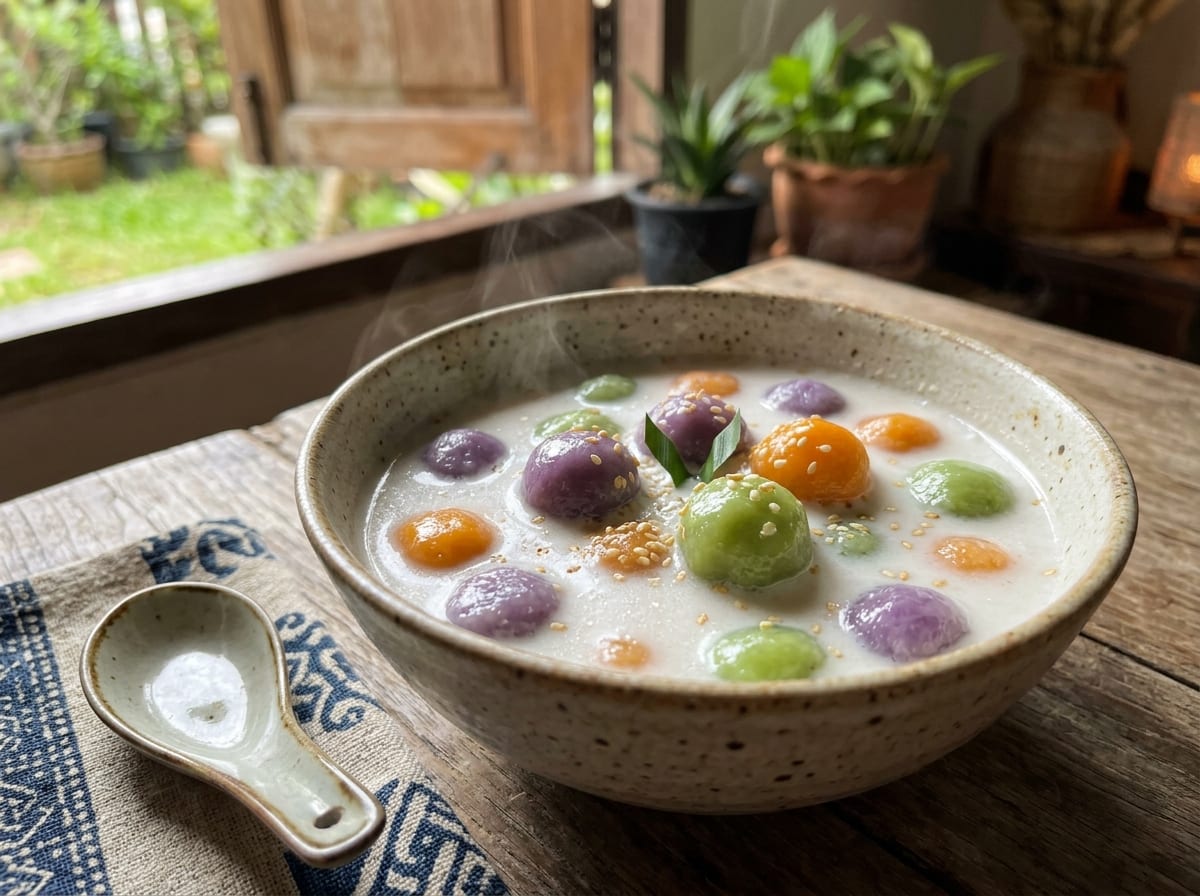
Bua Loy (Thai floating rice balls in coconut milk)
Chewy glutinous rice dumplings, rolled by hand and boiled until they float, then simmered warm in coconut milk sweetened with palm sugar and scented with pandan leaf. Unusual among Thai sweets for being served warm rather than chilled.
Dough ratio and coconut sauce proportions cross-checked against Hungry in Thailand, Simply Suwanee, and Import Food's Bua Loi recipes
Ingredients
Rice balls
- 200 g glutinous rice flour, also sold as sweet rice flour or mochiko, look for a flour labeled glutinous rather than plain rice flour rounded
- 150 ml warm water, added gradually, you may not need all of it rounded
Coconut sauce
- 400 ml coconut milk, full-fat, one standard can rounded
- 200 ml water rounded
- 90 g palm sugar, chopped or grated, packed light brown sugar works as a substitute rounded
- 1.5 g salt, about 1/4 teaspoon rounded
- 3 pandan leaves, tied in a knot, or 1/2 teaspoon pandan extract, or omit entirely (optional) rounded
Dietary labels are a guide, not a guarantee. If you have an allergy, read the ingredients yourself.
Method
- Make the dough. In a bowl, combine the glutinous rice flour with the warm water, added a little at a time, kneading by hand until you have a smooth, soft dough: it should feel like soft clay, not sticky and not crumbly. If it feels dry, work in another teaspoon of water; if it’s tacky, dust in a touch more flour.
- Pinch off small pieces and roll them between your palms into marble-sized balls, about 1.5 cm across. Set them on a lightly floured plate as you go so they don’t stick together, and try to keep them an even size so they cook at the same rate.
- Bring a large pot of water to a rolling boil. Drop in the balls in batches so the pot isn’t crowded, stirring gently so nothing sticks to the bottom. They will sink first, then rise; once they float, let them cook 1 to 2 minutes longer to firm up all the way through.
- Scoop the cooked balls straight into a bowl of cold water to stop the cooking and keep them from sticking to each other. Drain once cool.
- Make the sauce. In a saucepan, combine the coconut milk, water, palm sugar, salt, and pandan leaves, if using. Warm over medium heat, stirring, until the sugar has fully dissolved, then bring to a gentle simmer. Don’t let it boil hard, or the coconut milk can split.
- Remove the pandan leaves. Add the drained rice balls to the warm sauce and simmer gently for 1 to 2 minutes, just to heat them through.
- Ladle into bowls, balls and sauce together, and serve warm.
Colored and flavored variation. After mixing the base dough, divide it into two or three portions and work in about 2 to 3 tablespoons of steamed, mashed taro for purple, steamed mashed pumpkin for orange, or a teaspoon of pandan juice or paste for green, using a little less of the added water for each, since the puree or juice brings its own moisture. Roll, boil, and shock each color the same way as the plain dough, then combine all the colors in the same pot of sauce.
Notes
- “Glutinous” describes the flour’s stickiness once cooked, not gluten. Glutinous rice flour is naturally gluten-free, made entirely from sticky rice.
- Palm sugar gives the sauce its characteristic caramel depth. Packed light brown sugar is a reasonable stand-in if you can’t find it, though the flavor will be a shade milder and less complex.
- Bua loy is best eaten freshly made. The rice balls firm up and turn dense within a couple of hours, and the coconut sauce can start to separate on standing.
- If the sauce is simmered too hard, it can split into fat and liquid. Keep it at a gentle simmer once the sugar has dissolved and everything is combined.
Sources Consulted
- Hungry in Thailand, “Bua Loy Recipe (Glutinous Rice Balls in Coconut Milk)”
- Simply Suwanee, “Bua Loy (Thai Glutinous Rice Balls)”
- Import Food, “Thai Rice Balls in Warm Coconut Milk (Bua Loi)”
The flour-to-water ratio for the dough, the float-then-simmer test for doneness, the cold-water shock, and the coconut milk and palm sugar sauce proportions are drawn from the sources. The single-color base version, the quantities scaled to serve four, and the wording throughout are original.
From Christoph Mayer