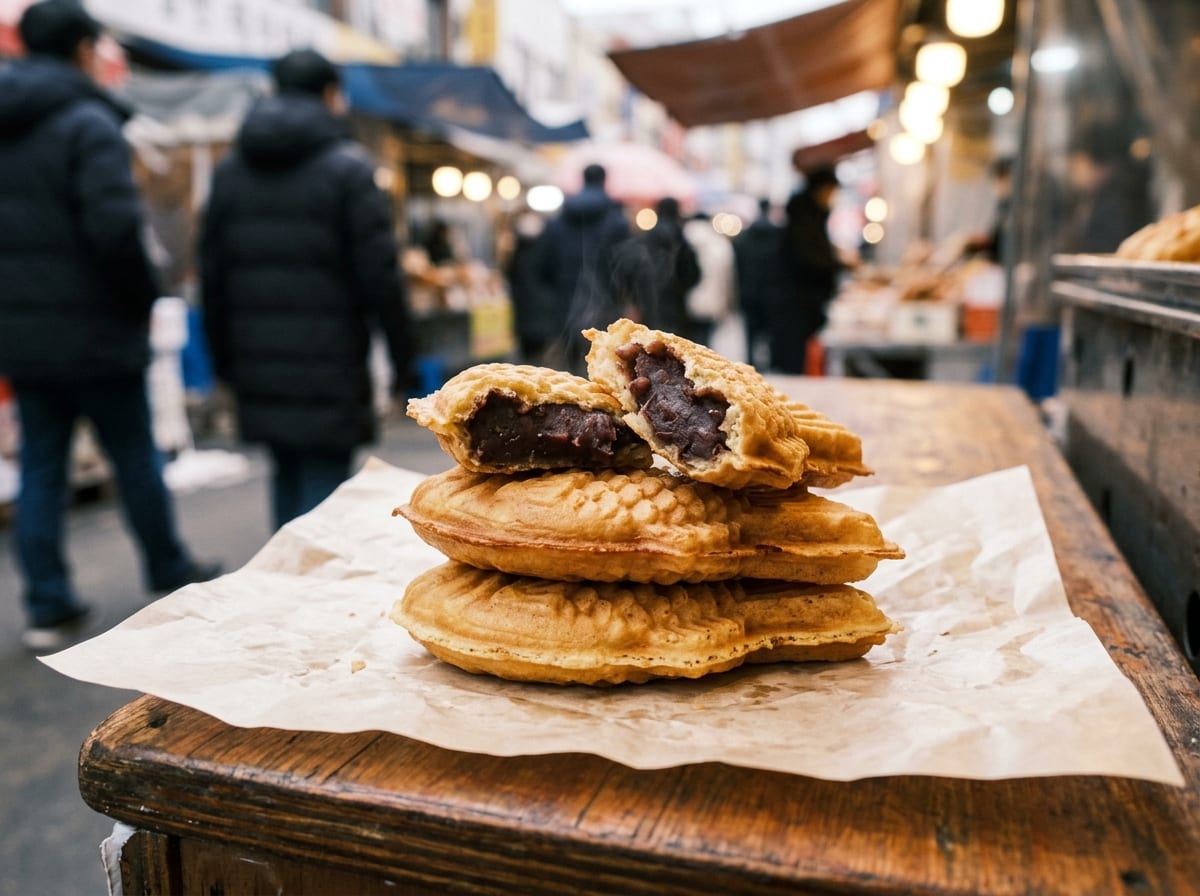
Bungeoppang
Korea's iconic winter street snack, a thin egg-free batter and sweet red bean paste pressed into a hinged fish-shaped mold and cooked crisp on the stovetop. Usually sold three to a bag from a paper cup outside the subway station.
Batter ratio and stovetop technique consolidated from three Korean home recipes for bungeoppang
Ingredients
Written for a 30 cm pan
Batter
- 150 g cake flour, or all-purpose flour rounded
- 40 g sweet rice flour, glutinous rice flour, sold as mochiko or chapssalgaru rounded
- 4 g baking powder rounded
- 1 g fine salt rounded
- 18 g sugar rounded
- 300 ml whole milk rounded
- 28 g unsalted butter, melted, or neutral oil rounded
Filling
- 300 g sweet red bean paste, patbang or anko, canned or tubbed, about 35 g per piece rounded
For the pan
- 15 ml neutral oil, for greasing the mold rounded
Dietary labels are a guide, not a guarantee. If you have an allergy, read the ingredients yourself.
Method
- Whisk the cake flour, sweet rice flour, baking powder, and salt together in a bowl. In a separate bowl or jug, whisk the sugar into the milk until it dissolves, then whisk in the melted butter.
- Pour the wet ingredients into the dry and whisk until smooth and thin, closer to a crepe batter than a cake batter. A few tiny lumps are fine. No resting time is needed, the batter is ready to cook as soon as it is mixed.
- Preheat the fish-shaped mold over medium-low heat on both sides of the hinge until a drop of batter sizzles gently on contact. Brush both halves lightly with oil.
- Ladle batter into each cavity until about 70% full. Spoon roughly 35 g (about 1½ tablespoons) of red bean paste into the center of each, then top with a little more batter to just cover the filling and the tail.
- Close the lid and flip the pan so the top half cooks too. Cook for 3 to 4 minutes, flip back, and cook the other side for a further 2 to 3 minutes, until both sides are deep golden brown.
- Open the mold carefully and lift the bungeoppang out with a fork or chopsticks onto a wire rack. Re-oil the mold lightly and repeat with the remaining batter and filling.
- Serve warm, ideally within a few minutes of coming off the pan, three to a bag if you want to do it properly.
Notes
- This uses the same hinged, fish-shaped mold as taiyaki (see this site’s taiyaki recipe), just with a thinner, egg-free batter and a rice-flour boost for a crisper shell. If you already own a taiyaki pan, it works here too, and vice versa. A cast-iron or aluminum bungeoppang or taiyaki mold is not something a typical German kitchen shop stocks; it turns up on Amazon.de, at Japanese and Korean specialty retailers online, and occasionally in well-stocked Asia-Läden.
- Unlike taiyaki batter, this one is not rested, egg-free batters do not need the gluten relaxed the same way, and bungeoppang street vendors mix and cook straight through. Whisk it just until smooth and get on with cooking.
- Fill the cavities evenly and do not overfill them. Batter that escapes the seam when you close the lid burns onto the hinge and is unpleasant to scrape off later.
- Sweet red bean paste (patbang in Korean, the same product sold as Japanese anko) is easier to find than the pan. Most Asia-Läden in German cities carry it tinned or in tubs. If yours does not, canned azuki beans mashed with sugar over low heat until thick make a reasonable home version.
- These are best eaten hot and freshly made, the entire appeal is the contrast between the crisp shell and the hot, soft filling, and the shell turns leathery within an hour or two at room temperature. If you must hold them, a few minutes in a dry skillet or toaster oven brings the crispness most of the way back. They do not freeze as well as taiyaki, since the thinner shell goes soft faster on reheating, so cook only what you plan to eat that day.
Sources Consulted
- Beyond Kimchee, “Bungeoppang (Korean Fish Pastry with Red Bean)”
- My Korean Kitchen, “Bungeoppang (Korean Fish Shaped Pastry)”
- Kimchimari, “Fish-shaped bread filled with sweet red beans (붕어빵 Bungeoppang)”
Beyond Kimchee's flour-to-milk ratio and egg-free batter is the base of this recipe, since it lands closest to the requested 8-piece yield without rescaling. My Korean Kitchen and Kimchimari were checked against it for filling quantity and pan technique; both agree that a fully preheated mold and a light, even grease are what keep the batter from tearing on release. Wording and method phrasing are original.
From Christoph Mayer