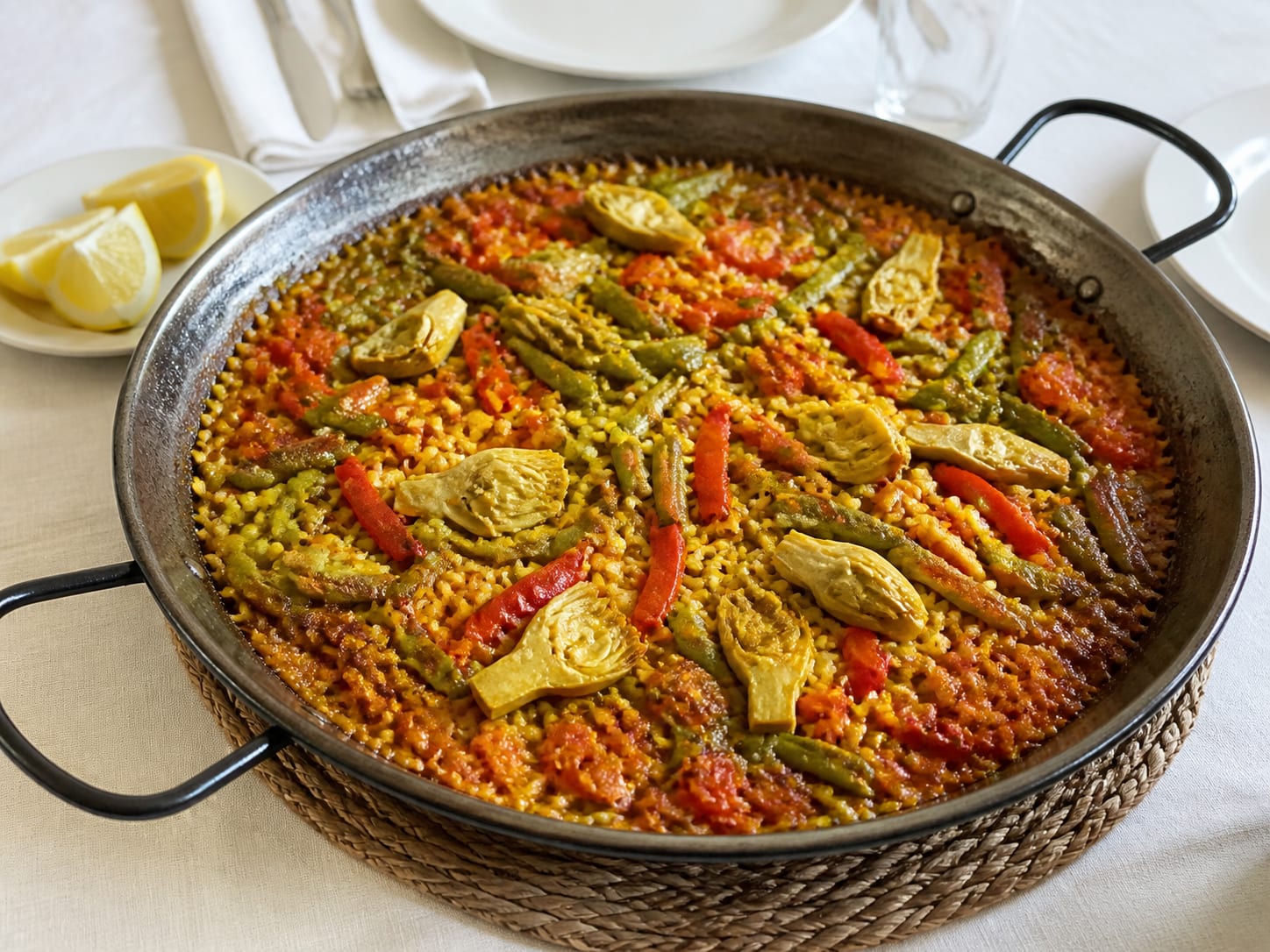
Bunte Gemüsepaella (colourful vegetable paella)
A vegetable paella built the traditional way, in a wide, shallow pan where the rice is left undisturbed once the liquid goes in so a crust of toasted rice, the socarrat, forms on the bottom. Stirring the rice at any point after the broth is added is the single biggest mistake, since it breaks up the very crust that makes a paella a paella rather than a vegetable rice.
Prep20 min
Cook30 min
Rest5 min
Servings4
Christoph's vegetable paella, the rice left undisturbed once the broth goes in so the socarrat crust can form.
Ingredients
Units
Temperature
Servings
Paella
- 150 g onion, finely chopped rounded
- 2 garlic cloves rounded
- 150 g red bell pepper, diced rounded
- 150 g green beans, trimmed, in 3 cm pieces rounded
- 200 g chopped tomatoes rounded
- 50 ml olive oil rounded
- 300 g paella or bomba rice rounded
- 1 g saffron threads, or 5 g sweet paprika as a substitute (optional) rounded
- 800 ml vegetable broth rounded
- 150 g artichoke hearts, quartered, tinned or jarred (optional) rounded
- to taste fine salt rounded
- 1 lemon, cut into wedges, for serving (optional) rounded
Dietary labels are a guide, not a guarantee. If you have an allergy, read the ingredients yourself.
Method
- Heat the olive oil in a wide, shallow paella pan or large frying pan over medium heat. Sweat the onion and garlic for 4 minutes, until softened.
- Add the pepper and green beans and cook a further 5 minutes, until starting to soften.
- Add the chopped tomatoes and simmer 5 minutes, until slightly reduced.
- Stir in the rice to coat, then add the saffron or paprika and the broth. Season with salt. Bring to a boil, then reduce to a steady simmer.
- Do not stir from this point on. Simmer, uncovered, for 18 to 20 minutes, until the liquid is absorbed and the rice is tender. In the last few minutes, listen and watch for a faint crackling sound and a toasted smell, which signals the crust forming on the bottom.
- Scatter the artichoke hearts over the top in the last 5 minutes, if using. Remove from the heat and rest 5 minutes before serving with lemon wedges.
Notes
- Do not stir the rice once the broth is added, under any circumstances. This is the single rule that makes or breaks a paella; stirring redistributes the rice and prevents the crust, or socarrat, from forming on the bottom, which is the whole point of cooking it this way rather than as a simple pilaf.
- Use a wide, shallow pan, not a deep pot. A thin layer of rice is what allows even evaporation and a crust to form; a deep pot traps steam and gives a wetter, risotto-like result instead.
- Saffron is traditional, but sweet paprika is a reasonable, much cheaper substitute for colour and a similar warmth, though the flavour is different.
- Paella is best eaten fresh, straight from the pan; it does not reheat well, since the crust softens and the rice overcooks.
Ingredient substitutions
- Paella or bomba rice absorbs liquid without turning mushy, which is essential here; a standard long-grain rice will not give the same result.
- Green beans and pepper can be any vegetables that hold their shape through a 20 minute simmer.
- Artichoke hearts are a traditional addition but entirely optional if unavailable.
From Christoph Mayer