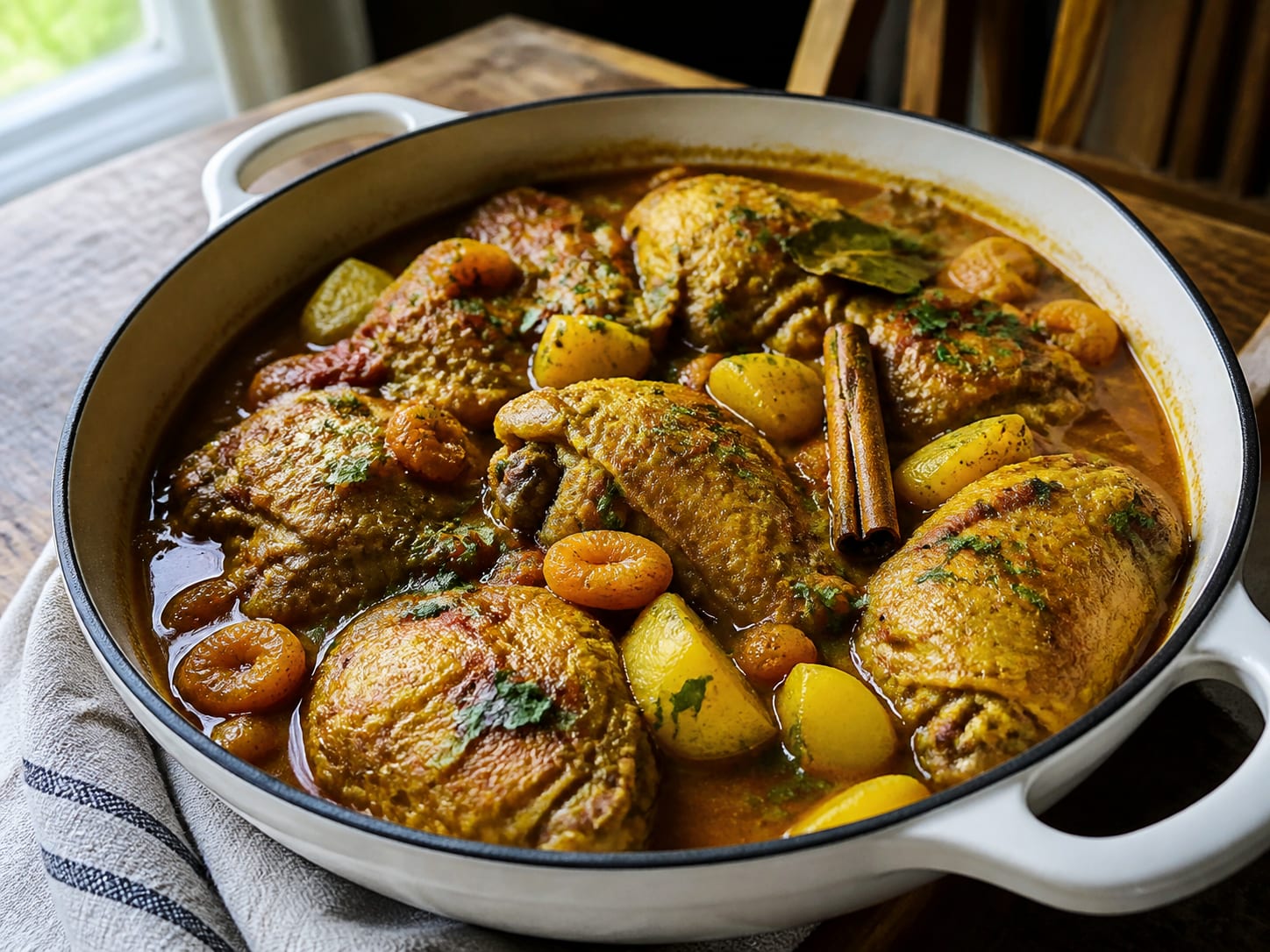
Cape Malay Hähnchen-Curry (Cape Malay chicken curry)
A South African curry built on the Cape Malay habit of putting fruit and spice in the same pot as the meat: dried apricots, a spoon of apricot jam, cinnamon and bay alongside the usual curry powder and turmeric. It reads sweet on the ingredient list and tastes rounded rather than sugary once it has simmered through.
Christoph's version of a Cape Malay chicken curry, keeping the fruit and spice combination that defines the style rather than smoothing it into a generic curry.
Ingredients
Written for a 4 L pot
Units
Temperature
Servings
Curry
- 25 ml neutral oil rounded
- 150 g onion, chopped rounded
- 15 g garlic, finely chopped rounded
- 15 g fresh ginger, peeled and grated rounded
- 15 g mild curry powder rounded
- 3 g ground turmeric rounded
- 1 cinnamon stick rounded
- 2 bay leaves rounded
- 1 kg bone-in, skin-on chicken thighs rounded
- 300 g waxy potatoes, peeled, in 3 cm chunks rounded
- 80 g dried apricots, halved rounded
- 30 g apricot jam rounded
- 300 g canned chopped tomatoes rounded
- 300 ml chicken broth rounded
- to taste fine salt rounded
To serve
- 10 g cilantro, leaves (optional) rounded
Dietary labels are a guide, not a guarantee. If you have an allergy, read the ingredients yourself.
Method
- Heat the oil in a 4 litre pot over medium heat and sweat the onion, garlic and ginger with a pinch of salt for 6 minutes, until the onion is translucent.
- Stir in the curry powder, turmeric, cinnamon stick and bay leaves and cook for 1 minute, until fragrant.
- Add the chicken thighs, skin-side down, and let them colour lightly for 2 minutes on each side; this is not a full sear, just enough to render a little fat.
- Add the potatoes, apricots, apricot jam, tomatoes and broth. Bring to a simmer, then turn down until it barely bubbles.
- Simmer, partly covered, for 35 minutes, until the chicken is tender enough to pull from the bone with light pressure and the potatoes are cooked through.
- Remove the cinnamon stick and bay leaves, season with salt, and serve with cilantro scattered over.
Method in the Thermomix
Written for a TM5 or TM6, 2.2 litre bowl.
- Garlic and ginger into the dry bowl. Chop 3 sec / speed 6. Add the onion, roughly chopped, and chop 4 sec / speed 5.
- Add the oil. Sauté 6 min / 120 °C / speed 1, measuring cup off, until translucent.
- Add the curry powder, turmeric, cinnamon stick and bay leaves. Sauté 1 min / 100 °C / speed 1, measuring cup off, until fragrant.
- Add the chicken thighs, potatoes, apricots, apricot jam, tomatoes and broth. Cook 35 min / 100 °C / reverse / speed 1, measuring cup on. Reverse keeps the chicken pieces and potato chunks whole.
- Remove the cinnamon stick and bay leaves, season with salt. Serve with cilantro scattered over.
Notes
- The dried apricots and jam are not a mistake in the ingredient list. Cape Malay cooking regularly puts fruit and warm spice in the same pot as meat, and the sweetness rounds out the curry powder rather than making the dish taste like dessert.
- Colouring the chicken skin briefly before the liquid goes in adds real flavour to the finished curry; skipping it gives a flatter, more one-dimensional pot.
- This is a mild curry by design. For more heat, add a chopped fresh chilli or a pinch of cayenne with the other spices rather than swapping in a hotter curry powder, which changes the whole flavour balance.
- It keeps for 3 days in the fridge and the flavour is, if anything, better on day two once the spices have had time to settle into the sauce.
Ingredient substitutions
- Bone-in chicken thighs give the most flavour and stay moist through the simmer; boneless thighs work with the simmer cut to 25 minutes.
- Dried apricots can be dried peaches or a small handful of raisins in the same weight, both common Cape Malay additions.
- Apricot jam can be a spoon of honey or brown sugar if it is not in the house, though the jam’s slight tartness is closer to the traditional flavour.
- For a vegetarian version, replace the chicken with 500 g of chickpeas and extra potato, and use vegetable broth; reduce the simmer to 20 minutes.
From Christoph Mayer