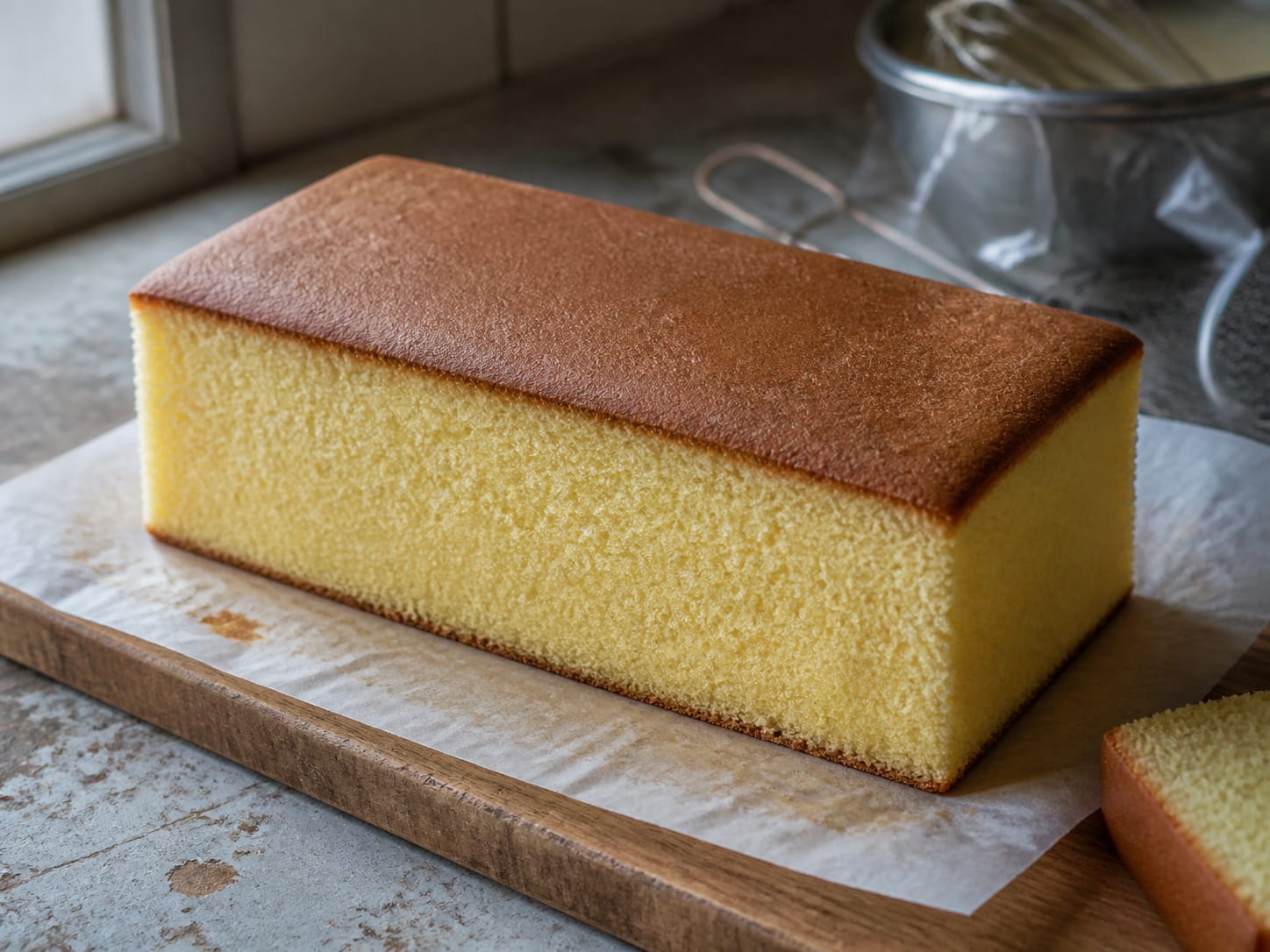
Castella (Japanese honey sponge cake)
A tall, deeply golden Japanese sponge cake whipped from whole eggs, honey, and mizuame, baked low and slow until close-textured and faintly chewy.
Adapted from Just One Cookbook's castella method, cross-checked against Wikipedia's history and Taste of Asian Food's bake temperature, and scaled up for a standard loaf tin
Ingredients
Written for a 25 × 11 cm loaf tin
For the pan
- 15 g coarse sugar, zarame or coarse turbinado; gives the traditional gritty golden bottom rounded
Cake batter
- 6 large eggs, about 50 g each; bring fully to room temperature rounded
- 200 g bread flour, sifted twice; bread flour rather than all-purpose gives the classic chew rounded
- 200 g granulated sugar rounded
- 130 g honey, a mild, floral honey keeps the crumb tender rather than assertive rounded
- 40 g mizuame (Japanese starch syrup), substitute light corn syrup or golden syrup if unavailable rounded
- 60 ml warm water, helps loosen the honey and mizuame so they fold in evenly rounded
Dietary labels are a guide, not a guarantee. If you have an allergy, read the ingredients yourself.
Method
- Bring the eggs fully to room temperature; submerge them in warm water for about 10 minutes if you are short on time. Heat the oven to 160°C. Line the base and long sides of the loaf tin with parchment, letting it overhang the rim by a few centimetres, then scatter the coarse sugar over the base and shake to coat evenly.
- Warm the honey, mizuame, and water together, either a few seconds in the microwave or gently in a small pan over low heat, just until the mizuame loosens and the mixture is pourable. Keep it warm while you whip the eggs.
- In a stand mixer bowl, or a large bowl if whisking by hand, beat the whole eggs on high speed for 4 to 5 minutes, until pale, thick, and roughly quadrupled in volume; the batter should fall off the whisk in a slow, thick ribbon that holds its shape for a few seconds before sinking back in. By hand this takes closer to 15 to 20 minutes of steady whisking, so a stand mixer or a strong hand mixer is worth using for this step.
- Reduce the mixer to low speed and drizzle in the warm honey mixture; mix for about 30 seconds, just until combined. Sift the flour over the batter in two additions, folding gently with a spatula after each until no streaks remain. Do not overmix, or the cake will lose the volume you just built.
- Pour the batter into the prepared tin from a height of about 20 cm to pop the largest bubbles, then drag a skewer through the batter in a zigzag to release more. Bake for 12 minutes, then open the oven, run the skewer through the surface again, mist it lightly with water, and close the door; repeat this every 10 to 12 minutes through the first half of the bake. Continue baking for 50 to 55 minutes total, until the top is a deep, even golden brown, springs back fully when pressed, and a skewer in the centre comes out clean.
- Take the tin out of the oven and drop it from about 20 cm onto the counter once or twice; this releases trapped steam and keeps the cake from sinking as it cools. Turn the cake out of the tin immediately onto a wire rack, peel off the parchment, and wrap the whole loaf tightly in plastic wrap while it is still warm.
- Let the wrapped cake cool completely at room temperature, then refrigerate it overnight, ideally for a full day, before unwrapping and slicing. If you want the traditional look, trim the dark crusts from the top, sides, and ends before cutting into thick slices.
Notes
- Castella is at its best the day after baking, once an overnight rest in the fridge, wrapped, has let the crumb settle into its close, faintly chewy texture. Do not skip the rest, even if the cake looks and smells done straight out of the oven.
- No stand mixer? A hand mixer gets you there almost as fast. A balloon whisk works too, but expect a genuine 15 to 20 minutes of steady whisking to reach full volume; do not stop early, since the trapped air is most of the cake’s structure.
- Mizuame is the traditional starch syrup and gives the crumb its characteristic moist chew; light corn syrup or golden syrup are close substitutes if you cannot find it.
- Wrapped tightly, the cake keeps at room temperature for 2 to 3 days or refrigerated for about a week; freeze sliced portions for up to 2 months and thaw wrapped at room temperature.
Sources Consulted
- Just One Cookbook, “Castella Cake Recipe”
- Wikipedia, “Castella”
- Taste of Asian Food, “Castella Recipe”
The whole-egg whipping method, the awakiri bubble-popping technique, and the overnight rest follow the sources; quantities are roughly doubled from Just One Cookbook's small loaf pan to fill a standard 25 cm loaf tin and serve 8 to 10, and the bake temperature follows the lower, slower approach several sources use for a taller cake.
From Christoph Mayer