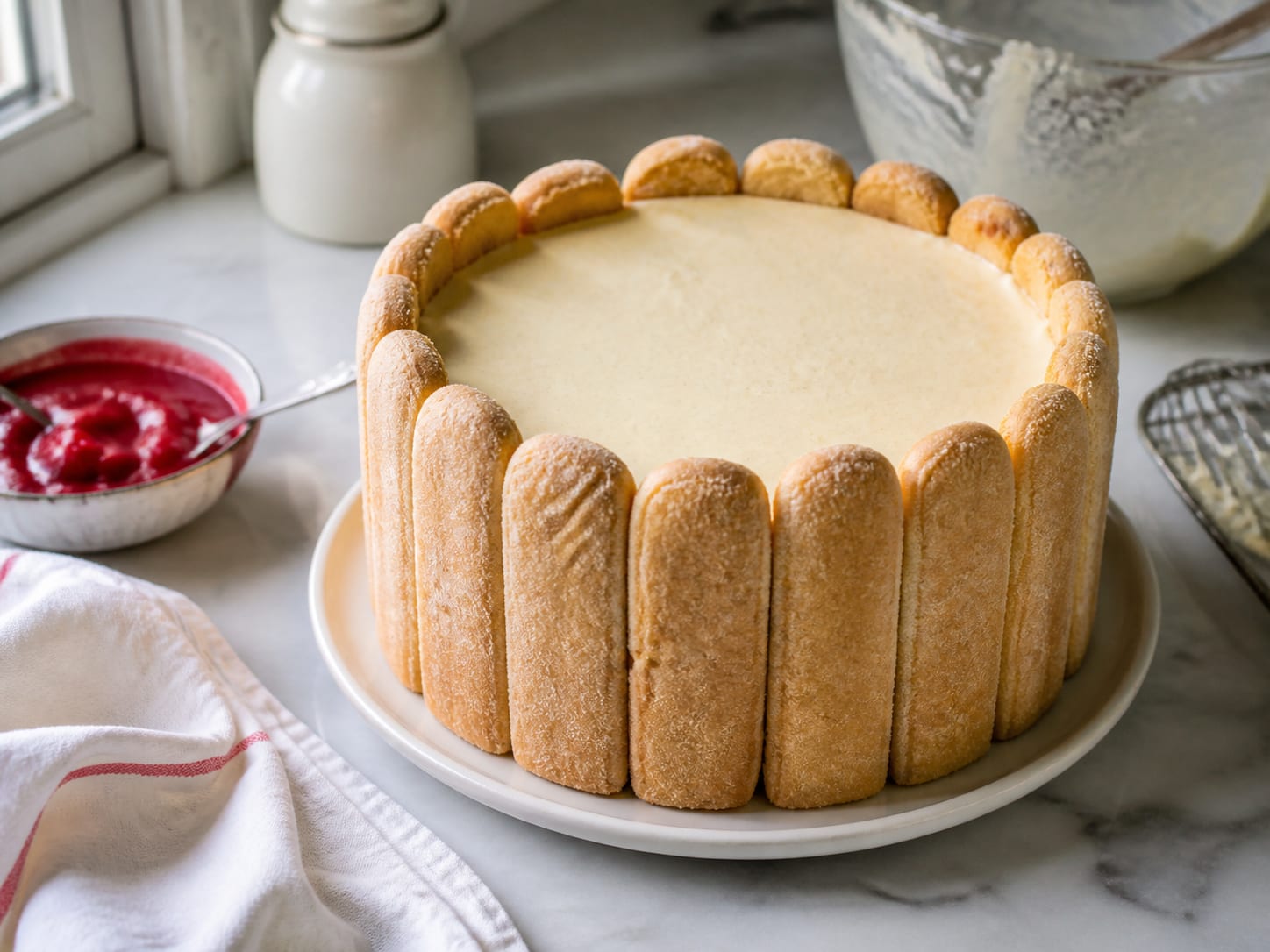
Charlotte Russe
The classic French entremet, a ring of ladyfingers standing around a plain vanilla Bavarian cream built on a properly cooked custard rather than a shortcut mousse. It is simple in flavour on purpose; the technique is the whole point, and a raspberry coulis on the side is what it has always been served with.
Christoph's Charlotte Russe, kept plain and classic, built on a properly cooked custard rather than a shortcut version.
Ingredients
Written for a 20 cm round tin
Units
Temperature
Servings
Charlotte
- 22 ladyfinger biscuits rounded
- 500 ml whole milk rounded
- 1 vanilla pod, split and scraped, or 8 g vanilla sugar rounded
- 6 egg yolks rounded
- 100 g sugar rounded
- 14 g gelatine sheets, about 7 sheets rounded
- 400 ml cream, cold, whipped to soft peaks rounded
Raspberry coulis
- 250 g raspberries rounded
- 40 g sugar rounded
- 10 ml lemon juice rounded
Method
- Line the base of a 20 cm springform or charlotte ring with baking paper. Stand the ladyfingers upright around the inside edge, sugared side out, packed close together, trimming the last one to fit if needed.
- Soak the gelatine sheets in cold water for 5 minutes, until floppy.
- Heat the milk with the vanilla seeds until steaming but not boiling. Whisk the egg yolks and sugar together in a bowl, then pour the hot milk slowly over them, whisking constantly.
- Return the mixture to the pan and cook over low heat, stirring constantly, until it coats the back of the spoon and a line drawn through it holds for a moment, about 6 to 8 minutes. Do not let it boil.
- Take off the heat immediately. Squeeze the gelatine dry and stir it into the hot custard until fully dissolved. Let cool to room temperature, stirring occasionally so a skin does not form.
- Fold the whipped cream into the cooled custard in two additions, gently, keeping as much air in as possible.
- Pour the Bavarian cream into the ring, right up to the top of the ladyfingers. Smooth the top and chill at least 5 hours, ideally overnight.
- For the coulis, purée the raspberries, sugar and lemon juice together and pass through a sieve to remove the seeds. Release the ring, trim the ladyfingers level if needed, and serve each slice with the coulis alongside.
Method in the Thermomix
Written for a TM5 or TM6, 2.2 litre bowl. This covers only the custard base; assembly is the same as the hand method.
- Insert the butterfly. Add the milk, vanilla seeds, egg yolks and sugar. Cook 8 min / 80 °C / speed 3, until the mixture coats the back of a spoon when tested. Do not exceed 85°C.
- Remove the butterfly. Squeeze the soaked gelatine dry and add it to the hot custard. Mix 10 sec / speed 3, until dissolved.
- Pour into a bowl and cool to room temperature, stirring occasionally, then fold in the whipped cream by hand as in the hand method.
- For the coulis, blend the raspberries, sugar and lemon juice 20 sec / speed 8, then pass through a sieve.
Notes
- The custard must not boil. Past about 84°C the egg yolks curdle into scrambled flecks, and there is no rescuing it; pull it from the heat the instant it thickens rather than waiting.
- Cool the custard fully before folding in the cream. Warm custard deflates whipped cream on contact, and the finished charlotte ends up dense instead of light.
- This dessert is deliberately plain. The flavour comes entirely from good vanilla and a properly made custard; there is nowhere to hide a shortcut, which is exactly the point of a classic entremet like this one.
- It keeps for 2 days in the fridge, covered, though it is at its best on the day the coulis is made fresh.
Ingredient substitutions
- A vanilla pod gives the cleanest flavour; good vanilla extract, about 10 ml, is a fair substitute if a pod is not available.
- Raspberry coulis can be strawberry, made the same way, or the charlotte can be served plain with just a dusting of icing sugar.
- Ladyfingers vary in size between brands; buy slightly more than the recipe calls for so there is room to trim and fit them exactly.
- For an orange-scented version, add the zest of one orange to the milk while it heats, and strain it out before mixing with the yolks.
From Christoph Mayer