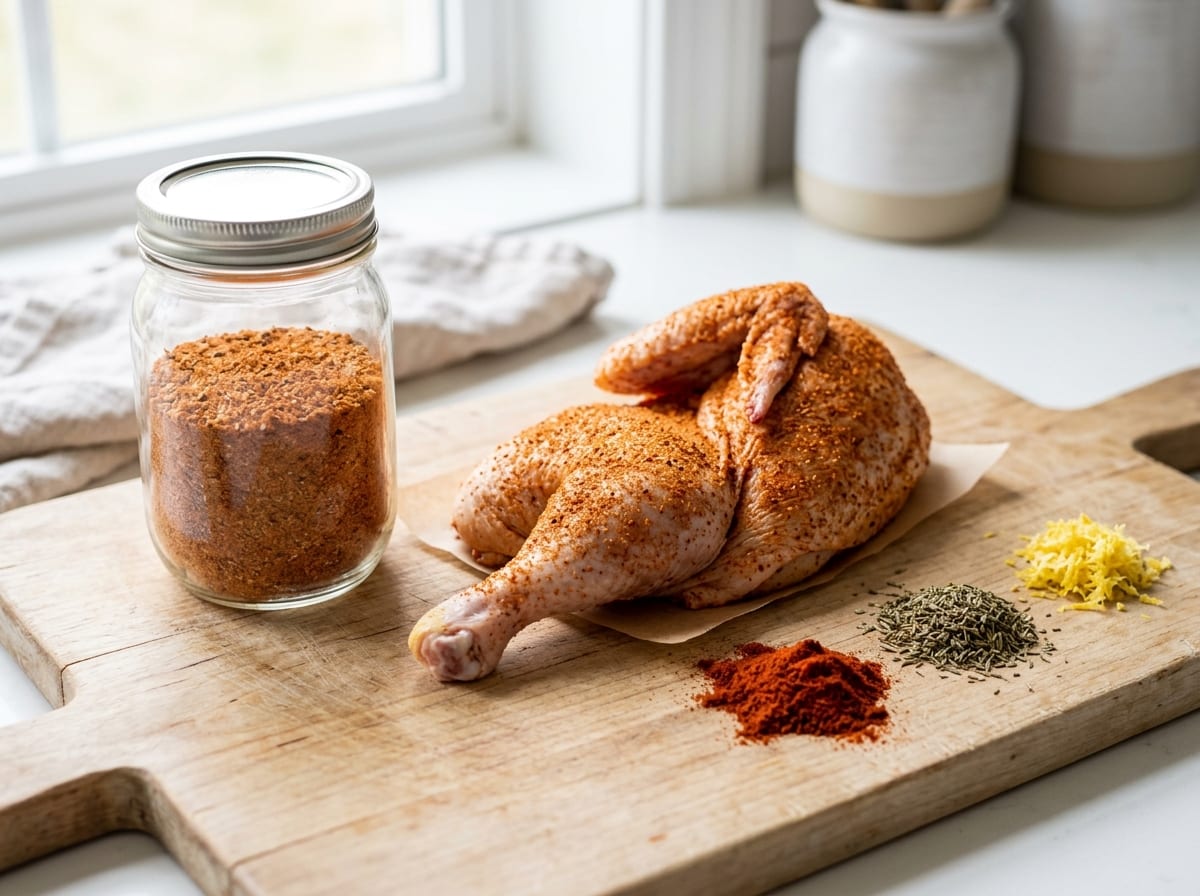
Chicken rub
Low in sugar because chicken is cooked hot enough to crisp its skin, and carrying one ingredient that is not a spice at all. A spoonful of baking powder in the jar is what turns flabby skin into glass.
The house chicken jar, built from the ratio and adjusted for skin
Ingredients
Rub
- 45 g sweet paprika rounded
- 40 g fine salt rounded
- 20 g dark brown sugar, a third of what ribs take, because chicken cooks far hotter rounded
- 15 g baking powder, not a spice, and the reason the skin crisps; see the notes rounded
- 15 g garlic granules rounded
- 12 g onion granules rounded
- 12 g coarse black pepper rounded
- 10 g dried thyme rounded
- 8 g dried lemon zest, or the finely grated zest of two lemons, dried in a low oven rounded
- 5 g cayenne rounded
Dietary labels are a guide, not a guarantee. If you have an allergy, read the ingredients yourself.
Method
- Mix everything and break up any sugar lumps.
- Rub it under the skin as well as over it, which is where most of the flavour is wasted otherwise.
- Leave it uncovered in the fridge for at least four hours, and overnight is better. The salt seasons through and the surface dries.
The baking powder
This is the one genuinely surprising ingredient in the jar and it is not there for taste. Baking powder is alkaline. Raising the pH of the skin does two things at once: it speeds up the Maillard browning reaction, so the skin colours faster and at a lower temperature, and it breaks down proteins in a way that lets the skin dry and blister rather than tighten into leather.
The result is skin that shatters. Use baking powder, not bicarbonate of soda on its own, which is much stronger and leaves a soapy, metallic taste.
Notes
- Sugar stays low on purpose. Chicken is cooked at 180°C to 200°C to render the fat under the skin, which is above the point where sugar burns. Ribs take three times as much because they cook at 135°C.
- Thyme and lemon are what make it read as chicken rather than as generic barbecue. Both are quiet next to paprika, so do not cut them.
- It keeps six months. The baking powder loses potency slowly, so make it in sensible quantities rather than a year’s worth.
- It is also excellent on roast potatoes, for exactly the same alkaline reason.
Ingredient substitutions
- Dried lemon zest is sold in German supermarkets as getrocknete Zitronenschale. Making your own is easy: grate, spread on paper, and leave in a 60°C oven for an hour.
- Smoked paprika for a third of the sweet gives an indoor roast some of the character of a grill.
Sources consulted
Good with
From Christoph Mayer