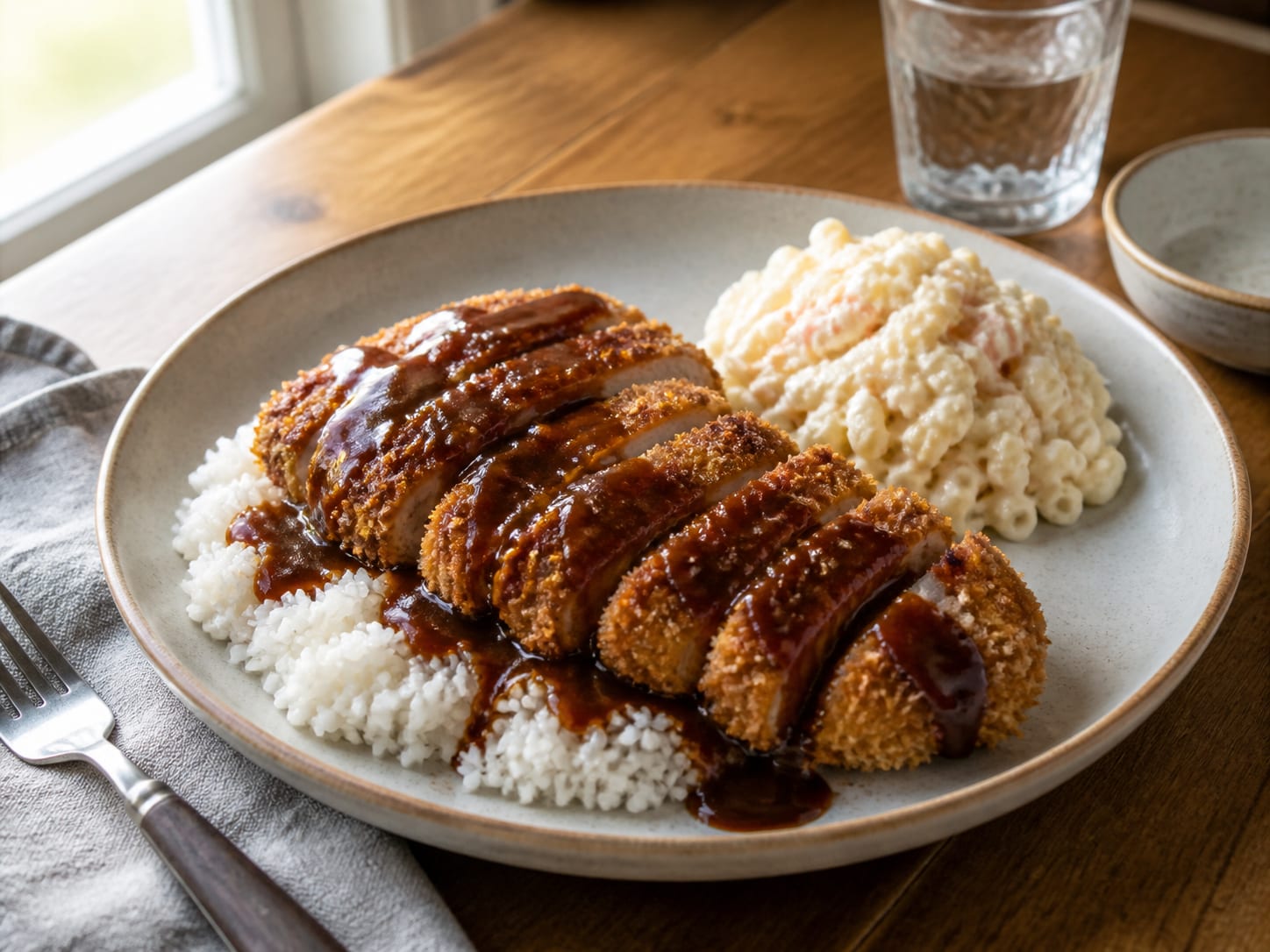
Chicken katsu plate lunch
A full Hawaiian plate lunch of panko-crusted chicken katsu sliced over rice with tangy-sweet katsu sauce and a scoop of classic creamy mac salad.
Research-based adaptation of chicken katsu breading and sauce technique and classic Hawaiian-style mac salad references; not represented as personally tested
Ingredients
Written for a 2 L pot
Units
Temperature
Servings
Chicken katsu
- 4 boneless, skinless chicken thighs, about 150 g each, pounded to even 1.5 cm thickness rounded
- 4 g fine salt rounded
- 1 g black pepper rounded
- 60 g plain flour rounded
- 2 large eggs, beaten rounded
- 120 g panko breadcrumbs rounded
- 700 ml neutral oil, for shallow-frying; depth depends on the pot rounded
Katsu sauce
- 75 g ketchup rounded
- 20 ml Worcestershire sauce rounded
- 15 ml soy sauce rounded
- 10 ml rice vinegar rounded
- 15 g dark brown sugar rounded
- 1 garlic clove, grated rounded
- 30 ml water rounded
Mac salad
- 250 g dry elbow macaroni rounded
- 150 g mayonnaise rounded
- 60 ml whole milk rounded
- 15 ml apple cider vinegar rounded
- 50 g carrot, grated rounded
- 40 g celery, finely diced rounded
- 20 g yellow onion, grated rounded
- 15 g green onion, sliced rounded
- 10 g brown sugar rounded
- 3 g fine salt rounded
- 1 g black pepper rounded
To serve
- 300 g cooked Japanese short-grain rice, two scoops per plate rounded
Dietary labels are a guide, not a guarantee. If you have an allergy, read the ingredients yourself.
Method
- Season and bread the chicken. Pat the pounded thighs dry and season both sides with the salt and pepper. Set up three shallow dishes: flour, beaten eggs, panko. Dredge each cutlet in flour, shaking off the excess, dip in egg, then press firmly into the panko so the crust coats both sides completely.
- Make the katsu sauce. In a small saucepan, whisk together the ketchup, Worcestershire sauce, soy sauce, rice vinegar, brown sugar, grated garlic, and water. Bring to a bare simmer and cook for 3 to 4 minutes, stirring, until glossy and just slightly thickened; it will thicken further as it cools. Set aside.
- Cook the macaroni past al dente. Boil the macaroni in well-salted water for 1 to 2 minutes longer than the package suggests, until fully tender with no bite left. Drain well; do not rinse.
- Dress the macaroni while it is still hot. Toss the hot, drained macaroni immediately with the apple cider vinegar and let it sit for 2 minutes so the noodles absorb it. This is the classic Hawaiian mac salad trick: warm pasta takes on the tang from the inside instead of just being coated. Fold in the mayonnaise, milk, grated onion, brown sugar, salt, and pepper while the pasta is still warm, then fold in the carrot, celery, and green onion once it has cooled for a few minutes. Cover and refrigerate for at least 1 hour.
- Fry the chicken. Heat the oil in a pot to 175°C. Fry the cutlets in batches, without crowding, for 3 to 4 minutes per side, until the crust is deep golden and the chicken reaches 74°C at the thickest point. Lift onto a wire rack; do not drain on paper, which softens the crust from below.
- Rest, slice, and plate. Let the cutlets rest for 2 minutes, then slice each on a slight diagonal into strips. Fan the slices over two scoops of rice, drizzle generously with katsu sauce, and add one scoop of mac salad alongside.
Notes
- The plate lunch format is fixed by convention: two scoops of rice, one scoop of macaroni salad, and the protein on top or alongside. It descends from the plantation-era bento carried by Hawaii’s Japanese, Filipino, Portuguese, and other immigrant laborers, and chicken katsu with this ketchup-based sauce became one of its most common proteins.
- Mac salad is a genuine make-ahead component. It should chill for at least an hour before serving, but it is noticeably better the next day, once the noodles have fully absorbed the dressing. It keeps well covered in the refrigerator for up to 4 days; stir in a splash of milk before serving if it has thickened too much.
- Do not skip overcooking the macaroni. Underdone noodles stay firm and never take on the dressing properly; the soft, slightly swollen texture is correct here, not a mistake.
- The katsu sauce keeps in a sealed jar in the refrigerator for up to 2 weeks and is worth doubling.
Ingredient substitutions
- Bottled Japanese-style katsu sauce, such as Bull-Dog or Kikkoman tonkatsu sauce, is the usual shortcut on Hawaiian plate-lunch counters. Both are stocked by Asian grocers in Germany and Canada, but their flavor leans more purely savory-fruity than the ketchup-forward, sweeter sauce typical of the Hawaiian version, so the homemade sauce above (ketchup, Worcestershire sauce, a little soy sauce, and sugar) is the practical everyday default in both places and closer to the plate-lunch original.
- Panko is now a routine supermarket item in both Germany and Canada; no substitution is needed. If only fine dried breadcrumbs are on hand, the crust will be denser and less shatter-crisp, but still workable.
- Chicken breast can replace the thighs; pound it to the same even thickness and watch the frying time closely, since breast dries out faster once it passes 74°C.
Sources consulted
- Hungry Huy: Chicken Katsu Recipe & Homemade Katsu Sauce
- Hawaii Guide: Chicken Katsu Recipe, How to Make Hawaii’s Plate Lunch Favorite
- House of Nash Eats: Hawaiian Macaroni Salad Recipe
- Two Red Bowls: Chicken Katsu, Mac Salad & Rice, a Birthday Hawaii Plate Lunch
Sources consulted
From Christoph Mayer