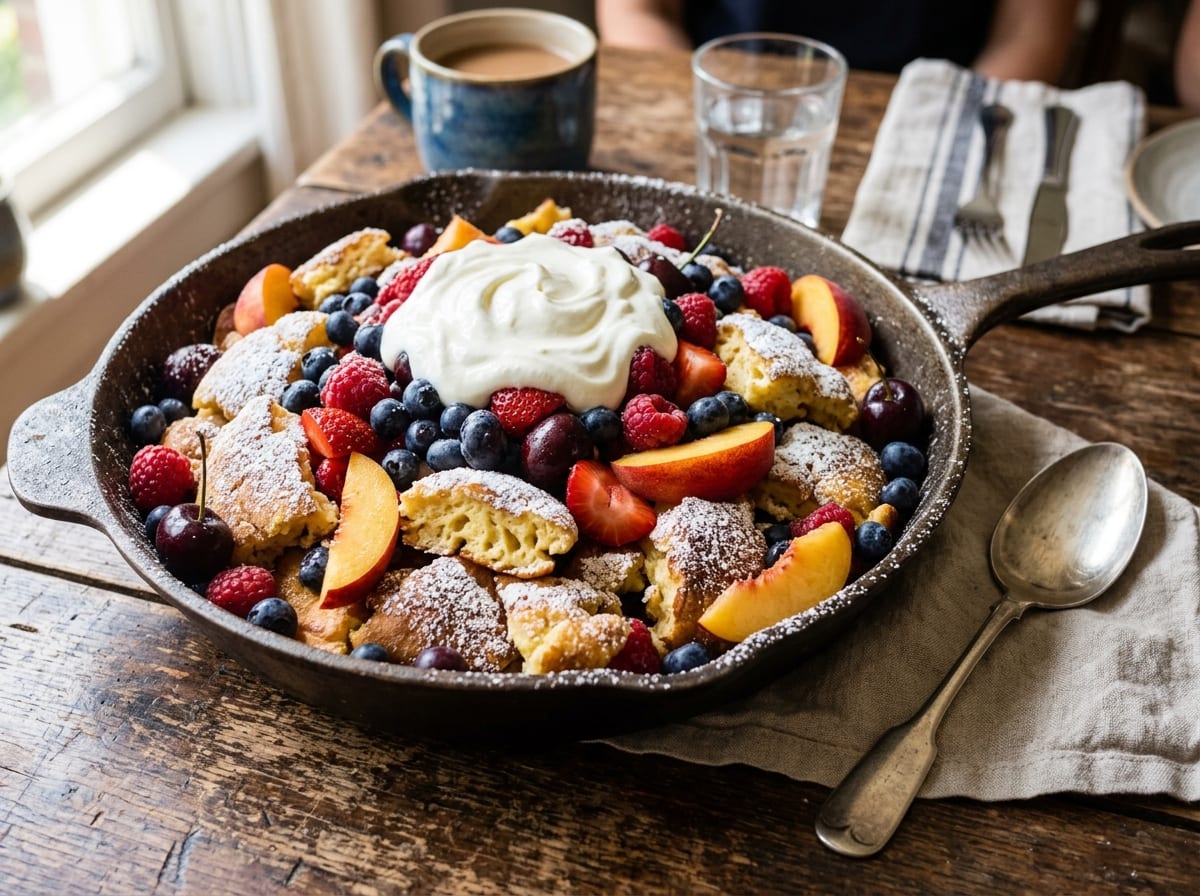
Christoph's Kaiserschmarrn
A Kaiserschmarrn built on the soufflé pancake method rather than the café one, with whipped cottage cheese or Greek yogurt folded through the batter. Cooked low and slow under a lid in one very large skillet, flipped whole, then torn and topped with fresh fruit.
Prep25 min
Cook20 min
0 Servings6
Christoph's own, a Kaiserschmarrn crossed with the Fallow soufflé pancake method, without the glaze and without rum raisins
Ingredients
Written for a 30 cm pan
Units
Temperature
Servings
The meringue
- 240 g egg whites, about 8 large whites, at room temperature rounded
- 20 ml lemon juice, acid stabilises the foam and keeps it from collapsing rounded
- 80 g caster sugar, less than the Michelin version, because the fruit and the topping add their own rounded
- 20 g cornflour, insurance; it holds the foam together through the folding rounded
The batter
- 100 g egg yolks, about 5 large yolks rounded
- 150 g cottage cheese or Greek yogurt, or half of each, whipped completely smooth first; see the notes rounded
- 140 g plain flour rounded
- 4 g fine salt rounded
- 30 ml whole milk, less than a plain batter takes, because the cheese brings moisture rounded
- 50 g butter, half for the pan and half for after the flip rounded
To finish
- 400 g fresh fruit, berries, stone fruit or whatever is in season, cut just before serving rounded
- 250 g Greek yogurt or double cream, whipped; the yogurt route is the one Christoph uses rounded
- to taste vanilla bean powder and sugar-free vanilla drops, for the whipped yogurt, to taste rounded
- to taste icing sugar, for dusting at the table rounded
Dietary labels are a guide, not a guarantee. If you have an allergy, read the ingredients yourself.
Method
- Whip the cottage cheese or yogurt completely smooth before anything else, in a blender or with a stick blender. Curds will tear the meringue apart later, so this is not a step to rush.
- Whisk the whites with the lemon juice to soft peaks. Add the sugar in three goes and whisk to medium-firm peaks, then whisk in the cornflour.
- Whisk in the yolks and the whipped cheese only until even. It will deflate a little, which is expected.
- Fold in the flour and salt in two additions, then the milk. Gently but decisively, and stop the moment no dry flour remains.
- Melt half the butter in a 30 cm skillet over low heat and wipe out the excess. Pour in all the batter and level it roughly.
- Put the lid on and cook 12 to 15 minutes on low. Both parts matter. The lid traps steam so the top sets without browning, and the low heat gives a batter this thick time to cook through before the base darkens.
- Add the rest of the butter around the edge, then flip the whole thing. Slide it onto a plate or board and invert it back into the pan, or use two wide spatulas if you are confident.
- Cook 3 to 4 minutes uncovered on the second side.
- Tear it into rough bite-sized pieces in the pan with two forks or a spatula, and give it another minute so the torn edges catch a little colour.
- Serve straight from the pan, dusted with icing sugar, with fresh fruit and whipped yogurt or cream on top.
How this differs from the other two
It borrows from both and copies neither.
| Kaiserschmarrn | Soufflé pancakes | This one | |
|---|---|---|---|
| Lift | folded whites | meringue with cornflour | meringue with cornflour |
| Pan | one pan, oven finish | four 16 cm pans | one 30 cm skillet, lid on |
| Cooked | pan then oven | 5 minutes, covered | 12 to 15 minutes, covered |
| Torn | yes | no | yes |
| In the batter | nothing extra | nothing extra | whipped cottage cheese or yogurt |
| Served with | rum raisins, Zwetschgenröster | maple brown butter glaze | fresh fruit and whipped yogurt |
The glaze belongs to the Michelin recipe and is deliberately not here. So are the rum raisins.
Notes
- Whip the cheese first, always. Cottage cheese straight from the tub is full of curds, and folding curds into a meringue punctures it. Whipped smooth, it disappears and leaves behind body and protein.
- Cottage cheese or yogurt is a real choice. Cottage cheese is milder and gives a slightly firmer, more custardy result. Greek yogurt is sharper and lighter. Half and half is the middle, and is what this was written for.
- The lid is not optional. Without it the top stays raw while the base burns, because the batter is roughly three times as deep as an ordinary Kaiserschmarrn.
- Two smaller pans beat one overloaded one. If your largest skillet is under about 28 cm, split the batter across two 24 cm pans rather than making one very deep pancake that will not cook through.
- Tear it late. Tearing before the second side is cooked gives you scrambled batter. The pieces should already be set when you pull them apart.
- If you want it more traditional, scatter a tablespoon of sugar over the torn pieces with the last of the butter and let it caramelise for a minute. Christoph leaves it out, because the fruit and the topping are doing that job.
Ingredient substitutions
- Cottage cheese is Hüttenkäse or körniger Frischkäse in Germany. Quark works and is sharper and denser; use 120 g rather than 150 g and add a splash more milk.
- Sugar-free vanilla drops are a liquid sweetener flavouring, easy to find online and in drugstores. Plain vanilla extract with a little sugar does the same job if you are not avoiding sugar.
- Vanilla bean powder is worth having and is not the same as vanilla sugar, which is mostly sugar. Scraped vanilla seeds are the direct substitute.
Sources consulted
Good with
Sources consulted
From Christoph Mayer