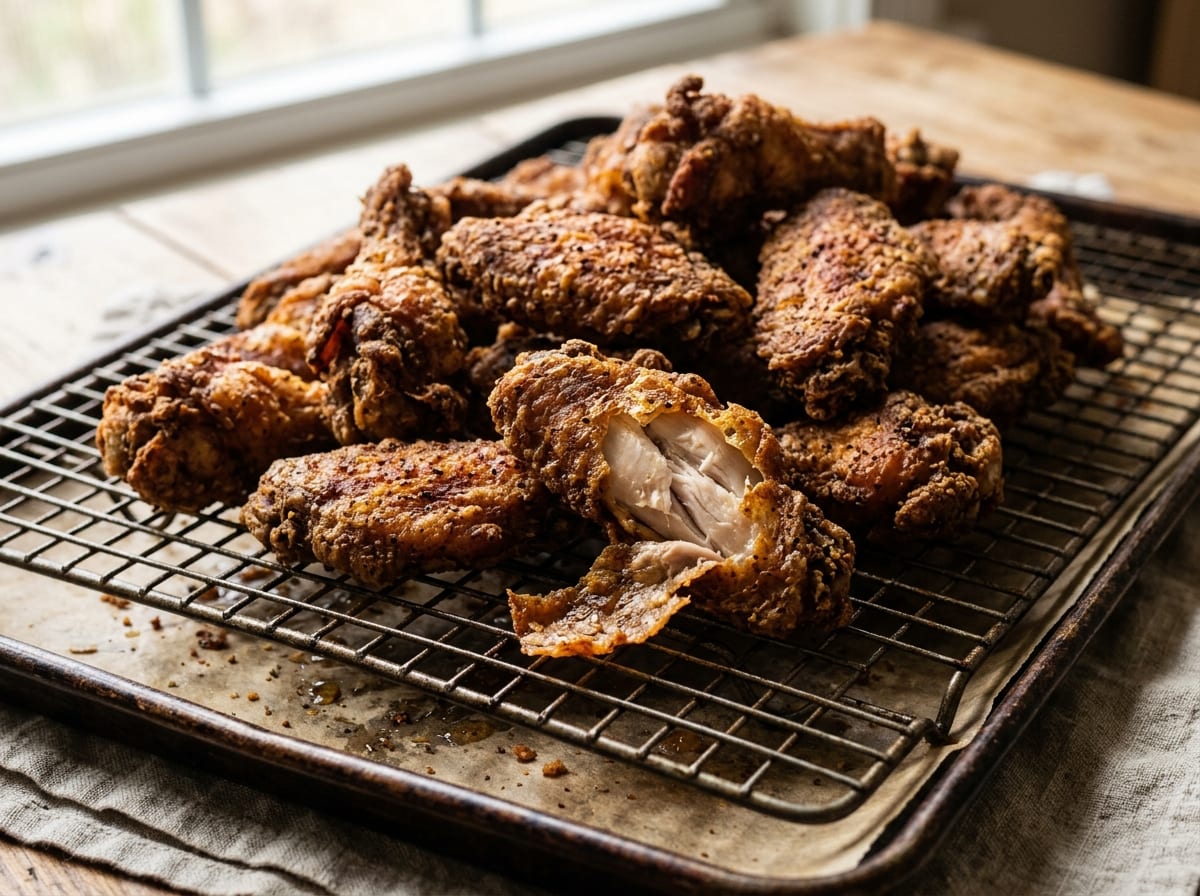
The crispiest baked chicken wings
Baking powder and salt, nothing else, left uncovered in the fridge overnight so the skin dries out completely before a hot oven ever sees it. This is the technique that gets an oven wing closest to a fried one. The price of "best" is a day of lead time, not a shortcut.
The baking-powder crispy-skin method, taken to its full overnight length rather than the shorter four-hour version, and adapted for wings on a rack.
Ingredients
Units
Temperature
Servings
Wings
- 1 3/8 kg chicken wings, split into flats and drumettes, tips removed and saved for stock rounded
- 20 g baking powder, aluminium-free if you can find it, since at this concentration, straight on the skin, ordinary baking powder can taste faintly metallic rounded
- 12 g kosher salt rounded
To finish
- to taste flaky salt, at the table, not before (optional) rounded
Dietary labels are a guide, not a guarantee. If you have an allergy, read the ingredients yourself.
Method
- Split the wings and dry them completely. Cut through both joints to separate each wing into a flat and a drumette, and freeze the tips for stock rather than cooking them. Pat every piece bone dry with paper towels, more thoroughly than feels necessary. Everything that follows depends on starting with as little surface moisture as possible.
- Toss with baking powder and salt only. No oil. Sprinkle both evenly over the wings in a large bowl and toss until every piece is coated in a thin, even film. Oil here would only trap moisture against the skin; the crisping fat comes from the wings themselves, later, once it renders.
- Spread in a single layer, skin side up, on a wire rack set over a sheet pan. Pieces should not touch. Crowding traps steam exactly where you don’t want it, and the rack is doing real work here: it lets air move on every side of the skin and lets rendered fat drip down and away instead of pooling under the wing and shallow-frying it in its own grease.
- Refrigerate uncovered for at least 8 hours, up to 24. This step is the actual difference between a good baked wing and this one. Open, dry fridge air pulls out the last of the surface moisture, and the alkaline baking powder gets the time it needs to fully break down the proteins in the skin, the same chemistry as the chicken dry rub, just given as long as it wants because nothing here is rushed.
- Heat the oven to 220 to 230°C, fan on if you have one. Moving air matters more in this recipe than in most baking: it’s what carries rendered fat and steam away from the skin instead of letting them sit on it. Put the wings in straight from the fridge, still on their rack.
- Bake 40 to 45 minutes, flipping once halfway. Go by the skin, not the clock: it should be a deep mahogany-gold and audibly crackling when you flex a piece. If it isn’t there at 45 minutes, give it 5 more rather than pulling early, the last stretch is where most of the visible crisping happens.
- Finish under the grill for 2 to 3 minutes if you want it darker still, watching the whole time. Baking powder browns fast once it gets going, and a grill turns “exactly right” into “burnt” in well under a minute of inattention.
- Rest 5 minutes, season with flaky salt, and serve immediately. The skin is at its most shattering the moment it leaves the oven. Serve any sauce on the side rather than tossing the wings in it: a wet toss is the fastest way to undo eight hours of drying.
Notes
- The overnight dry-brine is not optional. This is the one step that separates “the crispiest” from “quite good,” and skipping it produces a decent baked wing, not this one. If you don’t have the lead time on a given day, the easy version of this recipe exists exactly for that, a genuinely honest one-pan wing with no wait, rather than rushing this method and getting neither result properly.
- Why hotter than a roast chicken. 220 to 230°C would dry out a whole bird, but wings are almost all skin and thin bone with very little insulating meat, so they take the heat well, and the extra heat is what pushes dried, alkaline-treated skin into something that actually shatters rather than just crisps.
- No oil is the point, not an oversight. A wing baked in oil or butter is, in effect, shallow-fried in its own pan drippings. Bare, dry, treated skin on a rack over an empty pan is what makes an oven wing eat like a fried one.
- Baking powder, never baking soda. Soda is roughly three times as alkaline, and used directly against skin rather than buried inside a rub, it turns soapy and bitter well before the skin is done. Baking powder does the same job without the off-flavour.
- They do not hold. Crisp skin is a countdown starting the moment it leaves the oven. Plan to serve within about 10 minutes, and don’t cover the wings while they wait, or the steam will soften everything that just took a day to dry.
Ingredient substitutions
- Frozen wings work, but thaw them fully and pat them properly dry before the baking powder goes anywhere near them: any leftover ice-melt moisture undoes the whole overnight dry-out before it starts.
- Whole, unsplit wings are fine if you’d rather not joint them. Add about 5 minutes to the bake for the extra mass, and expect a bit less exposed, crisping skin per piece than you’d get from flats and drumettes.
- No wire rack. Use the easy version of this recipe instead. That one is built and tested to be genuinely good sitting flat on a pan; this method is built around the rack, and skipping it changes the actual result, not just the effort involved.
Sources consulted
Good with
Sources consulted
From Christoph Mayer