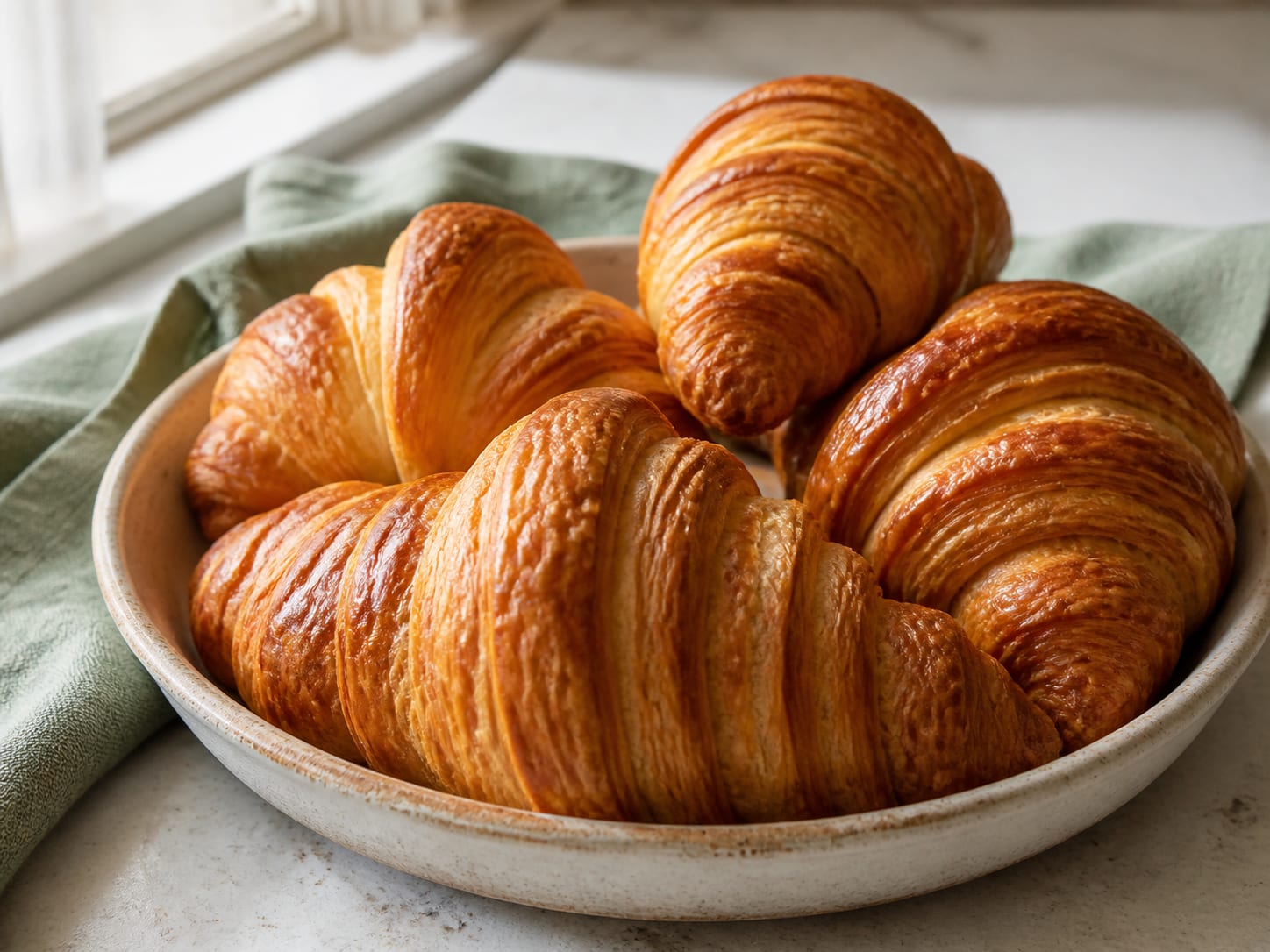
Croissants
Genuine laminated croissants, butter folded into yeasted dough in three turns to build the layers that puff into flaky sheets in the oven. This takes most of a day between folding, resting and chilling, and there is no way to shortcut the lamination without losing the layers entirely.
Prep90 min
Cook20 min
Rest780 min
Oven200°C
Servings12
Christoph's croissants, a straightforward three-turn lamination that takes a full day but needs no special equipment beyond a rolling pin and a cold kitchen.
Ingredients
Units
Temperature
Servings
Détrempe (base dough)
- 500 g bread flour rounded
- 55 g sugar rounded
- 10 g fine salt rounded
- 10 g instant dried yeast rounded
- 270 ml cold milk rounded
- 40 g butter, softened rounded
Butter block
- 250 g cold butter, high-fat European-style, if available rounded
To finish
- 1 egg, beaten, for egg wash rounded
Dietary labels are a guide, not a guarantee. If you have an allergy, read the ingredients yourself.
Method
- Mix the flour, sugar, salt, yeast, cold milk and softened butter into a smooth, slightly firm dough, kneading about 6 minutes by hand. Shape into a flat rectangle, wrap, and refrigerate at least 2 hours or overnight.
- Pound the cold block butter between two sheets of parchment with a rolling pin into a 20 by 20 cm square, keeping it cold throughout. Refrigerate until firm but still pliable, about 20 minutes.
- Roll the chilled dough into a rectangle roughly twice the size of the butter square. Place the butter in the centre at 45 degrees to the dough and fold the corners of the dough over it like an envelope, sealing the edges.
- Roll the dough out to a long rectangle, about 60 by 20 cm, on a lightly floured surface, always rolling away from you in one direction. Fold it in thirds like a letter, this is the first turn. Wrap and chill 30 minutes.
- Repeat the roll-and-fold twice more, chilling 30 minutes between each turn, for three turns total. If the butter ever starts to look greasy or breaks through the dough, stop and chill immediately; a warm, broken butter layer will not laminate.
- After the final turn, chill the dough at least 1 hour. Roll it out to a rectangle about 60 by 25 cm and 4 mm thick. Trim the edges straight, then cut into 12 triangles, each with a 10 cm base.
- Cut a small notch in the centre of each triangle’s base, gently stretch the triangle a little longer, then roll from the base to the point, curving the ends slightly inward to form the classic crescent.
- Arrange on lined baking sheets, well spaced, brush with beaten egg, and prove uncovered in a warm spot for 90 minutes to 2 hours, until visibly puffy and jiggling slightly when the tray is shaken.
- Brush again with egg wash. Bake at 200°C for 18 to 20 minutes, until deep golden brown all over, rotating the tray halfway through.
Method in the Thermomix
Written for a TM5 or TM6, 2.2 litre bowl. This covers only the détrempe; lamination is entirely by hand.
- Flour, sugar, salt and yeast into the bowl. Mix 5 sec / speed 5.
- Add the cold milk and softened butter. Knead 3 min / dough mode. The dough should be smooth and only slightly tacky.
- Shape, wrap and chill, then continue from step 2 of the hand method: laminate, shape and bake exactly as above.
Notes
- Keep everything cold throughout lamination. Warm butter smears into the dough instead of staying as a distinct layer, and a smeared layer will not puff; if the kitchen is warm, chill the dough and rolling pin between turns.
- Roll only in one direction each time, away from you, and rotate the dough rather than rolling side to side; this keeps the layers even and the final shape rectangular.
- The proof at the end matters as much as the lamination. Underproofed croissants bake dense despite good layers; they should look distinctly puffy and jiggle slightly before they go in the oven.
- They are best eaten the day they are baked. Shaped, unproofed croissants freeze well; thaw overnight in the fridge, then prove and bake as normal.
Ingredient substitutions
- High-fat European-style butter laminates more reliably than standard butter, which has a higher water content that can make the layers greasy; standard butter still works, just keep it colder for longer between turns.
- Bread flour gives the best structure for holding distinct layers; all-purpose flour will still work but with slightly less lift.
From Christoph Mayer