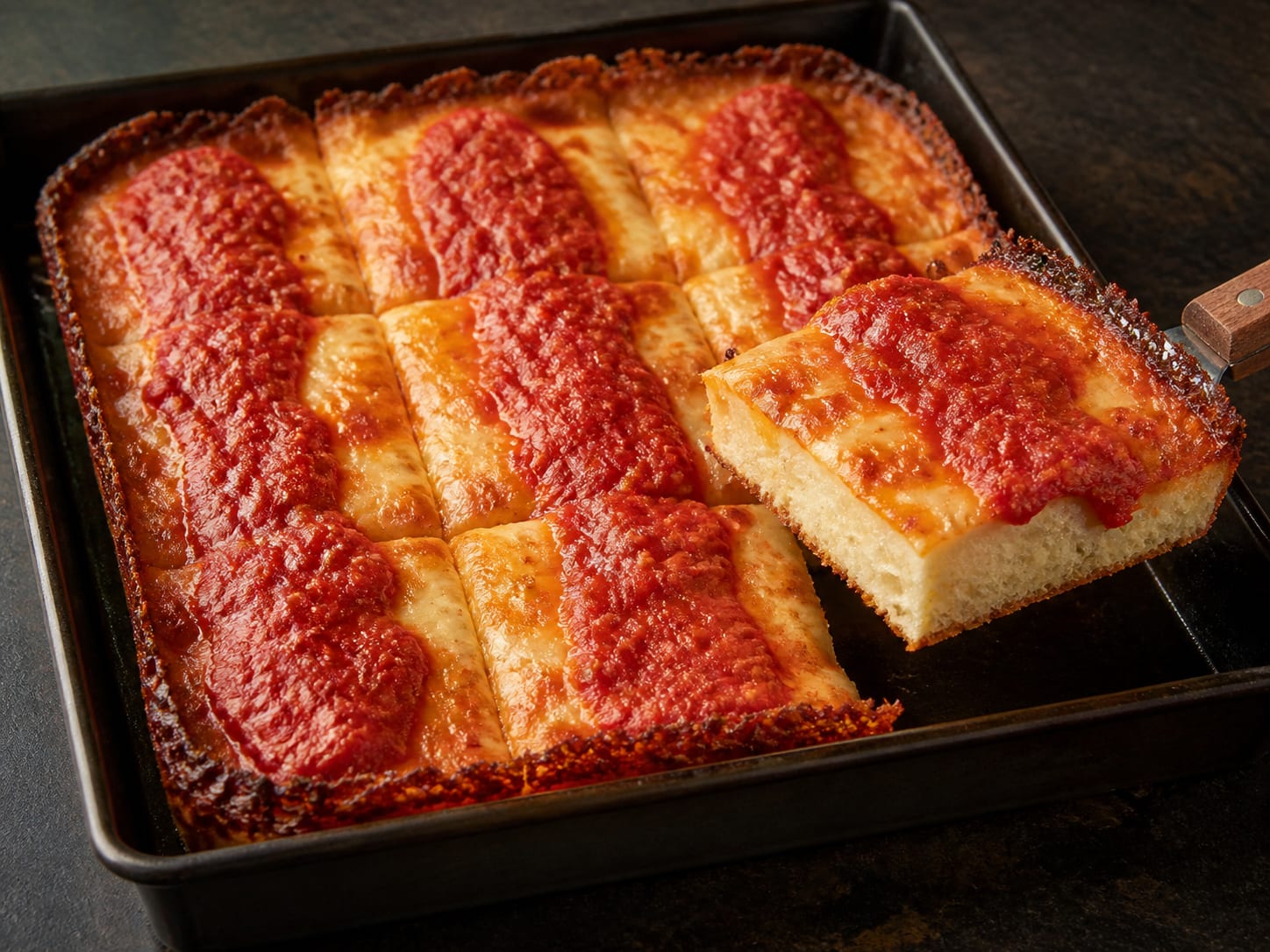
Detroit-style pizza
A high-hydration rectangular steel-pan dough with an airy crumb and crisp fried base, designed for edge-to-edge toppings and Detroit-style frico.
Prep35 min
Cook18 min
Rest210 min
Oven250°C
Servings4
Adapted from King Arthur Baking and Serious Eats techniques for Detroit pan dimensions, high hydration, cheese placement, and sauce order
Ingredients
Written for a 25 × 35 cm dish
Units
Temperature
Servings
Dough
- 300 g strong bread flour rounded
- 225 ml lukewarm water rounded
- 7.5 g fine salt rounded
- 2.5 g instant yeast rounded
- 15 g olive oil rounded
For the pan
- 20 g olive oil, for coating the pan rounded
Dietary labels are a guide, not a guarantee. If you have an allergy, read the ingredients yourself.
Method
- Mix the flour, water, salt, yeast, and 15 g oil until no dry flour remains. Rest for 15 minutes, then perform three rounds of stretch-and-folds at 15 minute intervals. The high-hydration dough will be sticky but should become cohesive and elastic. Its exact weight is 550 g.
- Cover and ferment at room temperature for 1 1/2 to 2 hours, until expanded by about half. For more flavour, refrigerate after the folds for 12 to 24 hours, then warm the covered dough for 60 minutes before panning.
- Coat a traditional 25 x 35 cm dark blue-steel Detroit pan with 20 g oil. An anodized aluminium Detroit pan is the best explicit alternative. A dark 23 x 33 cm metal baking pan also works, but gives taller corners and a less even frico; do not use glass.
- Transfer the dough to the pan and turn it once in the oil. Dimple and stretch it gently toward the corners. If it springs back, cover for 15 minutes and repeat. Cover and proof in the pan for 45 to 75 minutes, until airy, relaxed, and nearly doubled.
- Put a baking steel or stone on the lowest rack and heat the home oven to its maximum, ideally 250 to 275°C, for 45 to 60 minutes.
- Use the topping selector below for exact quantities, assembly order, and before-bake and after-bake steps. Choose a Detroit-compatible preset and take its cheese right to the steel-pan walls if a frico edge is desired. Where the selector calls for sauce on top, apply it in Detroit-style stripes. Do not exceed the preset’s pan capacity.
- Bake on the lowest rack for 15 to 20 minutes, rotating once, until the sauce bubbles, the centre is set, and the cheese at the walls is mahogany rather than black. If the base is pale, set the pan directly on the preheated steel for the final 2 to 4 minutes.
- Rest for 2 minutes only. Loosen the frico carefully with a thin spatula, lift the pizza from the pan to a rack, and wait 3 minutes before cutting into rectangles. Leaving it in the pan traps steam and softens the fried base.
Notes
- Baker’s percentages: strong bread flour 100%, water 75%, salt 2.5%, instant yeast 0.83%, and oil in the dough 5%. The exact 550 g dough fills one 25 x 35 cm pan.
- Brick cheese is a mild, high-fat Wisconsin cheese and is the traditional Detroit choice. In Germany, equal parts young Butterkäse and low-moisture mozzarella approximate its melt, richness, and browning better than wet fresh mozzarella.
- Brick cheese is style context, not part of this dough-only ingredient list. The topping selector supplies actual cheese or other topping quantities and their safe preparation.
- Detroit differs from Sicilian pizza through its smaller deep steel pan, cheese all the way against the walls for frico, and sauce stripes over the cheese. The crumb remains airy, but the caramelized cheese perimeter defines the style.
- A home oven cannot reproduce the strong bottom heat and rapid recovery of a commercial deck oven. A fully heated steel under a dark metal pan helps, but the bake is longer and the base may be less uniformly crisp.
- Use a thick sauce. A watery sauce placed on top can flood the crumb. Judge doneness by the crisp mahogany edge, browned underside, bubbling sauce, and springy centre rather than by time alone.
- Refrigerate cooled leftovers in a sealed container for up to 3 days. Reheat at 220°C on a rack or in a dry skillet so the base and frico become crisp again.
Sources consulted
Good with
Sources consulted
The formula is scaled to one 25 x 35 cm home-oven pan and includes a practical German cheese substitute.
From Christoph Mayer