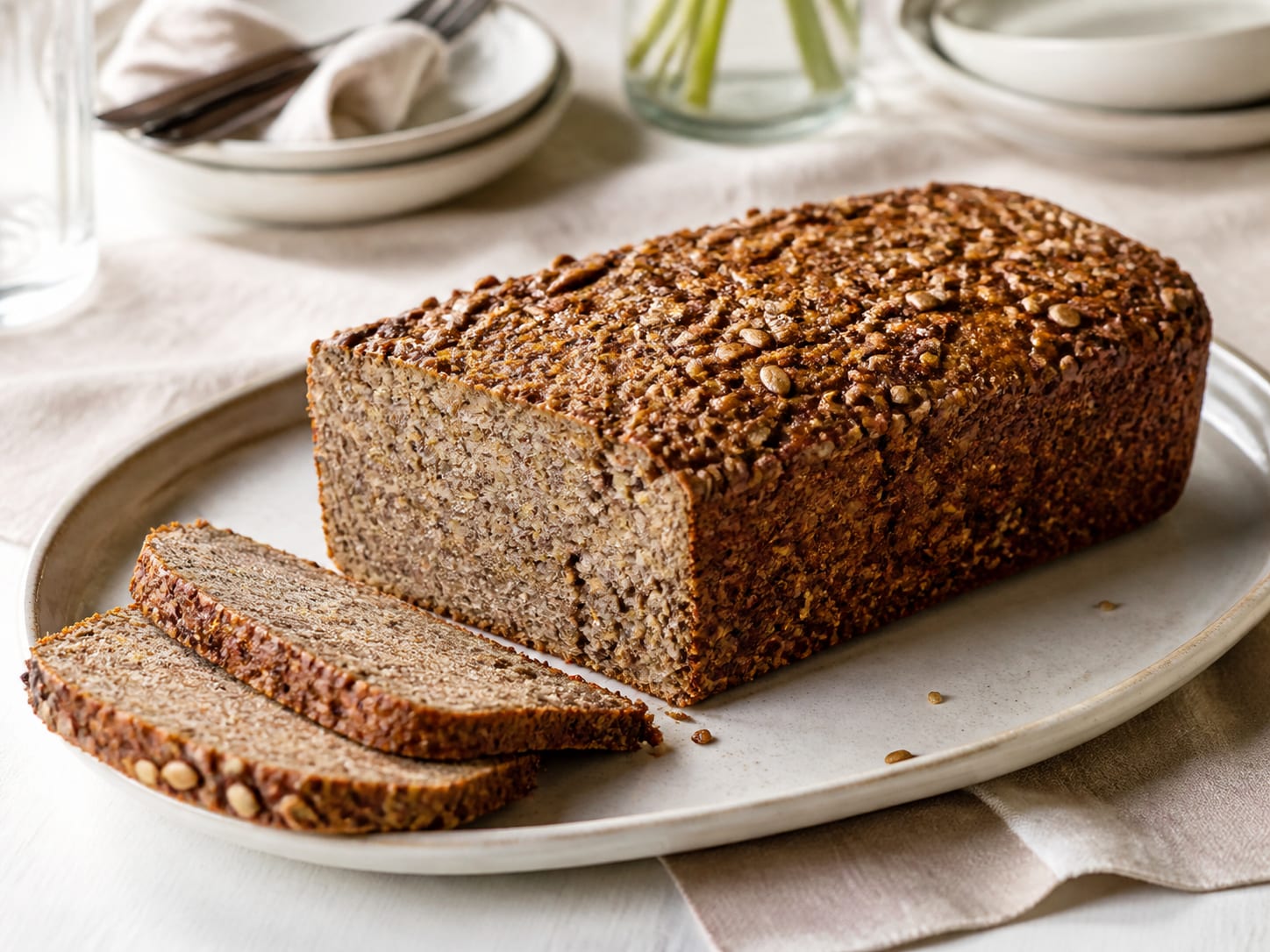
Dinkelkeimbrot (sprouted spelt bread)
A dense, naturally sweet bread made from whole spelt berries soaked and sprouted over two days, then blended whole into a thick batter rather than a kneaded dough. Sprouting breaks the starches down and changes both the flavour and the texture from anything a flour-based loaf can produce; there is no shortcut that skips the soak and sprout.
Christoph's sprouted spelt loaf, a two-day soak and sprout ahead of a wet, blended dough with no added flour at all.
Ingredients
Written for a 25 × 11 cm loaf tin
Sprouted grain
- 500 g whole spelt berries, unhulled, viable for sprouting; not pearled or pre-cooked rounded
Dough
- 15 g fresh yeast, or 5 g instant dried yeast rounded
- 15 g fine salt rounded
- 20 g honey rounded
- 40 g linseed (optional) rounded
- 40 g sunflower seeds (optional) rounded
Dietary labels are a guide, not a guarantee. If you have an allergy, read the ingredients yourself.
Method
- Rinse the spelt berries and soak in plenty of cold water for 12 hours. Drain and rinse well.
- Spread the drained berries in a shallow layer in a colander or on a clean tea towel, cover loosely, and leave at room temperature. Rinse them twice a day to keep them moist without sitting in water. After 24 to 36 hours, small white sprouts, about the length of the grain itself, should be visible on most of the berries.
- Rinse the sprouted grain once more and drain very well; excess water makes the batter too wet to hold structure. Blend the sprouted berries in a food processor or high-powered blender until you get a coarse, sticky, slightly wet paste, not a smooth purée.
- Warm the paste very gently if it is cold from the fridge, then work in the yeast, salt and honey by hand until evenly distributed. Fold in the linseed and sunflower seeds if using.
- Press the mixture into a lined loaf tin, smoothing the top with a wet spoon. It will be sticky and dense, more like a thick batter than a dough; this is correct.
- Cover loosely and prove in a warm place for 1 hour, until slightly domed and visibly aerated on top.
- Bake at 190°C for 55 to 60 minutes, until deep brown and a skewer comes out clean. Cool in the tin for 15 minutes, then turn out onto a rack and cool completely, at least 2 hours, before slicing; this bread slices raggedly if cut warm.
Method in the Thermomix
Written for a TM5 or TM6, 2.2 litre bowl. This covers only grinding the sprouted grain; soaking, sprouting and baking are as in the hand method.
- Sprouted, drained grain into the dry bowl, in batches if it exceeds half the bowl. Blend 30 sec / speed 8, scraping down once, until a coarse, sticky paste forms.
- Add the yeast, salt and honey. Mix 20 sec / speed 4. Tip into a bowl, fold in the seeds by hand, and continue from step 5 of the hand method.
Notes
- Sprouting is what makes this bread, not an optional step to rush. It converts some of the grain’s starch to sugar and softens the whole berry, which is why the loaf tastes faintly sweet and dense without needing any flour.
- Keep the sprouting grain moist but never sitting in standing water, which encourages mould rather than sprouts. A colander set over a bowl, rinsed twice daily, works well.
- The batter is meant to be sticky and dense, closer to a thick porridge than bread dough; do not try to knead it or add flour to make it more familiar.
- It keeps for 5 days at room temperature, wrapped, and improves slightly on the second day as the crumb settles.
Ingredient substitutions
- Whole spelt berries must be raw and viable for sprouting; pearled, cracked or pre-cooked grain will not sprout and cannot be used here.
- Wheat berries sprout the same way and can replace spelt in equal weight, giving a slightly less nutty result.
- Linseed and sunflower seeds are optional additions; pumpkin seeds or chopped walnuts also work well folded through.
From Christoph Mayer