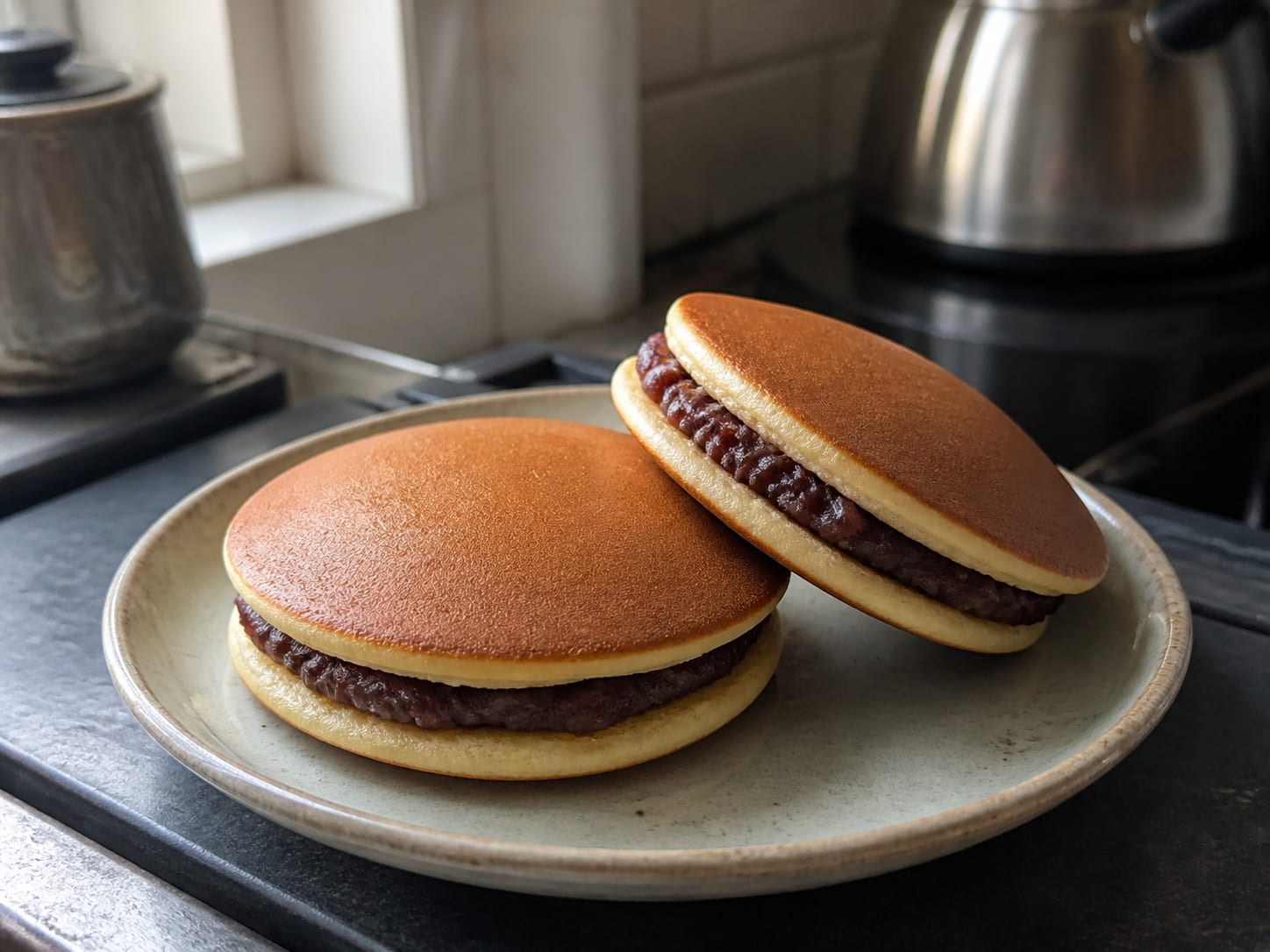
Dorayaki (Japanese red bean pancake sandwiches)
Two small, fluffy honey pancakes griddled until the surface bubbles and the edges set, sandwiched thick with sweet red bean paste (anko). Doraemon's favorite food, and an easy one to make at home.
Prep15 min
Cook20 min
Rest30 min
Servings4
Batter, resting time and griddle technique adapted from Just One Cookbook's dorayaki recipe
Ingredients
Written for a 24 cm pan
Units
Temperature
Servings
Batter
- 4 large eggs rounded
- 135 g granulated sugar rounded
- 42 g honey rounded
- 160 g all-purpose flour rounded
- 5 g baking powder rounded
- 15 ml water, plus more as needed to loosen the batter rounded
For the pan
- 5 ml neutral oil, for greasing the pan between batches rounded
Filling
- 500 g sweet red bean paste (anko), shop-bought or homemade, at room temperature so it spreads easily rounded
Dietary labels are a guide, not a guarantee. If you have an allergy, read the ingredients yourself.
Method
- Whisk the eggs, sugar and honey together until pale and noticeably thickened, about 2 to 3 minutes by hand or with a mixer.
- Sift the flour and baking powder over the egg mixture and fold in gently, just until no dry streaks remain. Cover and refrigerate for 30 minutes; anywhere from 15 minutes to 1 hour works, and the rest is what lets the pancakes puff and hold their shape.
- Stir in the water to loosen the batter to a thick, pourable pancake consistency. Add a little more water, a teaspoon at a time, if it still sits stiffly on the spoon.
- Heat a nonstick pan over the lowest setting for about 5 minutes to let the heat even out, then raise it to medium-low. Wipe it with a little oil using a paper towel.
- Spoon about 3 tablespoons of batter into the pan for each pancake, letting it spread into a round about 8 cm across. Cook until bubbles dot the whole surface and the edges look dry rather than wet, about 60 to 90 seconds.
- Flip and cook the second side until golden, about 20 to 30 seconds. Transfer to a plate, pretty side up, and cover loosely with a damp kitchen towel while you cook the rest, re-oiling the pan lightly between batches. You should end up with 12 pancakes.
- Once the pancakes have cooled, spread a thick layer of anko, about 2 to 3 tablespoons, over the flat side of one pancake, mounding it a little higher in the center so the sandwich domes. Top with a second pancake, flat side down, and press very gently to seal.
- Serve the same day, or wrap each dorayaki individually.
Notes
- Do not skip the batter rest. It hydrates the flour and lets the baking powder work evenly, and a rested batter holds a round, domed shape in the pan instead of spreading thin.
- Keep the heat genuinely medium-low. This batter is sweet enough to brown fast, and a hot pan scorches the outside before the crumb sets in the middle.
- These keep, wrapped, at room temperature for up to 2 days, or in the freezer for up to a month; thaw at room temperature before eating.
- Anko (sweet red bean, usually azuki, paste) is not something you will find on the shelf at Rewe or Edeka. It is stocked at Asian grocery stores in most German cities, canned or in tubs (Japanese and Korean brands both carry it), and that is the closest and easiest route if one is nearby. Without access to one, a workable homemade stand-in is dried azuki beans (sold as “Adzukibohnen” or “Aduki-Bohnen” in bio shops and reform houses, Rapunzel is a common brand), simmered soft and then cooked down with sugar to a thick paste. It gets you the same core flavor, but a home batch turns out coarser and less glossy than the smooth, machine-processed paste from a can, so expect a rustic version rather than an exact match.
Sources Consulted
Sources consulted
Quantities, the rest time and the flip cues follow the source closely; the ingredient grouping, the doneness cue and the wording throughout are original. Anko is given as one weight to spread across all the pancakes rather than a per-pancake spoonful, which is how the source states it.
From Christoph Mayer