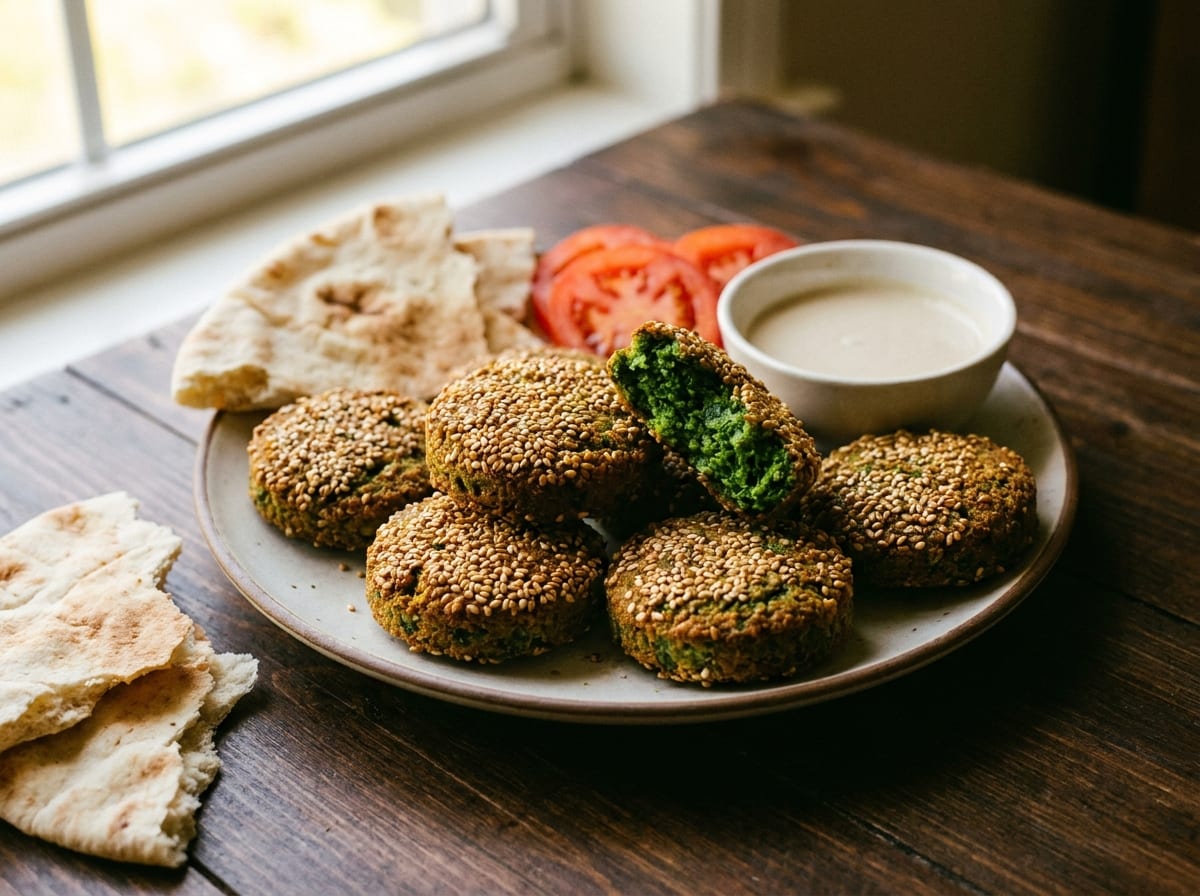
Egyptian Ta'ameya
Falafel's likely ancestor, built on dried split fava beans rather than chickpeas, so heavily loaded with dill, parsley and cilantro that the mixture is more herb than bean and the fried patty comes out a startling green all the way through. Shaped into flat disks rather than balls and rolled in sesame seeds before frying, which is what gives ta'ameya its own texture, softer and fluffier than a chickpea falafel, not a competing version of the same dish.
Prep45 min
Cook20 min
Rest750 min
Servings6
Egyptian ta'ameya, dried split fava beans ground with a heavy hand of dill and herbs, shaped flat and rolled in sesame.
Ingredients
Written for a 3 L pot
Units
Temperature
Servings
Ta'ameya
- 300 g dried split fava beans, peeled, soaked in plenty of cold water for 12 to 24 hours, never cooked rounded
- 80 g yellow onion, roughly chopped rounded
- 3 garlic cloves rounded
- 50 g fresh dill, fronds, roughly chopped rounded
- 40 g fresh flat-leaf parsley, leaves and tender stems, dried thoroughly after washing rounded
- 20 g fresh cilantro, leaves and tender stems, dried thoroughly after washing rounded
- 15 g green onions, sliced rounded
- 6 g ground coriander rounded
- 2 g ground cumin rounded
- 10 g fine salt rounded
- 3 g baking soda rounded
- 60 g sesame seeds, for coating rounded
- to taste neutral oil, for deep frying rounded
Dietary labels are a guide, not a guarantee. If you have an allergy, read the ingredients yourself.
Method
- Drain the soaked fava beans very well and spread them on a clean towel to dry.
- Pulse the fava beans, onion, garlic, dill, parsley, cilantro, green onions, coriander, cumin and salt in a food processor. Scrape down the sides several times. Stop when the mixture is coarse and holds together when squeezed; it should look more like finely chopped herbs than a bean paste.
- Cover and refrigerate the mixture for at least 30 minutes, up to overnight.
- Fold in the baking soda just before frying.
- Heat the oil to 175 to 190°C in a deep, heavy pot. Shape the mixture into flat disks about 6 cm across and 1.5 cm thick, roughly 40 g each. Press both sides into the sesame seeds to coat.
- Fry in small batches, without crowding the pot, for 3 to 4 minutes, turning once, until deep golden and crisp on both sides, the sesame toasted.
- Lift out with a slotted spoon onto a paper-towel-lined tray. Serve hot.
Notes
- This is a different dish from chickpea falafel, not a variation on it. Split fava beans give a softer, fluffier interior and a much more intense green from the sheer volume of herbs; ta’ameya is widely thought to predate chickpea falafel, possibly as a meatless Lenten dish among Egypt’s Coptic Christian community.
- Shape these flat, not round. A thinner disk cooks through evenly without the surface over-browning before the centre sets, which matters more here than for a denser chickpea falafel.
- The sesame coating isn’t a garnish, it’s part of the texture. Press it on firmly before frying so it toasts into the crust rather than falling off in the oil.
- Herbs should outweigh the beans by volume in the bowl. If the mixture looks more green than beige before frying, that’s correct, not a sign of doing too much.
Ingredient substitutions
- Split, peeled dried fava beans are worth seeking out specifically; whole dried favas need their skins removed by hand after soaking, which works but adds a step.
- Serve in warm pita or flatbread with tahini sauce, tomato and pickled vegetables, the traditional Egyptian breakfast build.
Sources consulted
- 196 Flavors: Falafel (Ta’amiya)
- Wikipedia: Ta’ameya
- Tasting Table: The Real Difference Between Ta’ameya And Falafel
Good with
Sources consulted
From Christoph Mayer