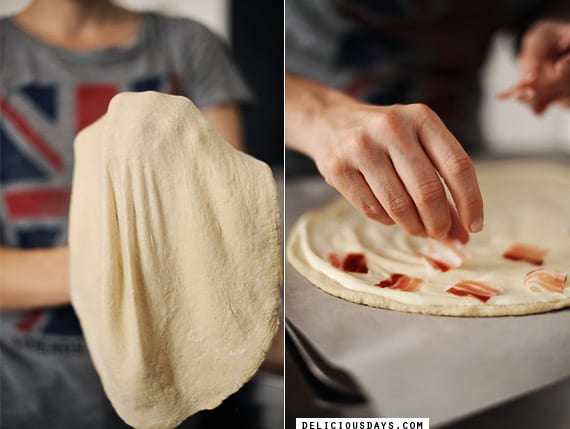
Alsatian Flammkuchen
Alsatian Flammekueche, called Flammkuchen in German and tarte flambée in French, is an ultra-thin unleavened flatbread style rolled without a raised rim.
Prep30 min
Cook20 min
Rest30 min
Oven250°C
Servings4
Adapted from My Dinner's unleavened Alsatian method and Craft Beering's home-oven Flammkuchen technique and naming context
Ingredients
Written for a 30 × 40 cm dish
Units
Temperature
Servings
Unleavened dough
- 250 g plain flour rounded
- 125 ml water rounded
- 20 g neutral oil rounded
- 5 g fine salt rounded
Dietary labels are a guide, not a guarantee. If you have an allergy, read the ingredients yourself.
Method
- Mix the flour, water, oil, and salt until no dry flour remains, then knead for 5 to 7 minutes until smooth. The unleavened dough weighs exactly 400 g. Cover and rest at room temperature for 30 minutes so it rolls without springing back.
- Put a baking steel or stone on the upper-middle rack and preheat the home oven at its maximum, ideally 250 to 275°C, for 45 minutes. Divide the dough into two exact 200 g portions.
- Roll one portion directly on baking paper into a 30 x 40 cm rectangle, about 1 mm thick. It should be nearly translucent and ultra-thin through the centre, with no raised pizza rim. Keep the second portion covered while the first bakes.
- Use the topping selector below for exact quantities, preparation, and before-bake and after-bake steps. Choose a Flammkuchen-compatible topping and spread it very thinly, leaving open spaces for steam. The Hohenloher Blootz option is the closest shared house route, but it is not a claim of traditional Alsatian formulation.
- Slide the paper and topped Flammkuchen onto the hot steel or stone. Bake for 8 to 12 minutes, pulling away the paper after 3 minutes if it releases easily. It is done when the base is crisp through the centre and the rim blisters dark brown. Repeat with the second 200 g portion.
- Follow the selector for any finishing ingredients. Cut immediately into rectangles and serve hot. Do not stack the pieces, because trapped steam softens the ultra-thin base.
Notes
- Baker’s percentages: plain flour 100%, water 50%, neutral oil 8%, and salt 2%. There is no yeast. The exact 400 g batch makes two 200 g sheets, each rolled to 30 x 40 cm.
- Flammekueche is the Alsatian name, Flammkuchen is German, and tarte flambée is French. The flatbread arose around the fierce heat of bread ovens in Alsace and neighbouring regions.
- This is pizza-adjacent, not an Italian pizza style. Its quick unleavened dough is rolled with a pin until ultra-thin, it has no risen rim, and crème fraîche replaces tomato sauce and mozzarella.
- The classic regional context is crème fraîche or fromage blanc, paper-thin onion, and bacon. The shared selector deliberately offers a related house adaptation rather than presenting it as the definitive traditional formula. This page teaches only the ultra-thin base and bake.
- A home oven cannot reproduce the flame and extreme heat of a traditional wood-fired bread oven. A fully heated steel or stone and two separately baked thin sheets give a crisper result than crowding one ordinary tray.
- Eat immediately. Refrigerate leftovers for up to 2 days and reheat on a bare rack at 220°C, though the base will never be quite as crisp as it was from the oven.
Sources consulted
Good with
Sources consulted
The base remains unleavened and is rolled extremely thin so it crisps during the short home-oven bake.
From Christoph Mayer