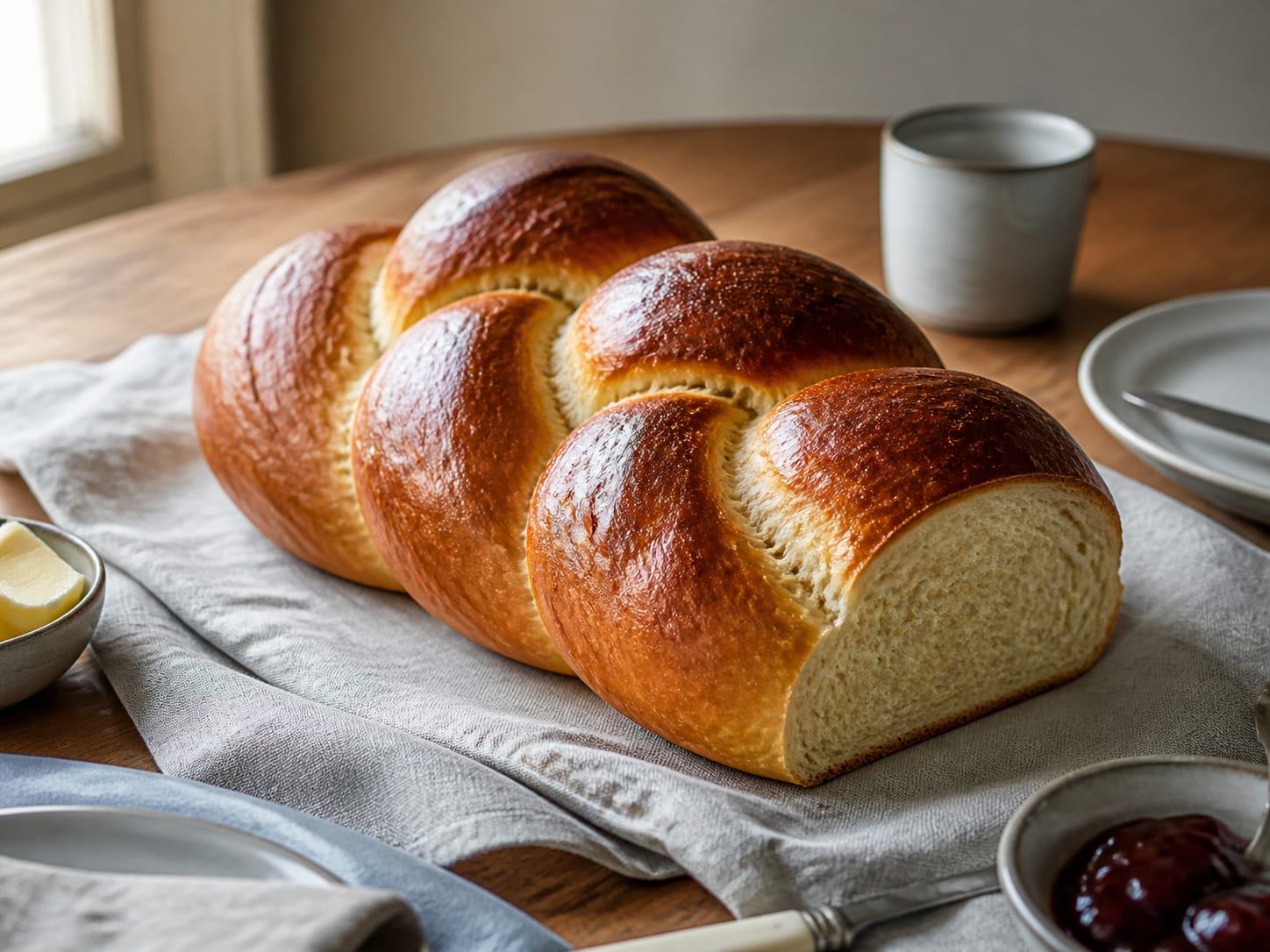
Hefezopf (German sweet yeast braid)
The rich, slightly sweet braided yeast bread found on every German breakfast table on a Sunday, a three-strand plait that bakes into a soft, buttery loaf with a glossy egg-washed crust. The dough is heavily enriched with butter and egg, which slows the yeast down and rewards a patient, slightly longer proof.
Prep30 min
Cook30 min
Rest120 min
Oven180°C
Servings12
Christoph's Hefezopf, the standard Sunday breakfast braid, enriched enough with butter and egg that it wants a longer, more patient proof than a lean dough.
Ingredients
Units
Temperature
Servings
Dough
- 500 g flour rounded
- 70 g sugar rounded
- 8 g instant dried yeast rounded
- 6 g fine salt rounded
- 220 ml warm milk rounded
- 2 eggs rounded
- 100 g butter, softened rounded
To finish
- 1 egg yolk, beaten with 1 tbsp milk, for egg wash rounded
- 15 g sliced almonds (optional) rounded
- 15 g coarse sugar (optional) rounded
Dietary labels are a guide, not a guarantee. If you have an allergy, read the ingredients yourself.
Method
- Whisk the flour, sugar, yeast and salt together. Add the warm milk and eggs, mix to a shaggy dough, then knead in the softened butter a little at a time, kneading by hand for about 12 minutes total, until smooth, elastic and no longer sticky. This is a slower knead than a lean dough because of the butter; be patient rather than adding flour to speed it up.
- Cover and prove in a warm place for 90 minutes, until roughly doubled; enriched dough rises more slowly than lean dough, so give it the full time rather than rushing on a set clock.
- Divide the dough into 3 equal pieces and roll each into a rope about 40 cm long, tapering slightly at the ends.
- Braid the three ropes into a plait, starting from the middle and working out to each end for the most even result, then pinch the ends and tuck them under.
- Transfer to a lined baking sheet, cover loosely, and prove 30 minutes, until visibly puffy.
- Brush generously with the egg yolk wash, scatter with sliced almonds and coarse sugar if using.
- Bake at 180°C for 28 to 30 minutes, until deep golden brown and a skewer in the thickest part comes out clean, tenting with foil partway through if the top browns too fast. Cool at least 30 minutes on a rack before slicing.
Method in the Thermomix
Written for a TM5 or TM6, 2.2 litre bowl. This covers only kneading the dough; braiding and baking are as in the hand method.
- Flour, sugar, yeast and salt into the bowl. Mix 5 sec / speed 5. Add the warm milk and eggs. Knead 3 min / dough mode, adding the softened butter in three additions through the lid opening while the machine runs.
- Knead a further 2 min / dough mode after all the butter is in, until the dough clears the sides of the bowl and feels smooth and elastic.
- Tip out, prove and continue by hand from step 3 of the hand method.
Notes
- Enriched dough like this proves more slowly than a plain bread dough. Judge readiness by how the dough looks and feels, roughly doubled and springing back slowly when poked, rather than by the clock alone.
- Braid loosely rather than tightly. A tight braid restricts the dough’s ability to expand in the oven and can distort the shape; a looser plait relaxes into an even, rounded braid as it bakes.
- The egg yolk wash, rather than whole egg, is what gives the deep golden colour and glossy finish traditional to this bread.
- It keeps for 3 days at room temperature, wrapped, and makes excellent French toast once a day or two old.
Ingredient substitutions
- Sliced almonds and coarse sugar on top are traditional but optional; a plain egg-washed crust is just as correct.
- A handful of raisins kneaded into the dough at the end is a common variation, though traditionalists keep the plain version for Sunday breakfast.
- Milk can be replaced with the same amount of water for a slightly less rich crumb if needed, though milk is standard here.
From Christoph Mayer