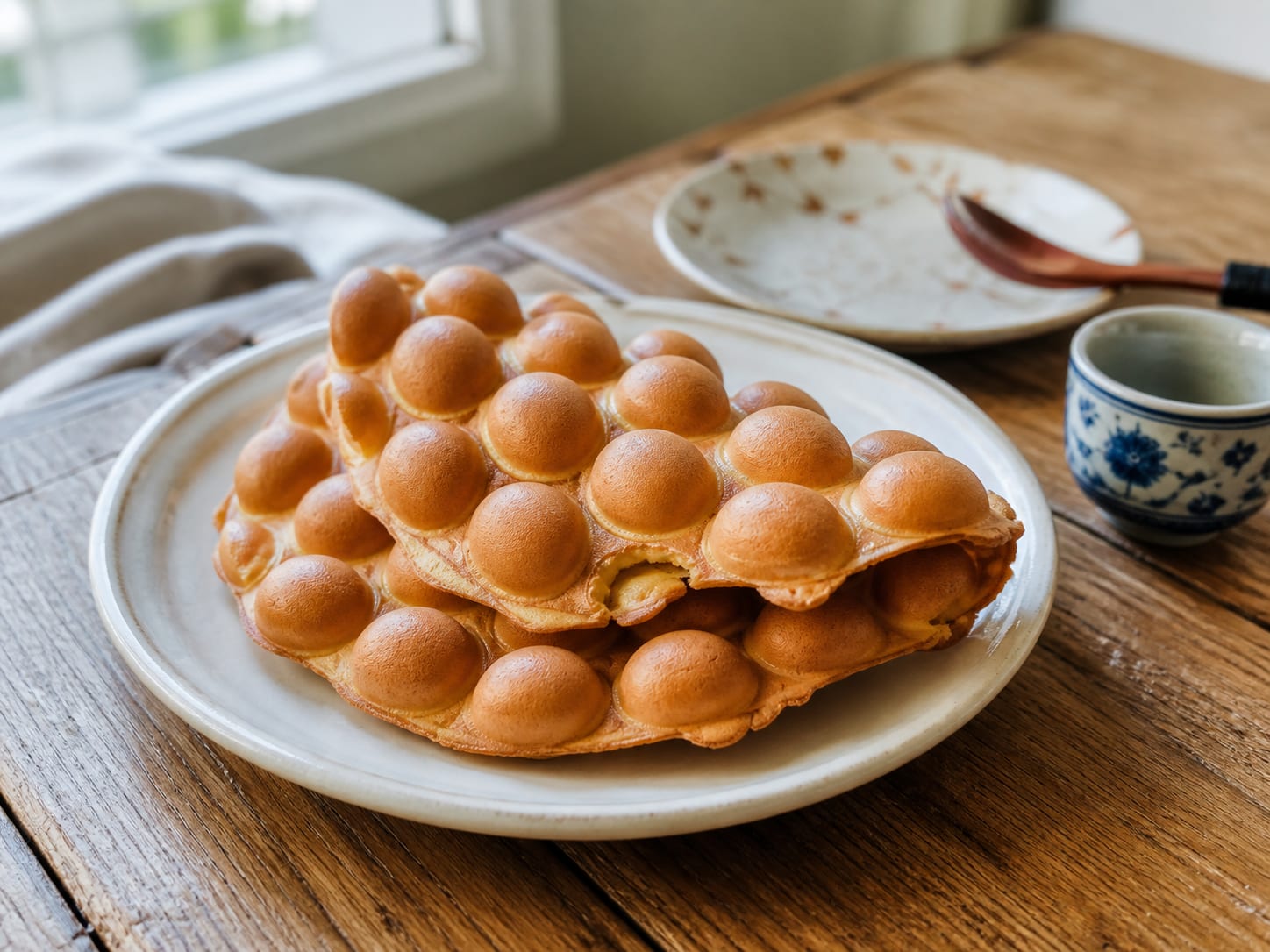
Hong Kong egg waffle
Golf-ball-sized bubbles of crisp-outside, custardy-soft-inside egg-and-sugar batter, cooked in a hinged honeycomb mold and eaten warm, folded in half straight off the griddle. Hong Kong's classic street snack since the 1950s, known locally as gai daan zai.
Quantities converged from Christine's Recipes and Hungry Huy's Hong Kong egg waffle recipes
Ingredients
Batter
- 2 large eggs rounded
- 130 g granulated sugar rounded
- 150 g all-purpose flour rounded
- 25 g cornstarch, tapioca starch if you have it rounded
- 6 g baking powder rounded
- 1 g fine salt, a pinch rounded
- 30 g evaporated milk, or whole milk rounded
- 140 ml water rounded
- 30 ml neutral oil rounded
- 5 ml vanilla extract rounded
For the mold
- 15 ml neutral oil, for greasing the mold rounded
Dietary labels are a guide, not a guarantee. If you have an allergy, read the ingredients yourself.
Method
- Sift the flour, cornstarch, baking powder, and salt into a bowl and whisk to combine.
- In a separate bowl, whisk the eggs and sugar together until the sugar mostly dissolves and the mixture lightens, about 1 minute.
- Whisk in the evaporated milk and water a little at a time until smooth.
- Add the dry ingredients in two batches, whisking just until no lumps remain. Do not overwork it.
- Whisk in the oil and vanilla extract until the batter is smooth and pourable, about the consistency of thin pancake batter.
- Cover and rest at room temperature for at least 1 hour, or overnight in the fridge (bring it back to room temperature before cooking). This lets the flour hydrate fully and the baking powder settle, so the bubbles hold their shape instead of collapsing flat.
- Heat the egg waffle mold over medium heat on both sides, then brush both faces lightly with oil. Ladle batter into the honeycomb wells until they are about three-quarters full, close the mold firmly, and immediately flip it over so the batter runs into the top half too.
- Cook, flipping the whole mold every 1 to 2 minutes and moving it around the burner so the heat stays even, until both sides are deep golden-brown and crisp, about 5 to 7 minutes total. Open carefully to check; if the underside is still pale, close it and cook another minute.
- Turn the waffle out onto a wire rack, working quickly so it comes free as one connected sheet. Repeat with the remaining batter, re-oiling the mold each time.
- Fold each waffle in half while it is still warm and pliable, like a taco, and eat it hot off the griddle, pulling the bubbles apart as you go.
Notes
- The mold matters, and most home cooks in Germany will not own one: this recipe assumes a hinged, cast-iron Hong Kong egg waffle mold (a gai daan zai iron), which is a specialty item, not something you will find in a normal kitchen shop. If you do not have one, an aebleskiver pan or a takoyaki pan gets you closer to the real thing than anything else, since both cook the batter in individual round wells rather than a flat grid, even though the wells will not connect into the honeycomb sheet street vendors pull off in one piece. A plain flat waffle iron will cook the batter into something that tastes right but looks nothing like an egg waffle; it loses the entire point of the dish, the crisp-shelled, air-pocketed spheres, so treat that route as a pancake-batter waffle rather than a real substitute.
- Eat it warm, folded in half like a taco, within a few minutes of coming off the mold. As it cools the shell softens and most of the appeal is gone within 20 minutes.
- New cast-iron molds need two or three “seasoning” batches before the waffles release cleanly. Expect the first one or two to stick a little.
- Do not overfill the wells. The batter expands a lot as the baking powder and trapped steam work, and overfilled wells push batter out along the seam and can fuse the two halves of the mold together as it cooks shut.
Sources Consulted
- Christine’s Recipes, “Hong Kong Style Egg Waffle (雞蛋仔 Original Flavour)”
- Hungry Huy, “Hong Kong Egg Waffle Recipe”
Christine's Recipes and Hungry Huy use different dry-ingredient blends (custard powder plus tapioca starch in one, rice flour in the other); this version simplifies to all-purpose flour and cornstarch, which is closer to what a German pantry already has, and settles on a batter thickness and rest time that sit between the two sources. Quantities and wording are original.
From Christoph Mayer