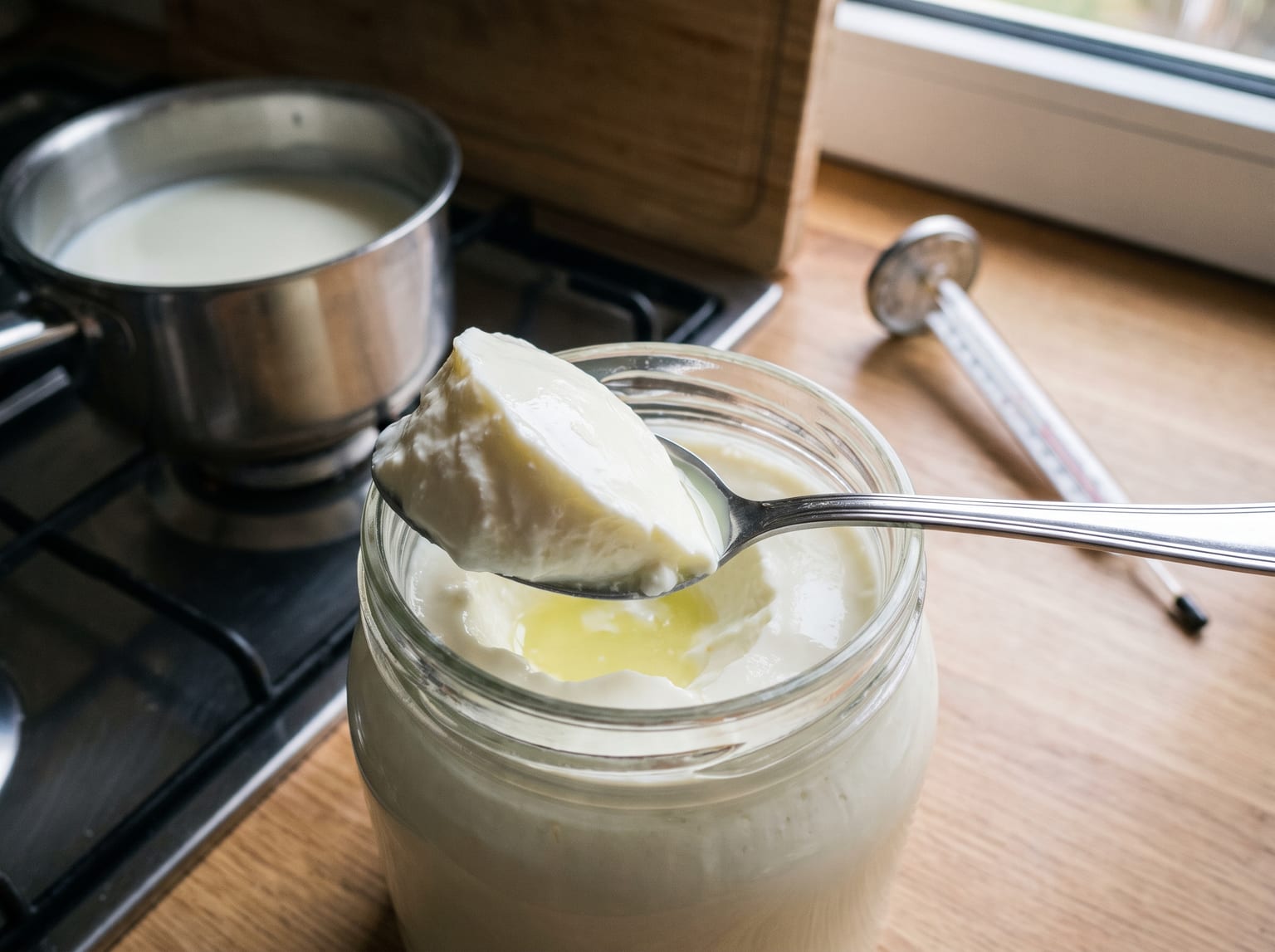
Homemade yogurt
Milk heated, cooled, stirred with a spoonful of live yogurt and left somewhere warm overnight. Two temperatures matter and nothing else does, and once you have made it once you will not buy it again.
Standard method, two temperatures and an overnight rest
Ingredients
Written for a 20 cm pot
Units
Temperature
Servings
Yogurt
- 1 L whole milk, not UHT if you can avoid it; the fresher the better rounded
- 40 g live yogurt, plain, with live cultures on the label, at room temperature rounded
- 30 g skimmed milk powder, optional, and the easiest way to a thicker set rounded
Dietary labels are a guide, not a guarantee. If you have an allergy, read the ingredients yourself.
Method
- Heat the milk to 85°C, stirring now and then so it does not catch, and hold it there for 10 minutes. This is not about killing anything. It unravels the whey proteins so they set into a network instead of staying loose, and it is the difference between thick yogurt and thin. Whisk in the milk powder now if you are using it.
- Cool to 43°C. A sink of cold water gets you there in about 10 minutes. Use a thermometer. This is the step that fails: above roughly 50°C the culture dies and nothing happens overnight.
- Temper the starter. Stir the live yogurt into a mugful of the warm milk until smooth, then stir that back into the pot. Adding cold yogurt straight into the pot gives you lumps.
- Pour into clean jars and keep them at 40 to 45°C for 8 to 12 hours. An oven with only the light on, a yogurt maker, a thermos, or a cool box with a bottle of hot water all work. Do not move or stir it while it sets.
- Chill for at least 4 hours before eating. It firms up considerably in the fridge and tastes sour and flat while still warm.
- Keep 40 g back in a clean jar as the starter for the next batch.
Notes
- Longer means sourer. Eight hours is mild, twelve is tangy, sixteen is sharp and closer to Balkan yogurt. Stop it when it tastes right to you by moving it to the fridge.
- The starter degrades. After about six or eight generations the culture gets sluggish and the set goes soft. Start again with a fresh shop pot when that happens.
- Whey is not waste. The clear liquid on top is protein. Stir it back in, or pour it off and use it in bread dough, smoothies or to cook grains in.
- Thicker without milk powder: strain it. Two hours in a muslin-lined sieve gives Greek-style, and overnight gives labneh, which is the recipe next door.
- UHT milk works and needs no heating step, because it has already been through worse. It sets softer and tastes flatter.
Ingredient substitutions
- Any live yogurt works as a starter as long as the label says live or active cultures. A tablespoon is plenty and more does not make it set faster.
- Freeze-dried culture from a brewing shop gives a more consistent result over many generations, which matters if you are making it weekly.
Sources consulted
Good with
Sources consulted
From Christoph Mayer