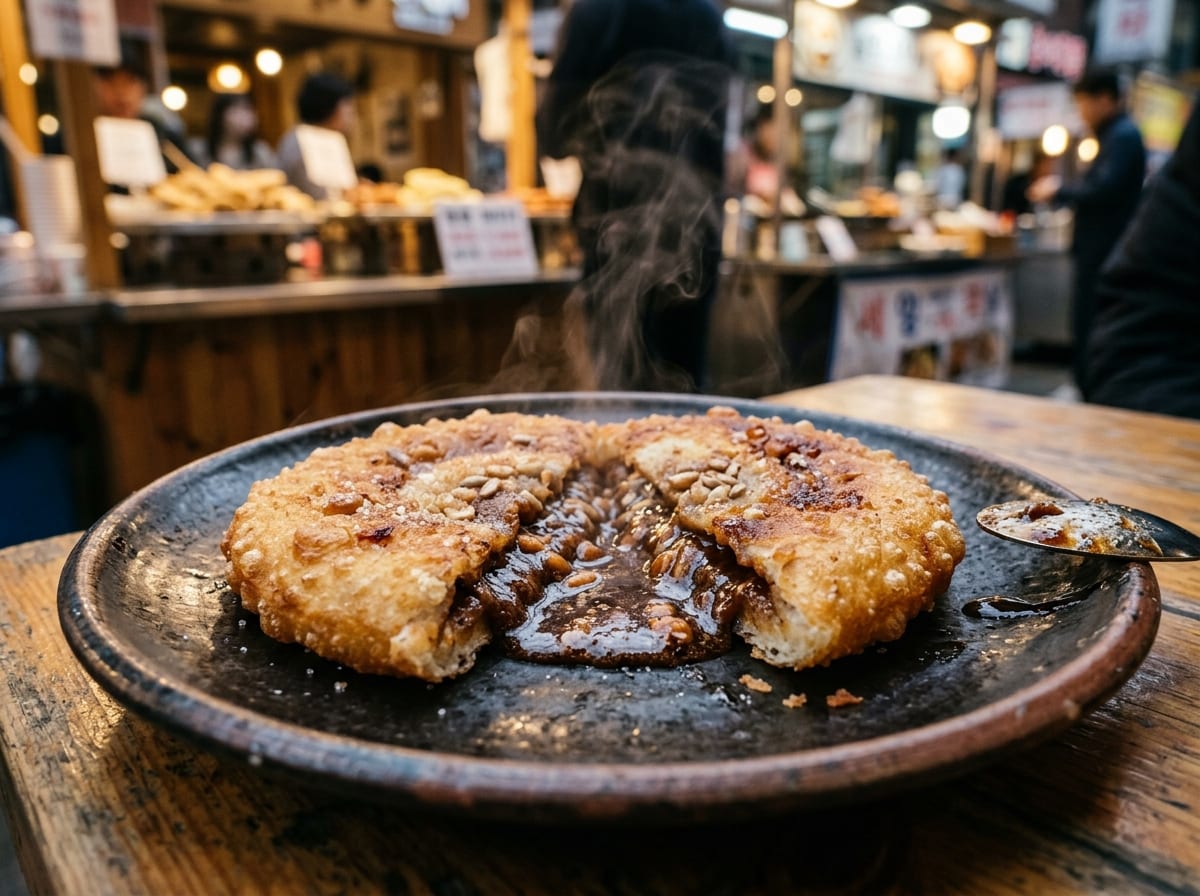
Hotteok (Korean sweet stuffed pancakes)
A yeasted dough with a little glutinous rice flour worked in, stuffed with brown sugar, cinnamon, and toasted nuts, then pressed flat and pan-fried until the crust turns deep gold and the filling goes molten. The hot street-cart snack sold across Korea, especially once the weather turns cold.
Dough ratios and filling amounts synthesized from three Korean home-cook recipes for hotteok
Ingredients
Written for a 28 cm pan
Dough
- 300 g all-purpose flour rounded
- 50 g glutinous rice flour, also sold as sweet rice flour or mochiko rounded
- 15 g granulated sugar rounded
- 7 g instant yeast, about 2¼ teaspoons rounded
- 6 g fine salt rounded
- 2 g baking powder, for a slightly lighter crumb (optional) rounded
- 300 ml lukewarm milk, or water rounded
- 15 ml neutral oil rounded
- 90 ml neutral oil, for pan-frying, plus more between batches rounded
Filling
- 100 g light brown sugar, packed rounded
- 3 g ground cinnamon, about 1 teaspoon rounded
- 8 g all-purpose flour, or fine breadcrumbs, keeps the melted filling from gushing straight out rounded
- 40 g roasted peanuts or walnuts, finely chopped rounded
Dietary labels are a guide, not a guarantee. If you have an allergy, read the ingredients yourself.
Method
- In a large bowl, whisk together the flour, glutinous rice flour, sugar, instant yeast, salt, and baking powder. Add the lukewarm milk and the oil and stir with a spoon or your hand until you get a soft, sticky dough with no dry flour left, about 2 minutes. Don’t knead it; this isn’t bread dough, and working it further does nothing useful.
- Cover the bowl and set it somewhere warm until doubled, 60 to 90 minutes.
- While the dough rises, stir together the brown sugar, cinnamon, flour, and chopped nuts for the filling in a small bowl.
- Oil your hands generously; the dough stays sticky the whole time you’re shaping it, and dry hands just fight you. Turn the dough out and divide it into 8 pieces, about 90 g each. Flatten one piece into a disk with a slight well in the middle, spoon in about 1½ tablespoons (20 g) of filling, then gather the edges up over the filling and pinch them together tightly to seal. This seal is the one place this recipe can go wrong: any gap and the melted sugar leaks straight into the hot oil the instant it hits the pan. Set it seam-side down on an oiled plate and repeat with the rest, letting the shaped pieces rest for 10 to 15 minutes while you heat the oil.
- Heat 2 to 3 tablespoons of the frying oil in a large skillet over medium-low heat. Working in batches of 2 or 3 so the pan isn’t crowded, set the hotteok seam-side down and cook for about 30 seconds, until the underside is just set enough to press.
- Flatten each one with an oiled spatula, a hotteok press, or the flat oiled bottom of a small saucepan, pressing gradually in two or three short pushes rather than one hard shove, until it’s about 1 to 1.5 cm thick and 10 to 12 cm across. Cook until the underside is deep golden, 1½ to 2 minutes, then flip. Press lightly again if it’s puffed back up, and cook the second side until it matches the first, another 1½ to 2 minutes.
- Lift onto a rack or plate and let each hotteok sit for a minute before anyone bites in; the filling is molten straight out of the pan and burns. Tear or bite from the edge rather than the middle first, so the built-up steam and syrup have somewhere to escape. Top up the oil between batches as the pan drinks it in, and repeat with the remaining dough.
Notes
- Peanuts or walnuts are the classic filling nuts, but sunflower seeds, pumpkin seeds, sesame seeds, or a mix of whatever’s in the cupboard all work. Keep the total around 40 g and chop it fine, so the filling spreads evenly through the pocket instead of pooling in one spot.
- The flour (or breadcrumbs) stirred into the filling isn’t traditional everywhere, but it keeps the sugar from going fully liquid and blowing the seal open in the pan. Leave it out only if you’re confident in your pinching technique.
- Hotteok are a straight-from-the-pan food. They firm up and the filling sets within about twenty minutes, and while a dry skillet reheat gets most of the crust back, it’s never quite as crisp as the first round. Fry only as many as you’re about to eat.
- Skip freezing the fried hotteok; the filling weeps as it thaws and soaks the crust soft from the inside out.
Sources Consulted
- Korean Bapsang, “Hotteok (Sweet Korean Pancakes)”
- Beyond Kimchee, “Easy Hotteok Recipe (Korean Sweet Pancakes)”
- Maangchi, “Sweet pancakes with brown sugar syrup filling (Hotteok)”
Korean Bapsang and Beyond Kimchee both cut a little glutinous rice flour into the all-purpose flour for a chewier crust, while Maangchi's simpler version uses all-purpose flour alone; this recipe keeps the rice flour. The flour stirred into the filling is Beyond Kimchee's tip for taming the molten sugar so it doesn't blow the seal open in the pan the moment it hits the oil. Quantities were harmonized across all three sources and scaled to 8 pieces; wording is original.
From Christoph Mayer