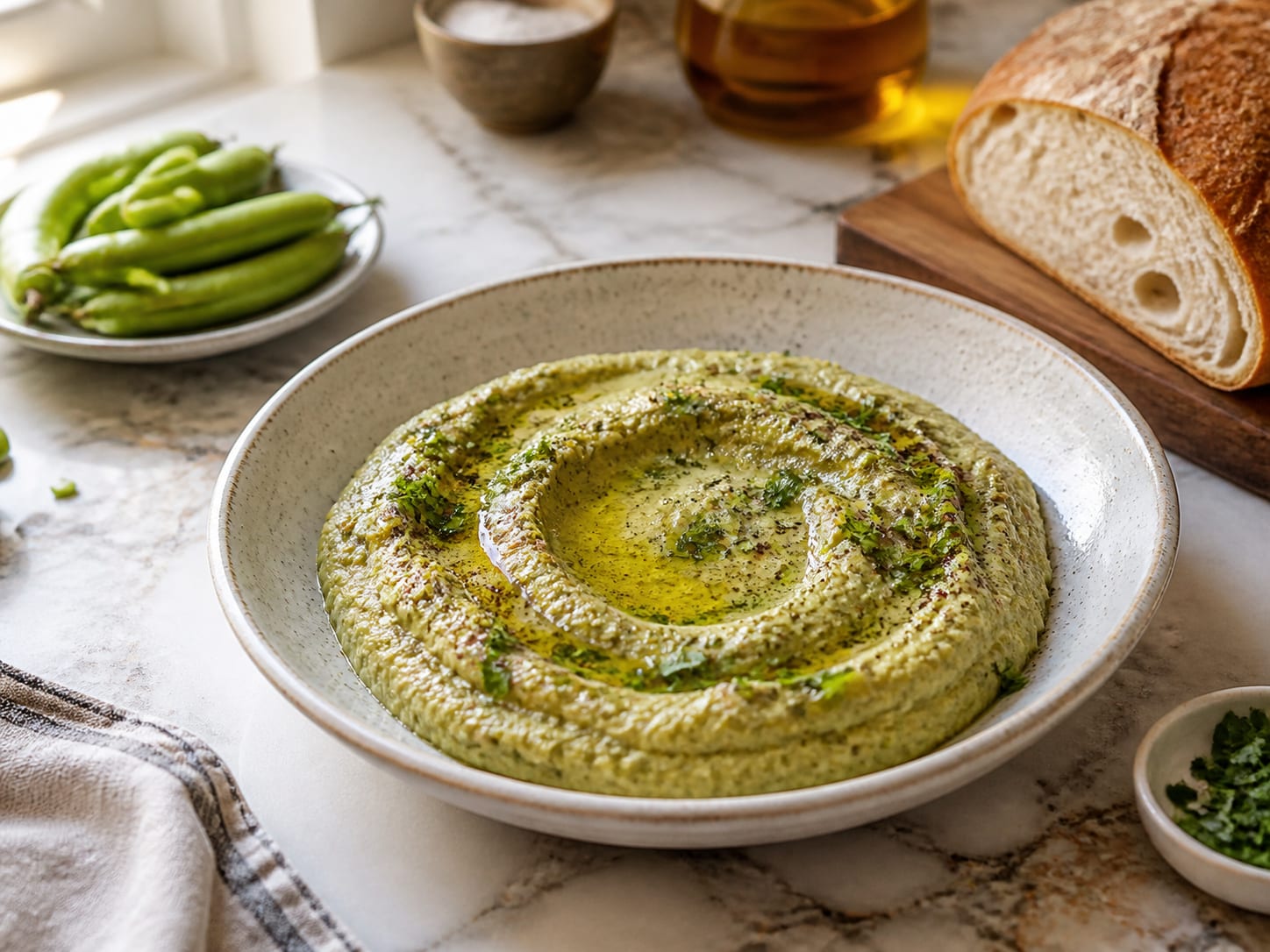
Hummus aus dicken Bohnen (fava bean hummus)
A hummus built on fava beans instead of chickpeas, the beans double-peeled, once from their tough outer pod and again from the thick individual skin around each bean, since the inner skin left on gives the finished spread a distinctly grainy, bitter edge no amount of blending fixes. Blending the beans while still warm from cooking is what gives this hummus its notably smooth texture compared to blending them cold.
Prep30 min
Cook15 min
Servings4
Christoph's fava bean hummus, the beans double-peeled and blended while still warm for a smooth texture.
Ingredients
Written for a 2 L pot
Units
Temperature
Servings
Hummus
- 500 g fresh fava beans in the pod, or 300 g shelled rounded
- 80 g tahini rounded
- 30 ml lemon juice rounded
- 1 garlic clove rounded
- 30 ml olive oil rounded
- 40 ml warm cooking water rounded
- to taste fine salt rounded
Dietary labels are a guide, not a guarantee. If you have an allergy, read the ingredients yourself.
Method
- Shell the fava beans from their pods. Bring a pot of salted water to a boil and cook the beans for 2 minutes. Drain and rinse briefly under cold water, just enough to handle them.
- Peel each bean by pinching the skin and squeezing the bright green bean out, discarding the tough outer skins.
- Return the peeled beans to a pot with fresh water. Simmer for 10 to 12 minutes, until fully tender and easily mashed. Reserve some of the cooking water, then drain.
- While the beans are still warm, blend with the tahini, lemon juice and garlic until mostly smooth.
- With the blender running, drizzle in the olive oil and warm cooking water, blending until completely smooth and creamy. Season with salt.
Notes
- Peel the beans twice: from the pod, then from the individual skin. The thick inner skin around each fava bean is genuinely tough and slightly bitter; leaving it on gives the finished hummus a grainy texture and off-flavour that no amount of blending removes.
- Blend the beans while they’re still warm from cooking. Warm beans blend noticeably smoother than cold ones, since the starches are still soft and pliable; letting them cool first makes for a grainier result.
- Use the reserved warm cooking water, not cold tap water, to thin the mixture. It helps the blend come together smoothly rather than seizing when cold liquid hits warm bean paste.
- It keeps for 4 days in the fridge, though the bright green colour dulls slightly over time.
Ingredient substitutions
- Frozen, pre-shelled fava beans work well if fresh ones in the pod aren’t available; you’ll still need to peel the individual skins.
- A pinch of cumin blended in is a nice addition.
- Top with a drizzle of olive oil, chopped mint, or a scattering of dukkah before serving.
From Christoph Mayer