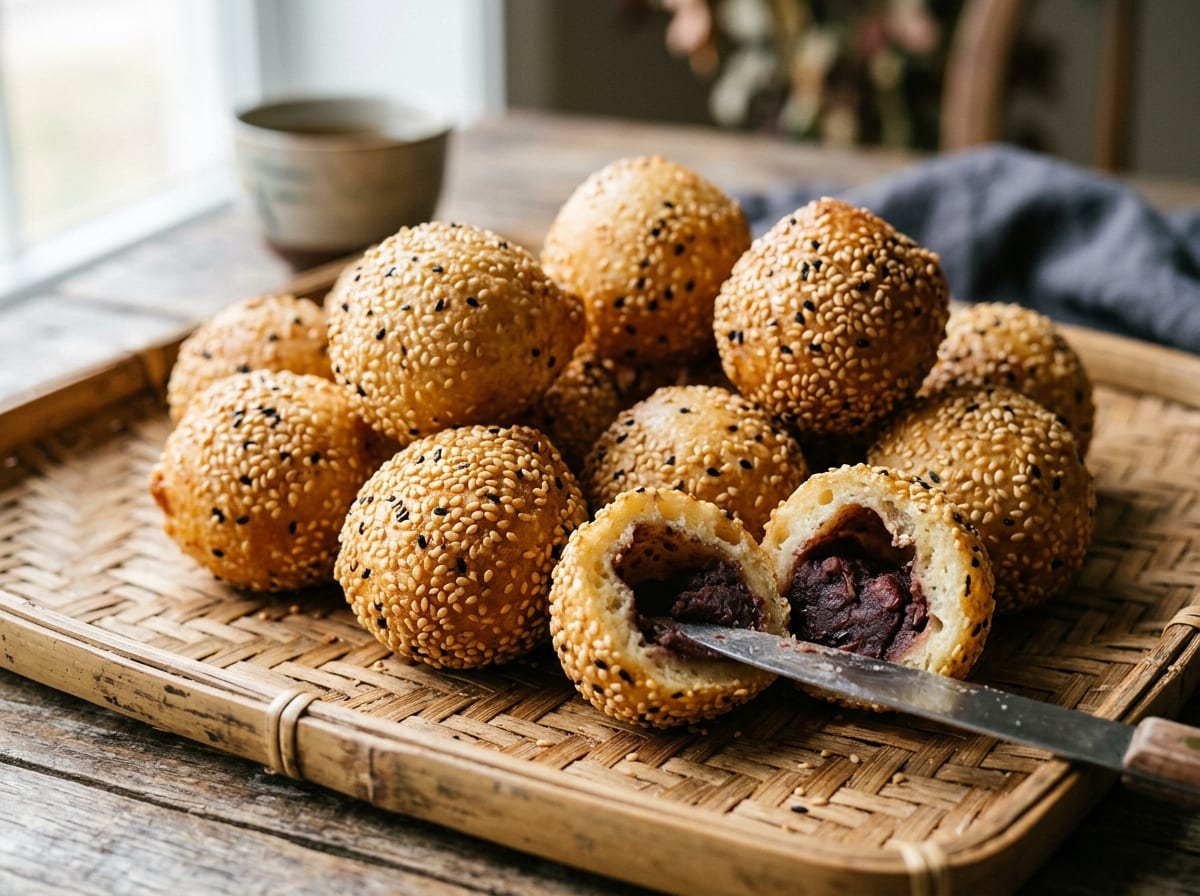
Jian Dui
Glutinous rice dough kneaded with hot sugar syrup, wrapped around sweet red bean paste, rolled in sesame seeds, and deep-fried in two stages, low then high, until the shell blisters gold and the middle puffs hollow from trapped steam. A round, gilded good-luck sweet for Lunar New Year.
Reconciled from the syrup-dough and two-stage frying method at Taste of Asian Food, the gentle-press submerging technique and cooked-dough tip at China Sichuan Food, quantities cross-checked against Sous Chef UK, and background on fillings and Lunar New Year symbolism from Wikipedia.
Ingredients
Written for a 3 L pot
Dough
- 300 g glutinous rice flour, also sold as sweet rice flour or mochiko; regular rice flour has no stretch and will not work rounded
- 90 g granulated sugar, for the syrup rounded
- 190 ml boiling water, for the syrup rounded
Filling and coating
- 260 g sweetened red bean paste, store-bought or homemade; lotus seed paste or sweetened peanut paste work the same way rounded
- 100 g raw white sesame seeds, more than you will use; a shallow dish needs volume for an even coating rounded
Frying
- 1 1/3 L neutral frying oil, enough for 6 cm depth in a heavy pot or wok, roughly 1.3 L in a 20 to 22 cm pot rounded
Dietary labels are a guide, not a guarantee. If you have an allergy, read the ingredients yourself.
Method
- Make the syrup. In a small saucepan or heatproof jug, dissolve the sugar completely in the boiling water, stirring until no grains remain.
- Pour the hot syrup into the glutinous rice flour and stir with a spoon until it’s cool enough to handle. Knead by hand for a few minutes until you have a soft, smooth, slightly tacky dough, about the give of an earlobe. Cover with a damp cloth and rest for 20 minutes; this lets the flour finish hydrating and makes the dough far easier to wrap without cracking.
- While the dough rests, divide the red bean paste into 14 portions of about 18 g each and roll each into a smooth ball. If the paste is very soft, chill it for 10 minutes first so it holds its shape.
- Divide the dough into 14 pieces of about 40 g each, keeping the pieces you aren’t working with under the damp cloth. Flatten one piece into a disc about 6 cm across, thinner at the edge than the center. Set a ball of filling in the middle, then gather the dough up and around it, pinching the edges together at the top and rolling gently between your palms until it’s a smooth, fully sealed sphere with no visible seam. A weak seam, or a pocket of trapped air folded in while wrapping, is where a ball splits open in the oil, so take the extra few seconds to check it.
- Fill a small bowl with water. Dip each sealed ball briefly to moisten the surface, then roll it in the sesame seeds, pressing gently all over so they coat evenly and hold. Set the finished balls on a tray without letting them touch.
- Pour the oil into a heavy pot or wok to a depth of about 6 cm and heat it to 130°C. Without a thermometer, a wooden chopstick dipped in should raise a slow, steady stream of small bubbles, not an aggressive fizz.
- Working in batches of 4 or 5 so the pot isn’t crowded, lower the balls in gently. Fry at 120 to 130°C for 5 to 6 minutes, using a slotted spoon to press each ball very gently under the surface every 30 seconds or so and roll it over. This is what makes them puff evenly all the way round rather than blistering on one side; don’t press hard, just enough to submerge and turn it. They’ll start to rise, expand, and eventually roll over on their own as the trapped steam pushes the dough outward.
- Once the balls have puffed to roughly double their size and are floating and turning mostly unassisted, raise the heat and bring the oil up to 170 to 175°C. Fry for a further 2 to 3 minutes, turning occasionally, until the shell is a deep, even gold all over and sounds faintly hollow when tapped.
- Lift the balls out with a slotted spoon and drain briefly on a rack or kitchen paper. Serve warm, or at room temperature within a few hours; the shell is at its crispest in the first hour and softens as it sits.
Notes
- Why the two-stage heat matters. Frying at a single high temperature sets and browns the shell before the trapped steam has had time to expand the dough, so the balls stay dense, crack along a seam, or burst outright once the steam finally forces its way out. Starting low and gentle-pressing lets the whole ball soften and balloon evenly first; the final blast of higher heat is only there to colour and crisp what has already puffed.
- The gentle press, not a hard one. The point of pressing the balls under the oil with a spoon is to keep the whole surface submerged and rotating, so steam pressure builds evenly on all sides. A ball left floating on one side puffs unevenly, and the thinner, drier side is the one that cracks. Press just enough to dunk and turn it; you are not trying to flatten it.
- Sealing is the other half of the job. Any gap in the dough around the filling, or a pocket of air folded in while wrapping, becomes the weak point where steam escapes explosively instead of pushing the dough out evenly. Take the time to pinch the seam fully closed and roll the ball smooth before it goes anywhere near the sesame seeds.
- Filling swaps. Sweetened red bean paste is the everyday filling; lotus seed paste is the more formal, banquet version, and sweetened peanut or black sesame paste both work at the same weight. Keep whatever you choose slightly firm rather than runny, or it will be hard to wrap.
- Storage. Best eaten the day they are fried. They will keep airtight at room temperature overnight and can be re-crisped in a 160°C oven or air fryer for 3 to 4 minutes; the microwave makes them chewy and dense instead. Shaped, sesame-coated, unfried balls also freeze well on a tray and then bagged; fry them straight from frozen, adding a minute or two to the low-heat stage.
- Why they are lucky. Round and gold, and growing bigger as they fry: jian dui are eaten at Lunar New Year for exactly those three reasons, unity, prosperity, and rising fortune in the year ahead.
Sources Consulted
- Taste of Asian Food: Sesame Balls (Jian Dui)
- China Sichuan Food: Sesame Balls, Jian Dui
- Sous Chef UK: Jian Dui, Stuffed Sesame Balls Recipe
- Wikipedia: Jian dui
Dough and filling ratios are a composite of several published quantities, scaled to a mid-size batch of about 14 balls; the staged frying temperatures follow Taste of Asian Food and China Sichuan Food most closely.
From Christoph Mayer