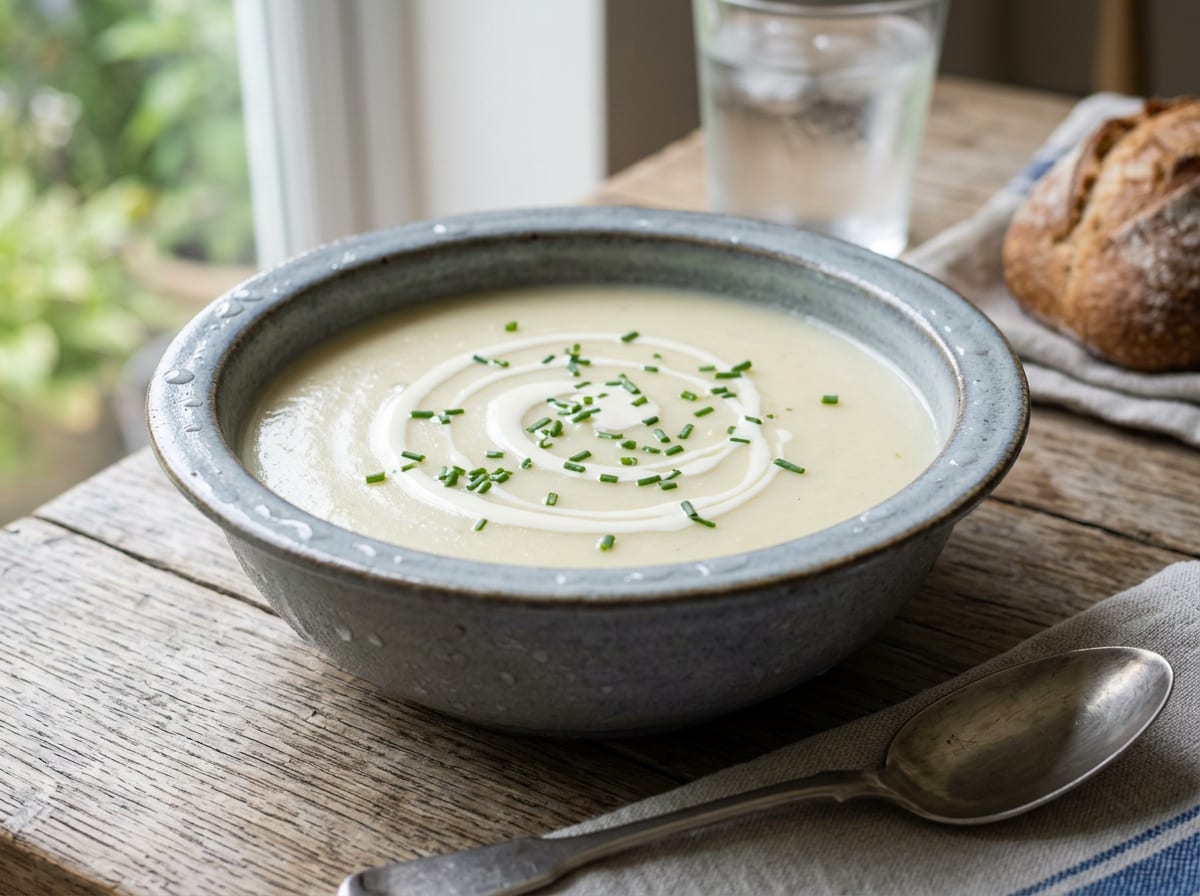
Kalte Kartoffel-Porree-Suppe (chilled potato leek soup)
A chilled, fully smooth potato and leek soup in the vichyssoise style, blended silky rather than left with texture, then rested cold for a few hours so the flavour settles before serving. Chives at the end are not a garnish so much as the missing top note.
Prep20 min
Cook25 min
Rest240 min
Servings4
Christoph's version of the classic French chilled leek and potato soup, written for a hot afternoon rather than a first course at a formal dinner.
Ingredients
Written for a 4 L pot
Units
Temperature
Servings
Soup
- 40 g butter rounded
- 300 g leek, white and light green parts, sliced rounded
- 100 g onion, chopped rounded
- 500 g floury potatoes, peeled, in 2 cm chunks rounded
- 900 ml vegetable broth rounded
- 150 ml cream rounded
- to taste fine salt rounded
- to taste freshly ground white pepper rounded
- to taste freshly grated nutmeg rounded
To serve
- 15 g chives, finely sliced rounded
Dietary labels are a guide, not a guarantee. If you have an allergy, read the ingredients yourself.
Method
- Melt the butter in a 4 litre pot over medium heat and sweat the leek and onion with a pinch of salt for 8 minutes, until soft but not coloured. Any browning here will show up as an off, roasted note in a soup meant to taste clean.
- Add the potatoes and broth. Bring to a simmer, then turn down until it barely bubbles.
- Simmer 20 minutes, until a knife slides into a potato chunk with no resistance.
- Blend until completely smooth, in batches in a blender if working by hand, longer than feels necessary. Any graininess left now will still be there cold, when it is far more noticeable.
- Stir in the cream, then season with salt, white pepper and nutmeg. Season it slightly more assertively than tastes right while warm; cold food reads as blander.
- Chill at least 4 hours, covered, until fully cold. Taste again once chilled and adjust; the seasoning almost always needs a top-up.
- Serve cold, with chives scattered over each bowl at the table.
Method in the Thermomix
Written for a TM5 or TM6, 2.2 litre bowl.
- Leek and onion into the dry bowl, in rough pieces. Chop 4 sec / speed 5.
- Add the butter. Sauté 8 min / 120 °C / speed 1, measuring cup off, until soft with no colour.
- Add the potatoes and broth. Cook 20 min / 100 °C / speed 1, measuring cup on.
- Blend until silky, working up gradually to 1 min / speed 8. Stop and scrape the sides down once if needed; the goal is a texture with no trace of graininess.
- Add the cream, salt, white pepper and nutmeg. Mix 10 sec / speed 3 to combine. Season slightly heavier than tastes right while warm, then transfer to a container and chill.
- Chill at least 4 hours, then taste cold and correct before serving with chives scattered over.
Notes
- Do not let the leek and onion take on any colour. This is meant to be a pale, clean-tasting soup, and any browning reads as an unwanted roasted note once the soup is cold and the flavours are more exposed.
- Season for cold, not for warm. Chilling mutes both salt and seasoning, so taste and adjust again after the soup has fully chilled, not just once while it is still hot from the blender.
- It keeps well for 2 days in the fridge, covered, and the flavour if anything improves overnight as the leek settles into the potato base.
- A swirl of olive oil over the top at serving, alongside the chives, is a common and welcome addition if there is good oil in the house.
Ingredient substitutions
- Cream can be reduced or left out entirely for a lighter soup; the potato alone gives it enough body to hold together.
- Vegetable broth keeps this vegetarian; a light chicken broth is the more classical French choice and gives a rounder finish.
- Chives can be replaced with finely sliced spring onion tops for a similar bite, or dill for a different, slightly sweeter direction.
- For a warm version, simply serve it straight from step 5 without chilling; it is a good soup either way, though the balance of seasoning shifts slightly warm versus cold.
From Christoph Mayer