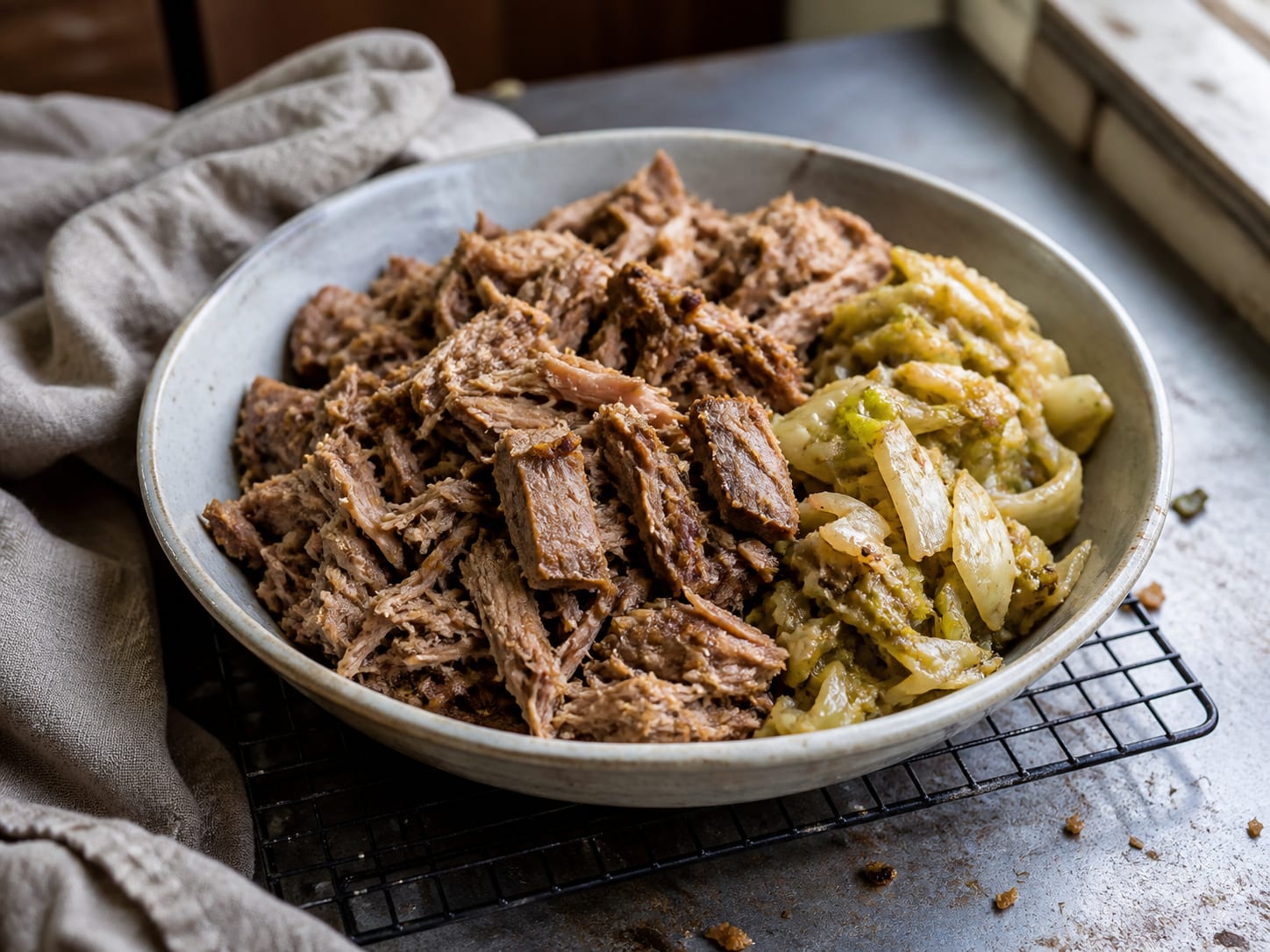
Kalua pork
A whole boneless pork shoulder dry-salted, wrapped, and slow-roasted until it shreds apart, finished with cabbage sautéed in the rendered juices.
Adapted from Hawaiian home-cooking references on kalua pork's imu origins and its oven adaptation, not represented as personally tested
Ingredients
Written for a 23 × 33 cm dish
Units
Temperature
Servings
Kalua pork
- 1 3/4 kg boneless pork shoulder, also sold as pork butt or Boston butt; cut into 2 or 3 large chunks rounded
- 25 g coarse Hawaiian sea salt, or any coarse sea salt rounded
- 15 ml liquid smoke rounded
- 4 banana leaves, thawed if frozen, plus heavy-duty foil to wrap over them; use two layers of foil alone if leaves are unavailable rounded
- 250 ml water, for the roasting dish, to keep the oven humid rounded
Cabbage finish
- 600 g green cabbage, shredded rounded
- 15 g neutral oil, or reserved pork drippings rounded
- 3 g fine salt, to taste rounded
Dietary labels are a guide, not a guarantee. If you have an allergy, read the ingredients yourself.
Method
- Salt the pork. Cut the pork shoulder into 2 or 3 large chunks so the salt reaches every side evenly. Rub the 25 g coarse salt over all surfaces, pressing it in. Let the meat sit at room temperature for 30 to 45 minutes, or for deeper flavor, cover and refrigerate for 8 to 24 hours, then let it lose its chill for about 30 minutes before wrapping.
- Wrap. Drizzle the liquid smoke evenly over the salted chunks. Lay the banana leaves shiny side down, overlapping them so they fully enclose the meat, and wrap tightly. Wrap the bundle again in heavy-duty foil to seal in the juices and smoke. If banana leaves aren’t available, wrap the salted, liquid-smoke-drizzled pork in two layers of heavy-duty foil alone.
- Slow roast. Set the wrapped pork seam-side down in the roasting dish. Pour the water around the bundle, not over it, to keep the oven humid, then cover the dish tightly with foil. Roast at 150°C for about 5 to 6 hours, until the internal temperature reaches 96°C, the standard target for a fully shreddable shoulder and well past food-safety minimums. Because the mass carries over roughly 3°C once out of the oven, pull the roast at around 93°C.
- Rest. Let the wrapped pork rest for 20 minutes before opening, so carryover cooking finishes and the juices settle. Unwrap it over the dish or a bowl to catch every bit of the rendered juices and fat.
- Shred. Discard the leaves and foil. Shred the pork with two forks, pulling out and discarding any large pieces of fat. It’s ready when it shreds apart easily and offers no resistance at the thickest part. Moisten the shredded meat with a few spoonfuls of the reserved juices and season with more salt if needed.
- Finish the cabbage. Skim a spoonful of fat from the reserved juices, or use the 15 g oil, and heat it in a wide pan over medium-high. Add the shredded cabbage and the 3 g fine salt, and sauté for 5 to 7 minutes, tossing often, until just wilted and lightly caramelized at the edges but still with some bite. Serve the pork over or alongside the cabbage, spooning any remaining juices over the top.
Notes
- This is a home-oven adaptation of the imu-pit method, not a literal reproduction. The imu builds flavor over hours underground on hot lava rocks, with banana or ti leaves protecting and lightly perfuming the meat; the wrap-and-steam oven method and a small amount of liquid smoke approximate that character without the pit.
- This freezes and reheats very well. Cool the shredded pork completely, portion it with a little of the reserved juices to keep it moist, and freeze airtight for up to 3 months. Thaw overnight in the fridge and reheat covered with a splash of water or broth at 160°C until hot throughout, or warm it gently in a pan.
- Slow-cooker alternative: skip the leaf wrap. Rub the pork with the salt and liquid smoke, place it in the slow cooker with 120 ml water, and cook on low for 8 to 10 hours, until it reaches 96°C and shreds easily. The result is wetter and more braise-like than the oven’s firmer roast texture; shred it the same way and finish the cabbage separately in a pan.
- A traditional whole pig cooks for 6 to 8 hours in the imu. This oven timeline of 5 to 6 hours is shorter because a single shoulder is a far smaller mass of meat, but it targets the same shreddable texture.
- The longer, refrigerated salt rest in step 1 deepens penetration and flavor, but a short 30-minute room-temperature rest still works well if time is tight.
Ingredient substitutions
- The imu traditionally wraps the pig in ti leaves, with banana leaves as an accepted alternative, laying it over hot lava rocks and rubbing the meat with true alaea, Hawaiian red volcanic clay sea salt.
- In Germany and Canada, frozen banana leaves are commonly available at Asian and Latin American grocers in both regions and work well as a stand-in for the wrapping and light aroma. Ti leaves are botanically different from banana leaves, so this is a practical substitution for the wrapping function, not a flavor-identical swap.
- Alaea sea salt can be ordered online in both regions. Otherwise substitute any coarse sea salt; you lose alaea’s mineral, faintly earthy character and reddish tint, which is a coloring and mineral-flavor difference rather than a functional one.
- Liquid smoke stands in honestly for the kiawe-wood pit smoke the imu provides. It’s a concentrated flavoring, so use it sparingly, and it’s available at well-stocked grocers or online in both regions.
- If pork shoulder isn’t labeled that way at the counter, ask for pork butt or Boston butt, the same cut sold under a different name.
Sources consulted
- Onolicious Hawaiʻi: 3-Ingredient Kalua Pork
- Chili Pepper Madness: Easy Kalua Pork, Hawaiian-Style, Oven or Slow Cooker
- Polynesian Cultural Center: Traditional Hawaiian Kalua Pork, 4 Ways to Cook It
- Wikipedia: Kālua
Sources consulted
From Christoph Mayer