Kartoffelsuppe
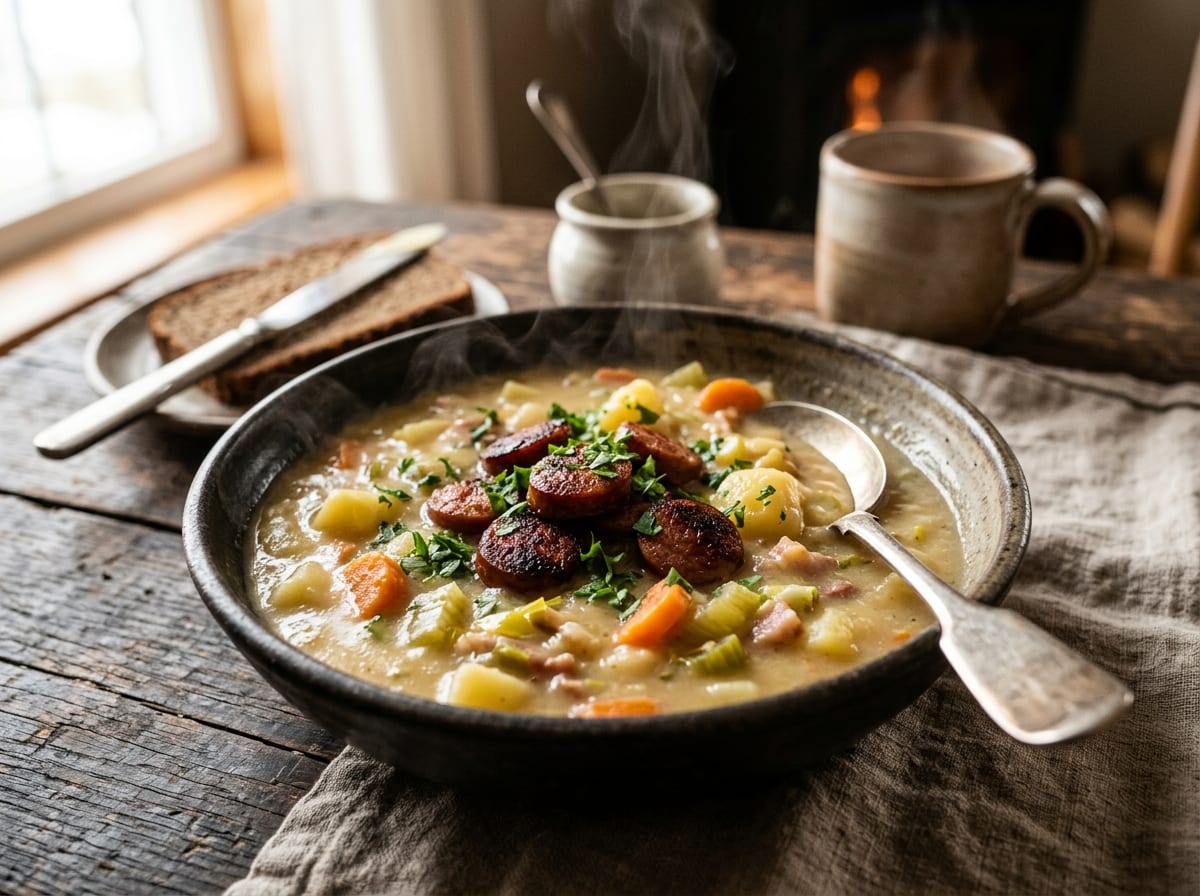
The German potato soup, thickened by nothing but its own potatoes. Floury potatoes, soup greens and a bay leaf, part of it blended and part of it left in pieces, so every spoon has something to chew. Marjoram is what makes it taste German rather than merely of potato.
Christoph's own version, written to fill the gap left by every German household having its own. The ratio of blended to chunky, and the insistence on marjoram, are the opinions here.
Ingredients
Written for a 4 L pot
Soup
- 800 g floury potatoes, peeled, in 2 cm chunks; the variety matters more than anything else here rounded
- 250 g soup greens, one bunch: carrot, celeriac and leek, roughly equal rounded
- 150 g onion, finely chopped rounded
- 30 g butter rounded
- 1 1/6 L vegetable broth, well seasoned; this is most of the flavour rounded
- 1 bay leaf rounded
- 2 g dried marjoram, not oregano, not thyme; marjoram is the flavour of this soup rounded
- 100 ml cream, optional, but it rounds the edges (optional) rounded
- to taste fine salt rounded
- to taste freshly ground white pepper rounded
- to taste freshly grated nutmeg rounded
To serve
- 15 g flat-leaf parsley, chopped, at the table rounded
- 4 Wiener or Bockwurst sausages, optional; sliced and warmed through in the finished soup (optional) rounded
Dietary labels are a guide, not a guarantee. If you have an allergy, read the ingredients yourself.
Method
- Melt the butter in a 4 litre pot over medium heat and sweat the onion with a good pinch of salt until it is translucent and smells sweet, about 6 minutes. Do not colour it. Browned onion turns this into a different, darker soup.
- Add the soup greens, diced small, and sweat another 5 minutes. They should soften but stay pale.
- Potatoes, broth, bay leaf and marjoram in. The liquid should sit about a centimetre above the potatoes. Bring it to a simmer, then turn it down until the surface is barely moving.
- Simmer 20 minutes, until a knife tip slides into a potato chunk and it drops off the blade on its own. This is the only step where you can ruin the soup by hurrying: underdone potatoes will not thicken it.
- Fish out the bay leaf. Blend roughly half the soup: either lift a few ladles into a blender, or use a stick blender in short bursts down one side of the pot. What you want is a thick base with whole pieces still in it, not a smooth purée. This is the whole texture of the dish.
- Stir the cream in off the heat, then season hard: salt, white pepper, and more nutmeg than feels sensible. Potato soup takes a lot of salt and tastes flat without it. Taste, adjust, taste again.
- If you are using sausage, slice it in and let it warm through for 3 minutes without boiling. Parsley goes on at the table, not in the pot.
Method in the Thermomix
Written for a TM5 or TM6, 2.2 litre bowl. This makes the full 4 portions, which is close to the bowl’s working limit for a liquid soup, so scale down if yours is a TM31.
- Onion and soup greens into the dry bowl, in rough chunks. Chop 5 sec / speed 5, then scrape the sides down. The machine will take these much finer than a knife would.
- Add the butter. Sauté 5 min / 120 °C / speed 1, measuring cup off so the water leaves. This is the step people skip, and it is the one that stops the soup tasting raw.
- Add the potatoes in 2 cm chunks, the broth, bay leaf and marjoram. Cook 20 min / 100 °C / speed 1, measuring cup on, with the simmering basket sat on the lid instead of the cup if it threatens to spit.
- Remove the bay leaf. Now the important part: blend only briefly, about 4 sec / speed 4. A Thermomix will take this to a smooth purée in ten seconds flat and you cannot undo it. You are aiming to break down roughly half. If in doubt, do 3 seconds, look, and go again.
- Cream, salt, white pepper and nutmeg in. Mix 10 sec / speed 2. Taste through the hole in the lid and correct. It will need more salt than you expect.
- Sausage, if using, sliced, then 3 min / 90 °C / reverse / speed 1 so it warms without being chopped up. Reverse blade is not optional here.
Notes
- Floury potatoes or nothing. Waxy varieties hold their shape and refuse to give up starch, so you end up with potato chunks floating in broth and no body at all. In Germany look for mehligkochend; elsewhere, Russets or Maris Piper.
- Marjoram is not a garnish, it is the point. It is what separates German potato soup from every other potato soup. Dried is correct here and better than fresh, which loses its character in a long simmer.
- Season at the end, not the beginning. The broth reduces and concentrates, so salt added early lands you somewhere you did not intend.
- It is better on the second day and it thickens overnight in the fridge. Loosen it with a splash of broth rather than water, which dilutes the seasoning along with the texture.
- It freezes badly if you have added cream, which splits on thawing. Freeze it before step 6 and add the cream when you reheat.
Ingredient substitutions
- Soup greens as a ready-tied bunch is a German convenience. Without it, use 100 g carrot, 80 g celeriac and 70 g leek. Celeriac is the one to keep if you can only find one. Parsnip is the nearest stand-in, though it is sweeter.
- Vegetable broth keeps it vegetarian. Beef or chicken broth makes it rounder and is the more traditional choice in most households.
- Cream can be crème fraîche for a slight tang, or left out entirely. Without it, blend a little more of the soup to compensate for the body you lose.
- For a vegan version, use oil instead of butter and oat cream instead of dairy, and skip the sausage. It stands up well, because the structure comes from potato starch rather than fat.
Good with
From Christoph Mayer