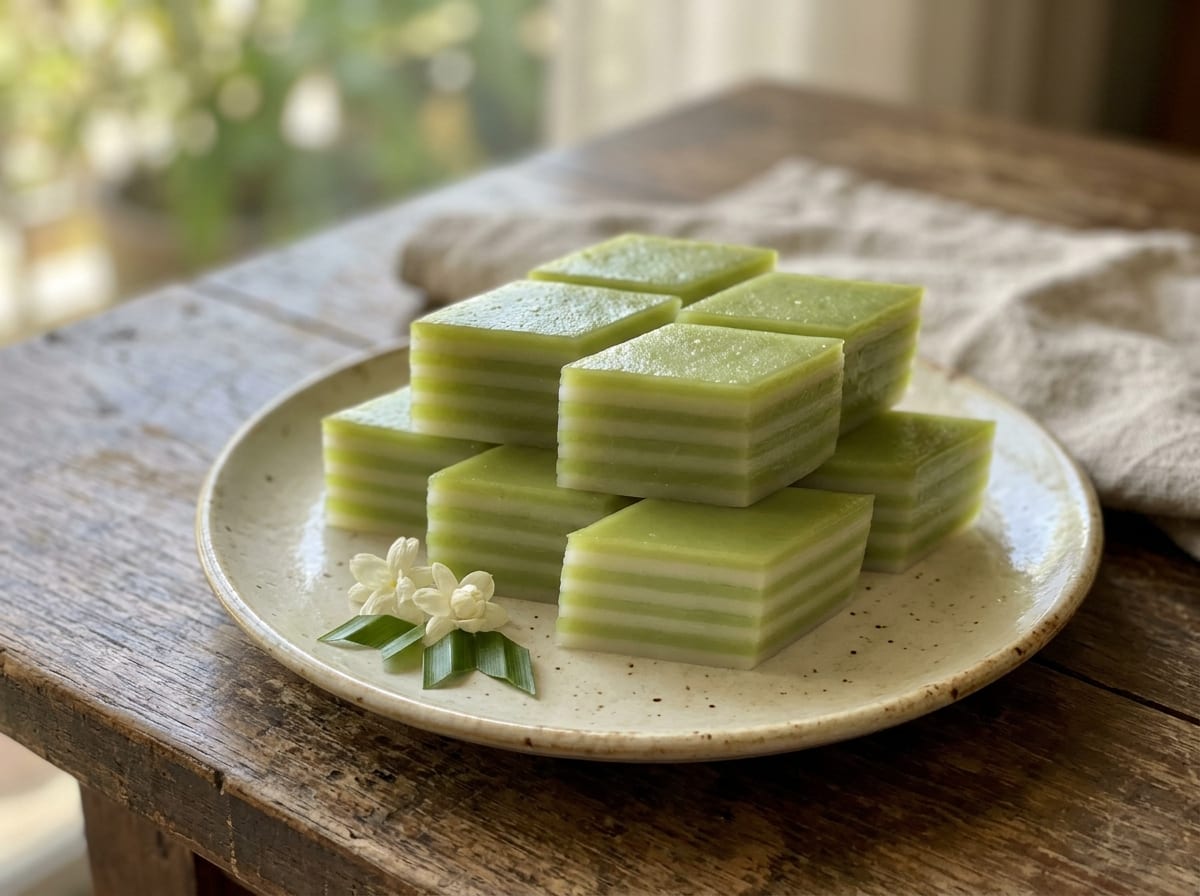
Khanom Chan (Thai nine-layer coconut-pandan cake)
A softly springy Thai steamed dessert built one thin layer at a time, alternating pandan-green and coconut-white, traditionally nine layers for good fortune at weddings.
Adapted from Hungry in Thailand's khanom chan and Rachel Cooks Thai's layered dessert, scaled up for a 20×20 cm dish
Ingredients
Written for a 20 × 20 cm dish
Batter
- 100 g rice flour rounded
- 300 g tapioca starch, fine tapioca starch, not pearls rounded
- 100 g arrowroot starch, or extra tapioca starch if you cannot find it rounded
- 500 g granulated sugar rounded
- 6 g fine salt rounded
- 1 L full-fat coconut milk, canned, well shaken rounded
Pandan colour
- 20 ml pandan extract or paste, from an Asian grocer; brands vary hugely in strength, so add gradually rounded
- 30 g tapioca starch, extra, stirred into the pandan half only, to match the thickness of the white layers rounded
Dietary labels are a guide, not a guarantee. If you have an allergy, read the ingredients yourself.
Method
- Warm the coconut milk, sugar, and salt in a saucepan over low heat, stirring just until the sugar dissolves. Do not let it boil. Remove from the heat and let it cool to room temperature.
- Whisk the rice flour, 300 g tapioca starch, and arrowroot starch together in a large bowl. Whisk in the cooled coconut milk mixture in stages until smooth, then strain through a fine sieve to catch any lumps.
- Weigh the batter and divide it evenly between two bowls. Leave one bowl plain, this is the coconut layer. Stir the pandan extract and the extra 30 g tapioca starch into the other bowl until the colour is even with no pale streaks, this is the pandan layer.
- Lightly oil a 20×20 cm dish that fits inside your steamer with headroom above it. Bring the steamer water to a full boil, and wrap the underside of the lid in a clean tea towel so condensation does not drip onto the layers.
- Steam the empty dish for 2 minutes to warm it. Stir the pandan batter well, since the starch settles fast, and ladle in a scant 200 ml, just enough to thinly and evenly coat the base. Cover and steam over high heat for 5 to 7 minutes, until the layer turns from glossy and liquid to matte and set, and springs back when touched.
- Stir the coconut batter and ladle another thin, even layer directly over the set pandan layer. Steam the same way, 5 to 7 minutes, until set.
- Keep alternating pandan and coconut layers, stirring each batter before every pour, until all nine layers are steamed. Finish on a pandan layer for the traditional look. Let the final layer steam a couple of minutes longer than the others to be sure it is fully set through.
- Turn off the heat and let the khanom chan cool completely in the dish at room temperature, then refrigerate uncovered for at least 4 hours, or overnight. Chilling is what lets you cut clean layers rather than a green-and-white smear.
- Run a thin knife around the edge, turn the whole cake out onto a board, and cut into small diamonds with an oiled knife, wiping the blade clean between cuts.
Notes
- On pandan. Fresh pandan leaves are the traditional colouring and flavouring here, and give a grassy, faintly vanilla note that nothing else fully replicates. They are essentially impossible to buy fresh in Germany outside a handful of specialist Southeast Asian shops, and even then it is hit or miss. Pandan extract or paste, sold in small bottles at most Asian grocers, is the practical stand-in this recipe is written around; taste and look for a vivid green before committing the full amount, since concentration varies a lot by brand. If you do get hold of fresh leaves, blend about 100 g roughly chopped leaves with 200 ml water, strain hard through a muslin cloth or clean tea towel, and use that juice in place of the extract, adjusting the coconut milk down a little since the juice adds extra liquid. If pandan is entirely unavailable, you can colour the coconut layer green with a scant 1/2 teaspoon of matcha powder or a pinch of spirulina instead. Be honest with yourself that this only fixes the colour: the dessert will look the part but taste like a plainer, more generic coconut layer cake rather than khanom chan.
- Every layer needs to actually set, glossy and wobbly is not done yet, before you pour the next one, or the layers will bleed into each other and the cross-section will look muddy instead of striped.
- Keeps refrigerated, covered, for up to 4 days. Serve cold or at cool room temperature; the texture firms up noticeably straight from the fridge and softens again after 15 to 20 minutes out.
- This does not freeze well, the starch gel turns grainy and weeps on thawing.
Sources Consulted
- Hungry in Thailand, “Khanom Chan Recipe (Authentic Thai Layer Cake)”
- Rachel Cooks Thai, “Khanom Chan (Thai Layered Dessert)”
Quantities and pan size scaled roughly 2x from Hungry in Thailand's loaf-pan recipe to fill a 20×20 cm dish at similar layer thickness, with the extra-starch-for-the-coloured-half trick from Rachel Cooks Thai. Pandan extract is given as the default ingredient since it is what is actually buyable in Germany; fresh pandan juice and a matcha or spirulina fallback are covered in the Notes.
From Christoph Mayer