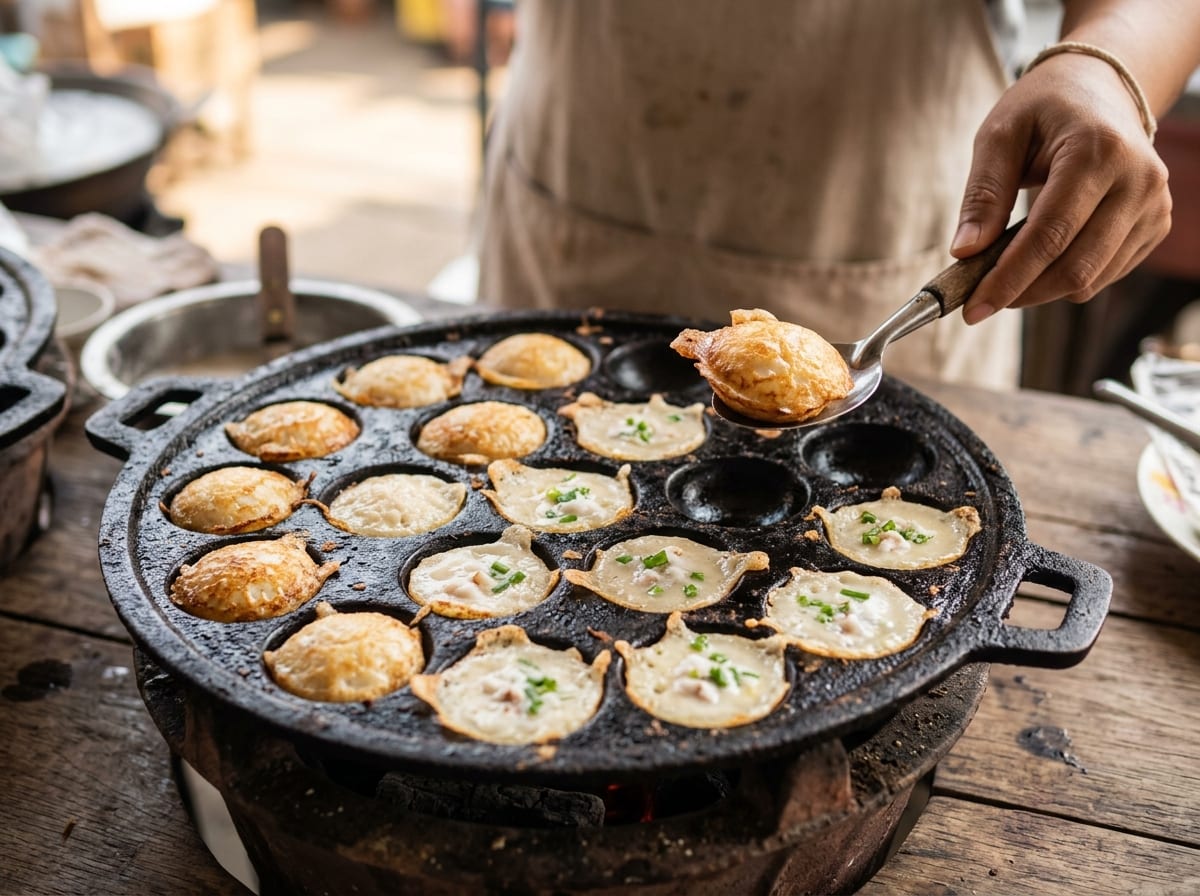
Khanom Krok (Thai Coconut Rice Pancakes)
Bite-sized Thai coconut pancakes cooked in a pan of round indentations, a thin rice-flour-and-coconut-milk batter poured first for a crisp shell, then a richer coconut custard spooned into the center for a soft filling.
Batter and filling ratios adapted from Inquiring Chef's and Hungry in Thailand's kanom krok recipes, scaled to serve four from a 7-cavity aebleskiver pan.
Ingredients
Shell batter
- 150 g rice flour rounded
- 240 ml coconut milk, well shaken rounded
- 120 ml water rounded
- 25 g sugar rounded
- 2 g salt rounded
Filling
- 300 ml coconut milk, the thick, well-shaken part of the can rounded
- 12 g rice flour rounded
- 30 g sugar rounded
- 2 g salt rounded
To finish
- 2 scallions, thinly sliced (optional) rounded
- 60 g sweet corn kernels, cooked (optional) rounded
- 15 ml neutral oil or melted coconut oil, for greasing the pan rounded
Dietary labels are a guide, not a guarantee. If you have an allergy, read the ingredients yourself.
Method
- Make the shell batter: in a bowl, whisk the rice flour, coconut milk, water, sugar, and salt together until smooth and free of lumps. The batter should be thin, about the consistency of heavy cream. Let it rest for 15 minutes so the rice flour hydrates fully.
- While the batter rests, make the filling: in a small saucepan, whisk together the coconut milk, rice flour, sugar, and salt. Set over medium-low heat and cook, whisking often, until the mixture visibly thickens, 2 to 4 minutes. Take it off the heat and stir occasionally as it sits, so a skin doesn’t form.
- Set your pan (see Notes on which pan to use) over medium heat for a few minutes until hot. Brush each cavity with a little oil.
- Pour the shell batter into the cavities, filling each about two-thirds full and leaving a little headspace. Cook for 2 to 3 minutes, until the edges look set and slightly dry.
- Spoon about a teaspoon of the warm filling into the center of each pancake. Scatter over a few corn kernels or scallions if using. Cover the pan with a lid or a sheet of foil to trap the heat, and cook for another 5 to 7 minutes, until the shells are crisp and golden at the edges and the centers are set but still soft.
- Run a thin spoon or a skewer around the edge of each pancake and lift it straight out; do not try to flip it. Serve immediately while the shell is still crisp, either loose or pressed two together, filling side in, the traditional way to eat them on the street in Thailand.
- Wipe out the pan, re-oil it, and repeat with the remaining batter and filling. This makes about 20 pancakes in 3 batches from a 7-cavity pan.
Notes
- On the pan: the pan built for khanom krok is a heavy, flat cast-iron disc studded with shallow round indentations, each one turned out with a spoon rather than flipped. It isn’t something you’ll find on a shelf in Germany outside a specialist Thai or Southeast Asian grocer, and importing one is more effort than the dish is worth for an occasional treat. An aebleskiver pan, widely sold in Germany for Danish aebleskiver, is the practical stand-in, and a Japanese takoyaki pan works too. Be honest with yourself about the trade-off: both are close, not identical. Aebleskiver cavities are usually deeper and more rounded, built so the batter can be turned into a full sphere, so the shell climbs higher up the sides here than it would in a true khanom krok pan and can need a minute or two longer to crisp. Takoyaki cavities are shallower and closer in shape but often smaller, so you’ll get more pieces from the same amount of batter and should shorten the cooking time slightly. Either way, do not flip: khanom krok is scooped out, not turned.
- The filling should still be warm and pourable when you spoon it in. If it has cooled and gone stiff, warm it back over low heat with a splash of water or coconut milk, whisking, until it loosens.
- Work in batches and keep the heat at medium. Too hot and the shells scorch before the centers set; too low and the shells never crisp.
- These do not keep or reheat well. The whole appeal is the contrast between the crackling shell and the soft center, and both are gone within the hour. Make them to eat, not to store.
Sources Consulted
The true khanom krok pan is a specialist item, not something sold on a normal shelf in Germany. This recipe is written for the aebleskiver pan sold widely here for Danish aebleskiver, or a takoyaki pan; both get an honest side-by-side comparison against the real pan in the Notes below, because the cavity shape and depth are close but not identical. The ratios and technique are cross-checked against two independently tested American food-blog recipes rather than invented from scratch.
From Christoph Mayer