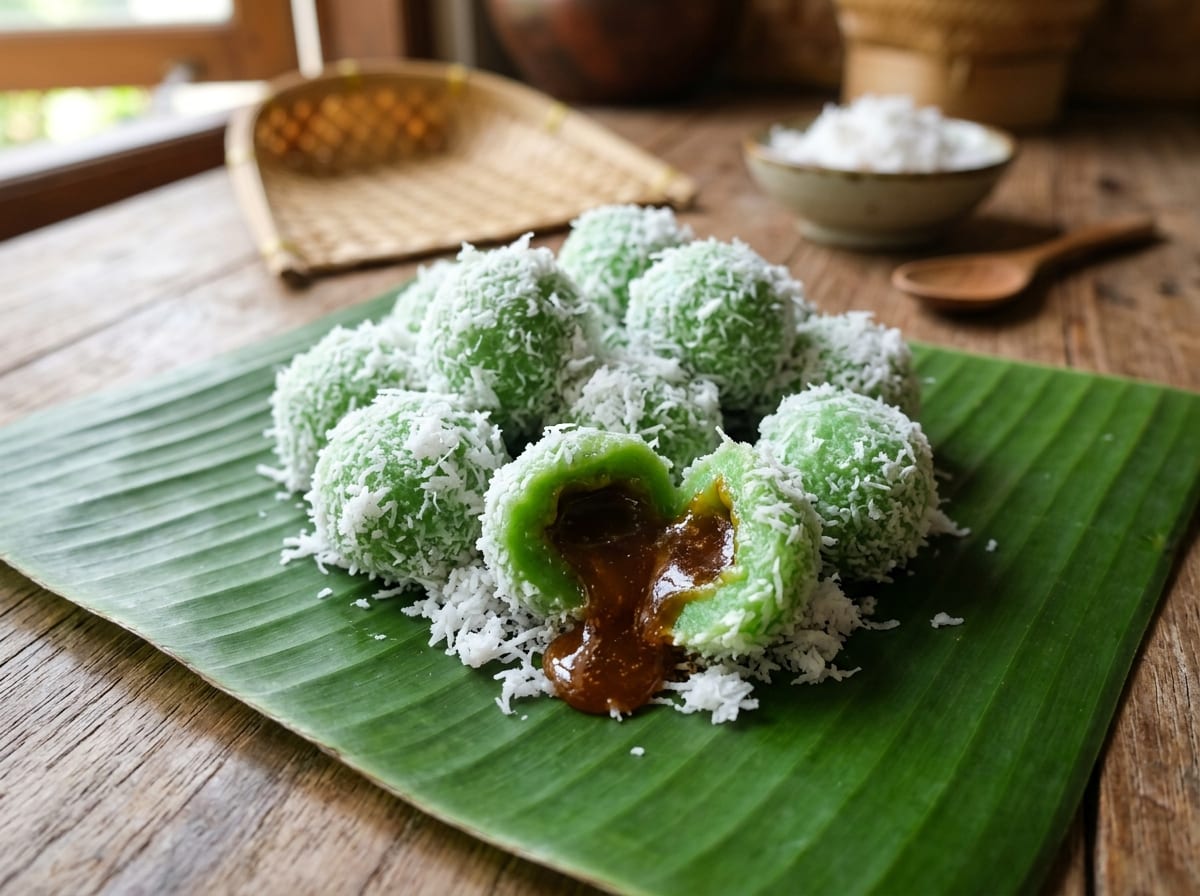
Klepon (Pandan Rice Balls with Palm Sugar)
Small bright-green glutinous rice balls flavoured with pandan, each hiding a chunk of palm sugar that turns molten as they boil, then rolled in fresh grated coconut. A Javanese street snack best eaten the day it is made.
Prep45 min
Cook20 min
Servings20
Dough ratio and boiling timing adapted from Pisang Susu's klepon recipe, sealing technique cross-checked against Wandercooks
Ingredients
Units
Temperature
Servings
Dough
- 200 g glutinous rice flour, also sold as sweet rice flour or tepung ketan, not the same as regular rice flour rounded
- 180 ml water, room temperature rounded
- 4 g pandan paste, about 1 tsp, for colour and aroma rounded
- 1 g fine salt rounded
Filling
- 75 g palm sugar (gula jawa), cut into roughly 1 cm dice rounded
Coconut coating
- 150 g freshly grated coconut, or thawed frozen grated coconut rounded
- 2 g fine salt rounded
- 1 pandan leaf, tied in a knot (optional) rounded
Dietary labels are a guide, not a guarantee. If you have an allergy, read the ingredients yourself.
Method
- Stir the pandan paste into the water until dissolved. In a bowl, mix the glutinous rice flour with the salt, then pour in the pandan water a little at a time, kneading by hand until you have a smooth, soft dough that doesn’t crack when you pinch it. Add a splash more water if it feels dry and stiff, or a little more flour if it’s sticky enough to cling to your fingers.
- Chop the palm sugar into roughly 1 cm dice.
- Pinch off pieces of dough about the size of a walnut (around 15 g) and roll into balls. Flatten each into a disc in your palm, press a piece of palm sugar into the centre, then draw the edges of the dough up and around the sugar and pinch them firmly together to seal. Roll the sealed ball again between your palms until it’s smooth all over, with no visible seam or thin patch: any weak point is exactly where the ball will split open in the boiling water and let the sugar leak out instead of staying molten inside.
- Bring a large pot of water to a rolling boil. Lower in the klepon in batches, without crowding the pot, so they have room to move without sticking together. Boil until they rise and float to the surface, 5 to 8 minutes, then let them boil for a further 2 to 3 minutes so the palm sugar inside fully melts. Lift out with a slotted spoon and drain briefly.
- While the klepon boil, steam the grated coconut with the salt and the knotted pandan leaf, if using, for 5 to 10 minutes, until warmed through and slightly glossy. Spread it on a plate.
- Roll the warm, just-drained klepon through the steamed coconut while they’re still a little sticky, pressing gently so it coats all sides. Use a fork or a second spoon rather than your fingers if they’re too hot to handle. Serve straightaway.
Notes
- Pandan paste or extract is sold at Asian grocers throughout Germany, usually as a bottled green “pandan paste” or “pandan flavouring” alongside the other Southeast Asian baking ingredients. Fresh pandan leaves, blended with the water and strained, are more traditional and give a grassier aroma, but paste is far easier to find here and works well. Without either, the klepon taste the same but come out pale rather than green.
- Palm sugar (gula jawa in Indonesia, gula melaka in Malaysia) is sold as hard dark discs or blocks, also available at Asian grocers. Dark brown sugar is a real substitute, but a different one: it melts into a straightforwardly sweet syrup rather than palm sugar’s smoky, caramel depth. If you use it, cut the pieces slightly larger, since it softens rather than staying as a firm molten pocket.
- Klepon are a same-day food. The dough toughens and the coconut coating dries out and turns leathery by the next day, so make them close to when you plan to eat them and serve within a couple of hours.
Sources Consulted
Sources consulted
The water-based dough ratio, the 1 cm palm sugar dice, the float-then-boil-a-little-longer timing, and the salted steamed-coconut coating come from the sources. Ingredient wording, the batch scaled to 20 pieces, and the method steps are original.
From Christoph Mayer