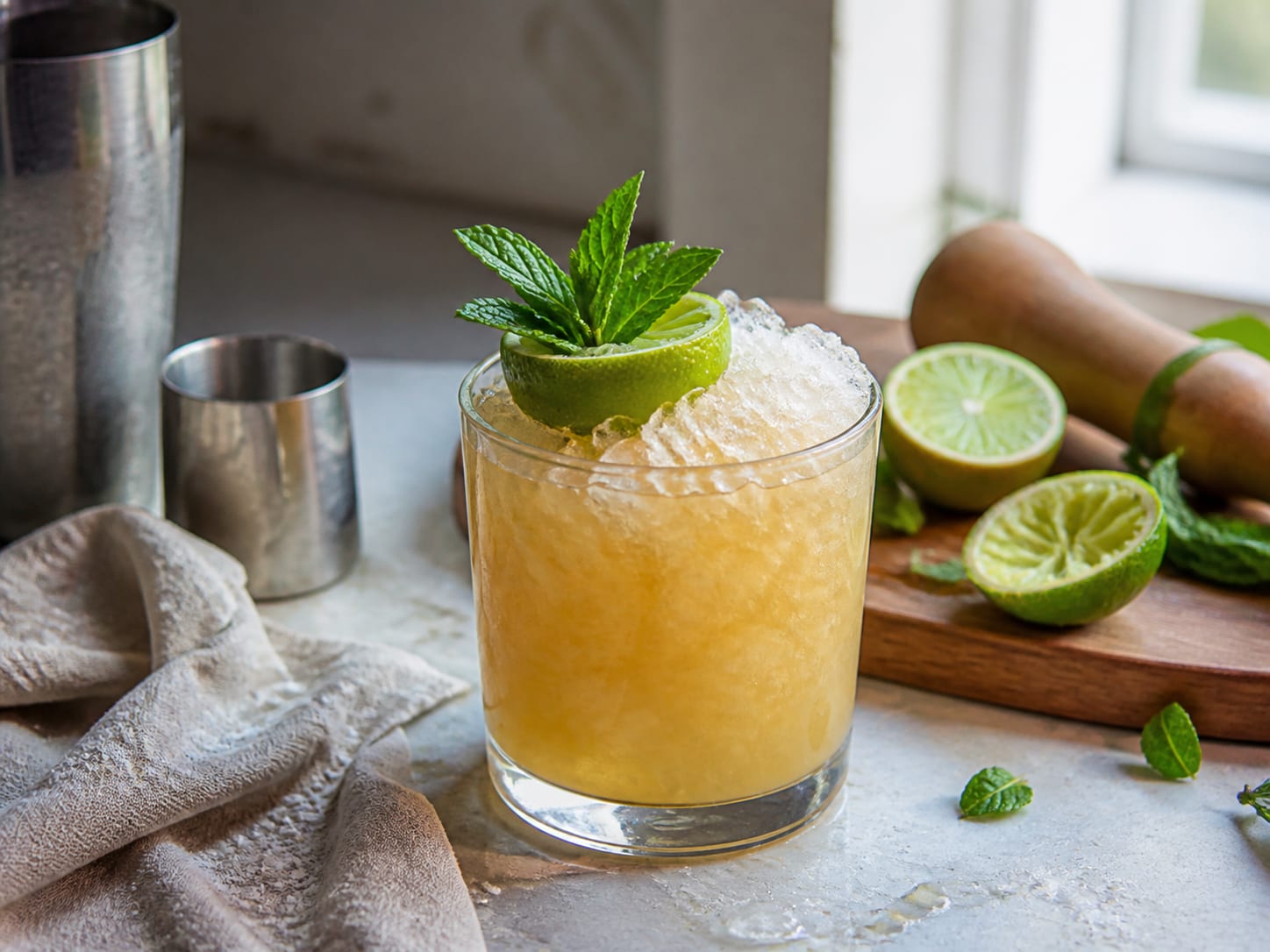
Mai tai
The classic tiki cocktail built on a blend of aged Jamaican rum and Martinique rhum agricole, fresh lime juice, orange curaçao, and orgeat, shaken hard over crushed ice and finished with the spent lime shell and a sprig of mint.
Prep3 min
Servings1
Adapted from Victor "Trader Vic" Bergeron's 1944 original at his Oakland, California restaurant and the Jamaican-and-Martinique rum blend he later settled on, honoring the drink's true birthplace even though it became inseparable from Hawaiian tiki-bar and resort culture.
Ingredients
Units
Temperature
Servings
Mai tai
- 30 ml aged Jamaican rum, funky, pot-still character, such as Appleton Estate 8 Year rounded
- 30 ml rhum agricole, aged Martinique rhum agricole vieux, such as Clément or La Favorite rounded
- 22 ml fresh lime juice, squeezed from about 1 lime; reserve the spent shell for garnish rounded
- 15 ml orange curaçao, such as Pierre Ferrand Dry Curaçao or Cointreau rounded
- 15 ml orgeat (almond syrup), almond-based; contains tree nuts rounded
- 7 ml rich sugar syrup, 2 parts sugar to 1 part water; Trader Vic's original used rock candy syrup, adjust or omit to taste (optional) rounded
- 150 g crushed ice, for the shaker, plus more to fill the glass rounded
- 1 mint sprig, for garnish rounded
- 1 spent lime shell, the shell from the juiced lime above, for garnish rounded
Dietary labels are a guide, not a guarantee. If you have an allergy, read the ingredients yourself.
Method
- Squeeze the lime. Juice about 1 lime to get 22 ml, and set the spent shell aside for the garnish.
- Combine everything in a shaker. Add the Jamaican rum, rhum agricole, lime juice, curaçao, orgeat, and sugar syrup if using to a cocktail shaker with the 150 g crushed ice.
- Shake hard. Shake for about 10 to 15 seconds, until the shaker is frosted and cold to the touch.
- Pour into the glass. Pour everything, ice included, into a double old-fashioned or rocks glass. Top up with a little more crushed ice if the glass isn’t full.
- Garnish and serve. Sink the spent lime shell into the drink and tuck a mint sprig alongside it. Serve with a short straw.
Notes
- The Mai Tai was invented at Trader Vic’s in Oakland, California, in 1944, not in Hawaii. Victor “Trader Vic” Bergeron mixed it for two visiting friends from Tahiti, using an aged 17-year-old J. Wray & Nephew Jamaican rum, orange curaçao, orgeat, lime, and rock candy syrup. Hawaii’s own Don the Beachcomber has a rival claim to an earlier, different drink of the same name, but the version that became famous everywhere is Trader Vic’s Oakland original.
- It became a Hawaiian icon anyway. Once Trader Vic’s opened locations in Hawaii and the drink spread through resort bars and tiki culture there, it became inseparable from the image of a Hawaiian vacation, which is why it belongs alongside genuinely Hawaiian dishes in a Hawaiian-themed collection, even though its birthplace was mainland California.
- Rum selection matters more than any other choice here. Bergeron’s original 17-year-old Jamaican rum sold out and was never replicated, so he settled on a blend of a funky, pot-still Jamaican rum and a grassy, vegetal Martinique rhum agricole. That pairing is what gives a Mai Tai its layered, complex backbone; a single generic dark rum makes a flatter, sweeter, more one-note drink.
- This is a strong, spirit-forward cocktail, not a fruity slushy. It holds close to 60 ml of rum plus curaçao in a single serving. Treat it as a full alcoholic drink, pace yourself, and don’t drive after having one.
Ingredient substitutions
- Orgeat (almond syrup) is the traditional ingredient and the one worth sourcing rather than skipping. It’s sold online and at well-stocked bar or spirits shops in both Germany and Canada under brands like Small Hand Foods, Fee Brothers, or Giffard. If it’s genuinely unavailable, a homemade almond-sugar syrup is a reasonable DIY substitute; note that both routes contain almonds and are not safe for a tree-nut allergy.
- Rhum agricole is a specialty item made from fresh sugarcane juice rather than molasses, and it may need a dedicated spirits shop or an online order in both Germany and Canada. If it truly can’t be found, blend the funky Jamaican rum with a small amount of a lighter aged rum instead; the drink will still work, though it will miss the grassy, vegetal sugarcane note that rhum agricole brings.
- Orange curaçao or triple sec is routinely available at any well-stocked shop in both regions, so no substitution is needed.
Sources consulted
- Distiller: Cocktail of the Week, The Original 1944 Mai Tai
- Difford’s Guide: Mai Tai (Trader Vic’s)
- The Search for the Ultimate Mai Tai: History of the Mai Tai
- Liquid Alchemist: Original 1944 Trader Vic’s Mai Tai Recipe
Sources consulted
From Christoph Mayer