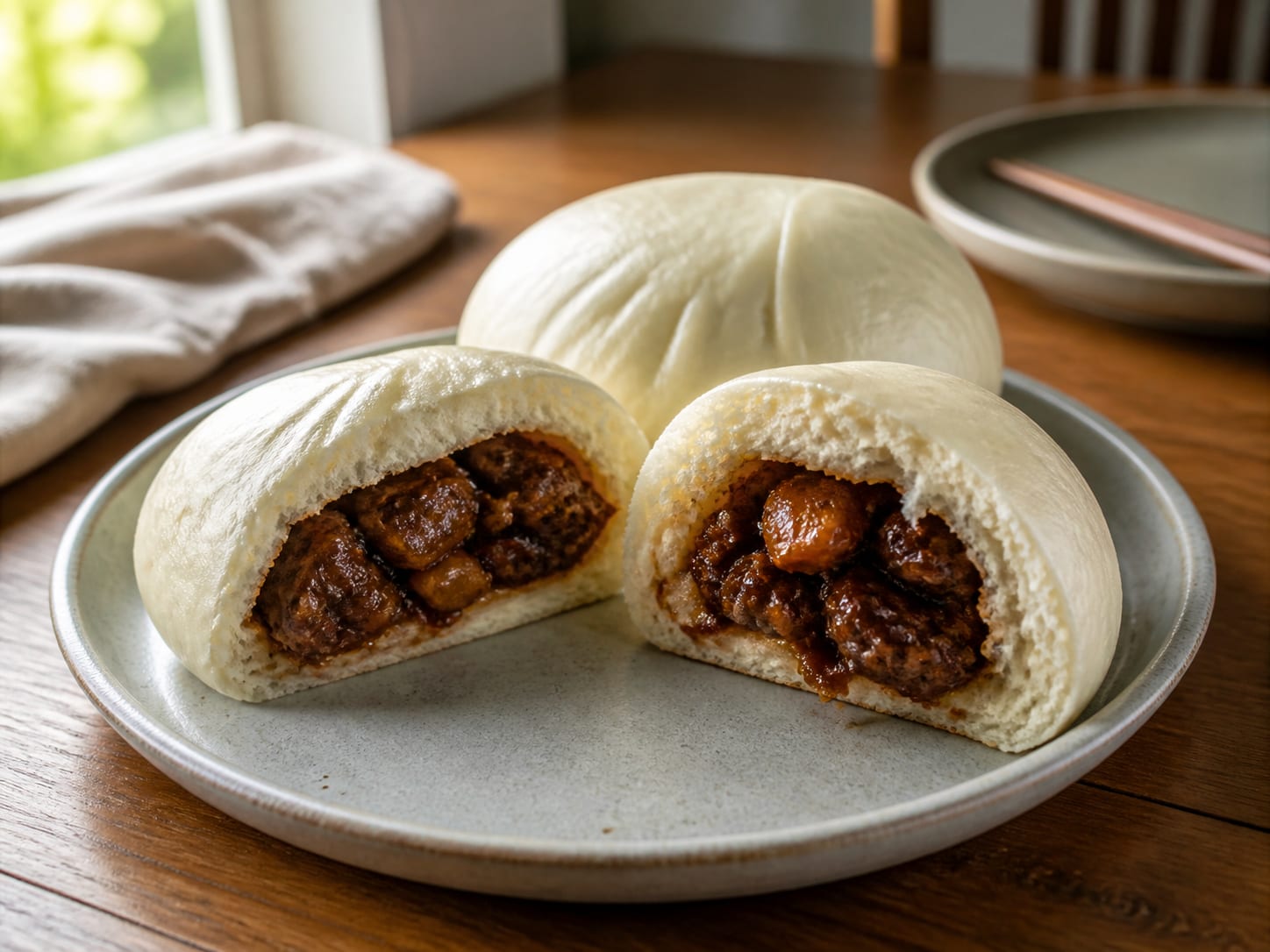
Manapua (steamed char siu bao)
Soft, slightly sweet steamed bao buns wrapped around glossy hoisin-and-oyster-sauce char siu pork, the plantation-era Hawaiian-Chinese snack sold from bakery counters and manapua trucks across Honolulu.
Prep45 min
Cook35 min
Rest110 min
Servings12
Compiled from published Hawaiian and Hawaiian-diaspora recipes for steamed bao dough hydration, char siu filling ratios, and pleating technique; not represented as personally tested
Ingredients
Written for a 4 L pot
Units
Temperature
Servings
Bao dough
- 480 g plain flour rounded
- 60 g sugar rounded
- 7 g instant yeast rounded
- 5 g baking powder, optional; gives the characteristic pillowy Hawaiian-style crumb, see Notes (optional) rounded
- 6 g fine salt rounded
- 280 ml lukewarm whole milk rounded
- 40 g neutral oil, such as sunflower or vegetable oil rounded
Char siu filling
- 500 g char siu (Chinese barbecue pork), diced small; store-bought or homemade, see Ingredient substitutions rounded
- 40 g yellow onion, finely diced rounded
- 20 g spring onion, green parts only, thinly sliced rounded
- 1 garlic, minced rounded
- 15 g neutral oil, for the pan rounded
- 60 g hoisin sauce rounded
- 30 g oyster sauce rounded
- 15 g soy sauce rounded
- 12 g sugar rounded
- 15 g Shaoxing wine, or dry sherry rounded
- 5 g toasted sesame oil rounded
- 8 g cornstarch rounded
- 45 ml water, for the cornstarch slurry rounded
Dietary labels are a guide, not a guarantee. If you have an allergy, read the ingredients yourself.
Method
- Prepare the char siu. If using homemade char siu (see Ingredient substitutions), let it cool completely, then dice it small, about 1 cm. If using store-bought char siu, dice it the same way. You need 500 g diced meat.
- Make the filling. Heat the 15 g oil in a pan over medium heat and sauté the diced onion and garlic until soft, about 3 minutes. Whisk together the hoisin sauce, oyster sauce, soy sauce, 12 g sugar, and Shaoxing wine. Add the diced char siu and the sauce mixture to the pan and simmer 2 to 3 minutes, stirring, until everything is well coated. Stir the cornstarch into the 45 ml water to make a slurry, add it to the pan, and cook, stirring, for 30 to 60 seconds until the sauce turns thick and glossy. Off the heat, stir in the sesame oil and sliced spring onion.
- Chill the filling. Spread the filling on a plate or tray in a thin layer and refrigerate, uncovered, until completely cold, at least 1 hour; it can be made up to a day ahead. Warm or even room-temperature filling makes the buns hard to pleat and steams unevenly, so do not skip the chill.
- Mix the dough. Whisk together the flour, 60 g sugar, instant yeast, baking powder, and salt in a large bowl. Add the lukewarm milk and 40 g oil and bring together into a shaggy dough.
- Knead and bulk-proof. Knead by hand or with a dough hook for 8 to 10 minutes, until smooth, elastic, and only slightly tacky. Shape into a ball, place in a lightly oiled bowl, cover, and leave somewhere warm for about 90 minutes, until roughly doubled.
- Divide and shape. Turn the dough out and divide into 12 pieces, about 73 g each; keep the pieces you are not working with covered. Flatten each piece into a round about 10 cm across, leaving the centre slightly thicker than the edges.
- Fill and pleat. Place about 50 g of the cold filling in the centre of each round. Gather the edges up and around the filling, pleating as you go, and twist to seal firmly at the top. Set each bun, pleated side up, on a small square of baking paper.
- Second proof. Space the buns well apart in one or more steamer baskets, leaving room for them to expand without touching. Cover loosely and proof for 20 to 30 minutes, until visibly puffed.
- Steam. Bring water to a rolling boil in a pot of about 4 litres fitted with a steamer basket. Steam the buns in batches so the basket is never crowded, 15 to 18 minutes per batch, without lifting the lid partway through. Turn off the heat and let the buns rest in the covered steamer for 5 minutes before opening the lid, so the sudden temperature drop does not make them collapse or wrinkle.
- Serve. Serve warm, ideally within 30 minutes of steaming.
Notes
- Manapua freezes and reheats exceptionally well. Freeze the fully cooled, steamed buns in a single layer until solid, then bag them; they keep for up to 3 months. Reheat from frozen by steaming for 12 to 15 minutes, or microwave a single bun wrapped in a damp paper towel for about 90 seconds for a faster, slightly less pillowy result.
- A baked version of manapua also exists and is common at Honolulu bakeries alongside the steamed one: shape and fill the same dough, proof the buns on a tray, brush with an egg wash, and bake at 190°C for about 18 to 20 minutes until deep golden. It gives a firmer, slightly sweeter crust rather than the soft, matte skin of a steamed bun; the steamed version above is the more traditional and more common route.
- The baking powder alongside the yeast is what gives Hawaiian-style manapua dough its characteristic light, cottony crumb, distinct from a plainer Chinese-style bao dough. Leave it out if you prefer a denser, more classic dim-sum-style bun.
- Keep the steamer from overcrowding; buns that touch while steaming fuse together and can prevent steam from circulating evenly, leaving some sides gummy.
Ingredient substitutions
- Char siu (Chinese barbecue pork) is the traditional filling here and the most authentic route is to buy it ready-made rather than substitute it.
- In Germany, look for char siu at the deli counter of a Chinese or other East Asian grocer, or ask at a Chinese restaurant, some sell their roast pork by the kilo. Where it is not available, make a quick homemade version: marinate 500 g pork shoulder, cut into strips, in a mixture of hoisin sauce, honey, five-spice powder, a little soy sauce, and a splash of rice wine for at least a few hours, ideally overnight, then roast until caramelized and cooked through. It will lack the deep red colour of traditional char siu, which normally comes from fermented red bean curd (ang kak, also called red yeast rice); that colour is purely cosmetic and does not affect the flavour.
- In Canada, char siu is commonly available ready-made at Chinese BBQ shops and Asian grocers in most cities with an established Chinatown, such as Vancouver and Toronto. Where it is not available, use the same homemade hoisin-honey-five-spice marinade route described above.
- Shaoxing wine can be replaced with dry sherry.
Sources consulted
- Tasty: Char Siu Bao (Manapua) As Made By Zhe
- Hawaii Guide: Manapua, Hawaii’s Steamed Char Siu Bun
- Plays Well With Butter: Easy Baked Manapua (Hawaiian-Style Char Siu Bao)
- Onolicious Hawaiʻi: Manapua and The Manapua Man
Sources consulted
From Christoph Mayer