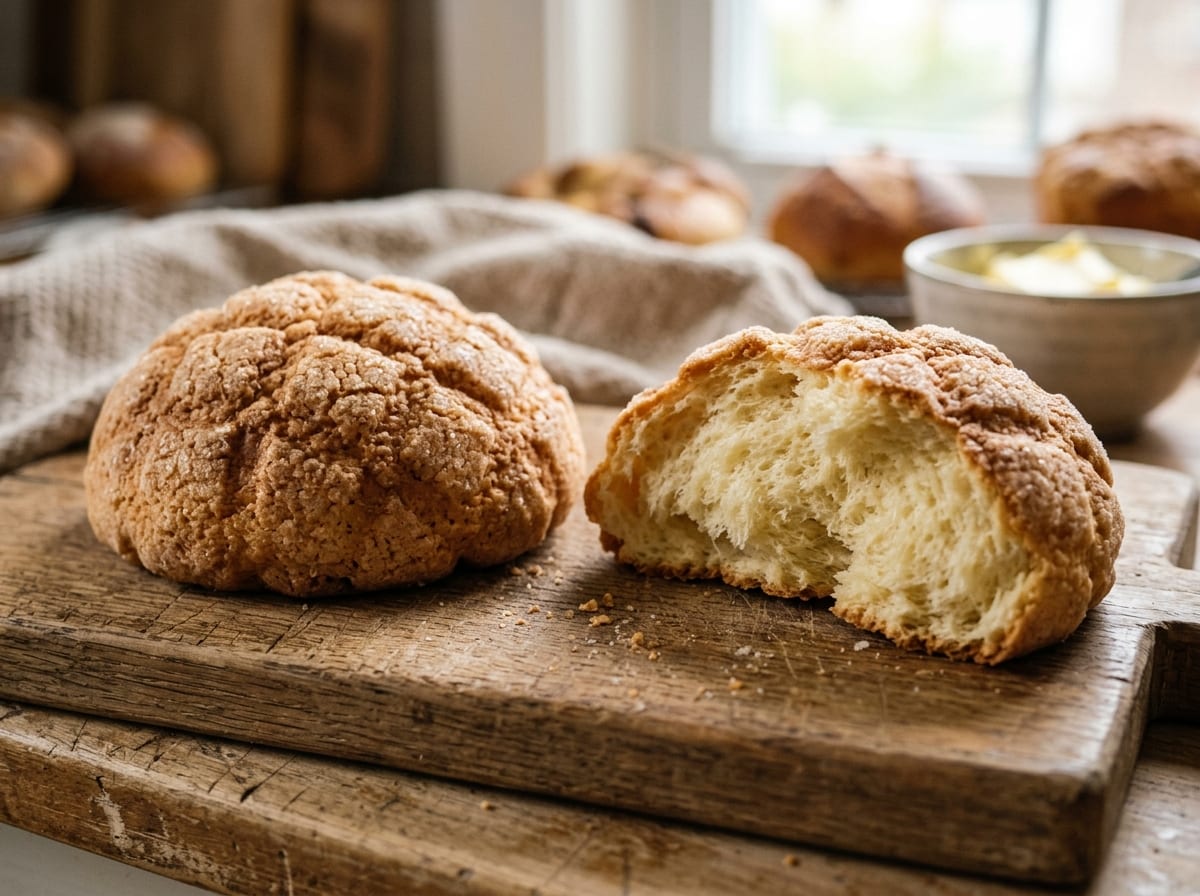
Melonpan
A round Japanese bakery bun, soft milk bread under a crisp cookie-dough shell scored in a crosshatch like a melon rind. It doesn't taste of melon; the name and the pattern are about the rind, not the fruit.
Prep50 min
Cook14 min
Rest150 min
Oven180°C
Servings8
Scaled down from Just One Cookbook's 10-bun version to 8, keeping whole eggs in both doughs rather than fractional ones; bake temperature and time cross-checked against Chopstick Chronicles and Cooking with Dog, which land in the same 170 to 180°C, 12 to 15 minute range.
Ingredients
Units
Temperature
Servings
Milk bread dough
- 180 g bread flour rounded
- 20 g plain flour, cake or pastry flour also works, for a slightly more tender crumb rounded
- 30 g granulated sugar rounded
- 3 g fine salt rounded
- 3 g instant yeast, about 1 tsp rounded
- 1 egg, size M, beaten rounded
- 40 ml whole milk, lukewarm, about 30°C rounded
- 40 ml water, lukewarm, about 30°C rounded
- 28 g unsalted butter, softened, cut into small pieces rounded
Cookie dough shell
- 48 g unsalted butter, softened rounded
- 80 g granulated sugar rounded
- 1 egg, size M, beaten rounded
- 160 g plain flour, cake flour gives the shortest, most sandy shell if you have it rounded
- 2 g baking powder, about 1/2 tsp rounded
- 20 g granulated sugar, for rolling the buns before scoring rounded
Dietary labels are a guide, not a guarantee. If you have an allergy, read the ingredients yourself.
Method
- Make the bread dough. In a stand mixer bowl, or a large bowl if kneading by hand, whisk the bread flour, plain flour, sugar, salt, and instant yeast together, keeping the yeast and salt on opposite sides of the bowl if you’re not mixing straight away. Add the egg, milk, and water, and mix on low speed, or with a wooden spoon, until you have a shaggy dough.
- Knead 8 to 10 minutes with the dough hook, or 12 to 15 minutes by hand, until smooth and elastic. Add the softened butter in two or three additions, kneading each one in fully before adding more; the dough will look like it’s falling apart and then come back together, that’s normal. Keep kneading until it passes a windowpane test: pull a small piece thin enough to see light through without it tearing.
- Shape the dough into a ball, set it in a lightly oiled bowl, cover, and leave it somewhere warm, around 27 to 30°C, an oven with just the light on works well, until it has doubled, 60 to 90 minutes.
- While the dough rises, make the cookie dough. Beat the softened butter and sugar together until pale and creamy, beat in the egg, then fold in the plain flour and baking powder until just combined into a soft, slightly sticky dough. Flatten it into a disc, wrap it, and chill 20 to 30 minutes; it needs to firm up enough to roll without sticking to everything.
- Turn the risen bread dough out, knock it back gently, and divide it into 8 equal pieces, about 49 g each. Round each into a tight ball, cover, and let them rest 10 minutes. A rested ball shapes more easily than one straight off the scale.
- Divide the chilled cookie dough into 8 equal pieces, about 43 g each. Roll each between two sheets of parchment or cling film into a thin circle, about 9 to 10 cm across.
- Set a bread dough ball in the centre of a cookie dough circle. Lift the edges up and over the top, working around the ball and stretching the cookie dough gently rather than pulling it, until it covers the top and sides and meets underneath. Pinch the seam closed; it doesn’t need to be neat, gravity and the crosshatch hide it later.
- Roll the covered bun in granulated sugar so the top and sides are lightly and evenly coated, then set it seam side down on a lined sheet pan, spaced well apart. They spread as they proof and bake.
- Score a crosshatch into the sugared top with the back of a knife or a bench scraper: shallow diagonal lines one way, then the other, about 1 cm apart, just enough to mark the sugar and press slightly into the dough without cutting through the cookie shell.
- Cover loosely and proof again somewhere warm until the buns have grown about one and a half times, roughly 50 minutes. They won’t double this time; the cookie shell restrains them, and that’s what keeps the crosshatch open rather than stretched flat.
- Heat the oven to 180°C. Bake 13 to 15 minutes, until the crosshatch has opened and the shell is a deep, even gold. Rotate the pan halfway through if your oven bakes unevenly.
- Cool on a rack at least 15 minutes before eating. The shell is at its crispest warm but still holds together once cool; the crumb is actually worse hot, still gummy from the oven.
Notes
- Best the day they’re baked, ideally within a couple of hours. The whole appeal of Melonpan is a crisp shell over a soft crumb, and that contrast is gone by the next morning as the sugar shell pulls moisture from the bread.
- Store leftovers at room temperature in a paper bag or a loosely closed container, not sealed plastic and not the fridge; both trap moisture that softens the shell. Refresh a stale bun with 3 to 4 minutes in a 160°C oven, which won’t rebuild the original crispness but takes the staleness off.
- Freeze the baked and cooled buns whole, wrapped individually, for up to a month. Thaw at room temperature and refresh in the oven as above.
- The shaped, unbaked buns also freeze well after the second proof: freeze them on the tray until solid, then bag them. Bake straight from frozen at 180°C, adding 4 to 5 minutes.
- Cake flour is genuinely worth seeking out for the cookie shell if you have it; it gives a shorter, more sandy crumb than plain flour manages alone. Bread flour matters more in the dough itself, where the extra gluten is what gives Melonpan its pull, distinct from a plain dinner roll.
Sources Consulted
- Just One Cookbook: Melon Pan (メロンパン)
- Chopstick Chronicles: Melon Pan
- Cooking with Dog: Melonpan Recipe
Sources consulted
From Christoph Mayer