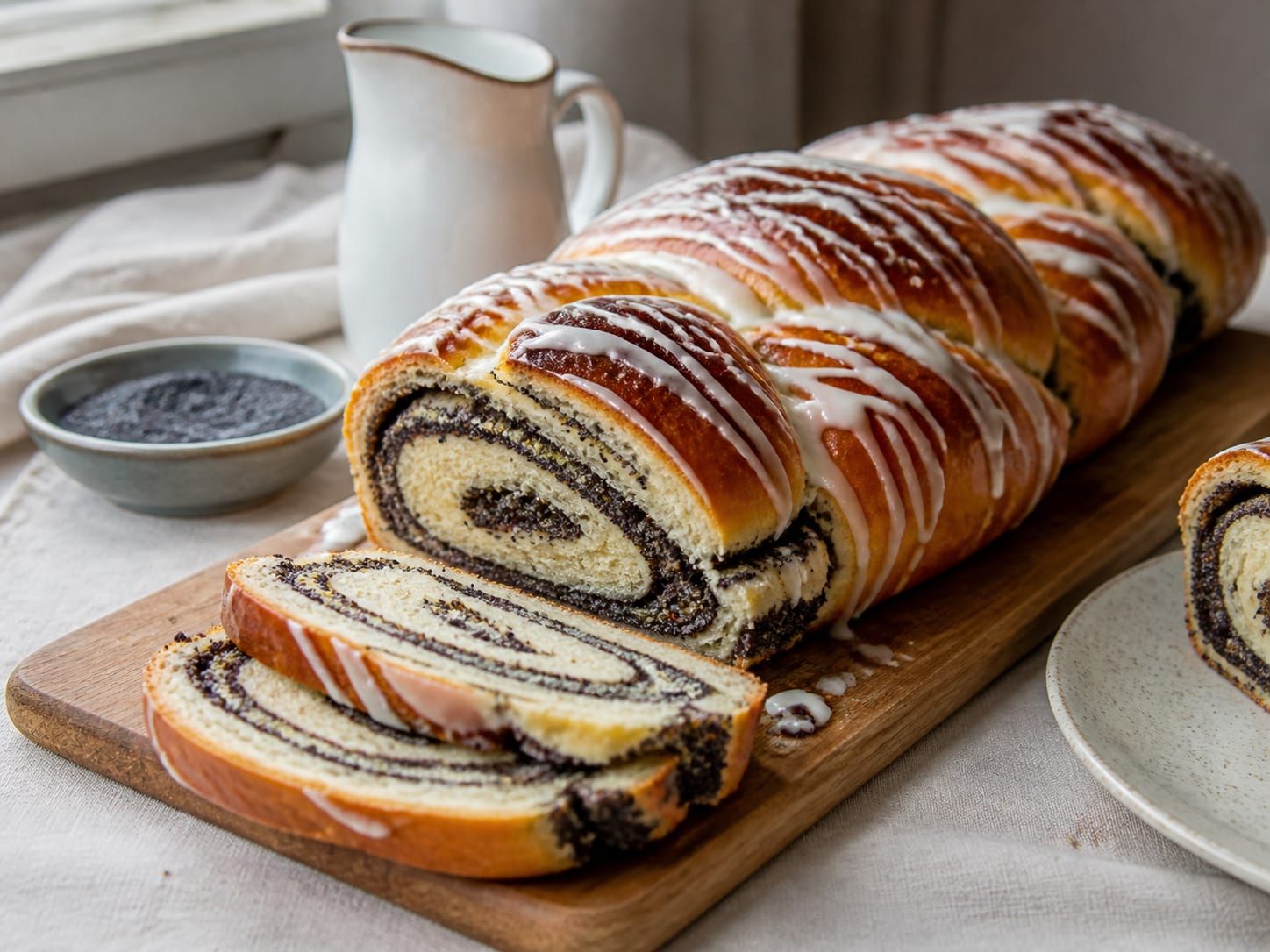
Mohnstriezel (braided poppy seed cake)
A braided yeast loaf with a genuine poppy seed filling, ground poppy seeds cooked in milk with sugar and butter rather than sprinkled in raw, so it stays creamy instead of gritty and actually holds together when the log is rolled. An icing sugar drizzle is the usual finish, not a garnish to skip.
Prep45 min
Cook35 min
Rest90 min
Oven180°C
Servings14
Christoph's poppy seed braid, cooking the poppy seeds into a proper filling rather than leaving them raw and gritty in the dough.
Ingredients
Written for a 35 × 25 cm baking sheet
Units
Temperature
Servings
Yeast dough
- 400 g flour rounded
- 50 g sugar rounded
- 3 g fine salt rounded
- 7 g instant yeast rounded
- 180 ml milk, lukewarm rounded
- 60 g butter, melted and cooled rounded
- 1 egg rounded
Poppy seed filling
- 200 g poppy seeds rounded
- 200 ml milk rounded
- 70 g sugar rounded
- 30 g butter rounded
- 40 g raisins rounded
- 30 g breadcrumbs rounded
- 1 lemon, zest only rounded
To finish
- 1 egg, beaten, for glazing rounded
- 100 g icing sugar rounded
- 15 ml water rounded
Dietary labels are a guide, not a guarantee. If you have an allergy, read the ingredients yourself.
Method
- Whisk the flour, sugar, salt and yeast together, then add the lukewarm milk, melted butter and egg. Knead by hand or with a dough hook for 8 minutes, until smooth and elastic.
- Cover and prove in a warm spot for 60 minutes, until roughly doubled.
- Grind the poppy seeds finely in a food processor or spice grinder, in short bursts; whole poppy seeds do not release their flavour or bind into a filling.
- Combine the ground poppy seeds, milk, sugar and butter in a pot. Cook over medium heat, stirring constantly, for 5 minutes, until thickened. Stir in the raisins, breadcrumbs and lemon zest. Cool completely.
- Roll the risen dough out into a rectangle, about 40 by 30 cm. Spread the cooled poppy seed filling evenly over it, leaving a small border.
- Roll up tightly from the long edge into a log. Cut in half lengthwise and twist the two halves around each other, cut sides facing up, then form into a braid or a simple loose spiral on a lined baking sheet.
- Cover and let rest for 20 minutes. Brush with the beaten egg.
- Bake at 180°C for 30 to 35 minutes, until deep golden brown and hollow-sounding when tapped.
- Whisk the icing sugar and water together and drizzle over the braid once it has cooled slightly.
Method in the Thermomix
Written for a TM5 or TM6, 2.2 litre bowl. This covers milling and cooking the poppy seed filling; the dough, braiding and baking are the same as the hand method.
- Poppy seeds into the dry bowl. Grind 1 min / speed 9, until finely ground.
- Add the milk, sugar and butter. Cook 5 min / 90 °C / speed 2, until thickened.
- Add the raisins, breadcrumbs and lemon zest. Mix 10 sec / reverse / speed 2. Pour out and cool completely, then continue as in the hand method.
Notes
- Grinding the poppy seeds is not optional. Whole seeds sit gritty in the mouth and taste of almost nothing; ground and cooked, they turn dark, rich and genuinely poppy-flavoured.
- Cool the filling fully before it goes onto the dough. Warm filling softens the dough and makes it harder to roll tightly without tearing.
- Cutting the log in half and twisting is what gives the classic marbled cross-section when sliced; a single uncut roll bakes fine but looks plainer inside.
- It keeps for 3 days at room temperature, wrapped, and freezes well unglazed for up to 2 months.
Ingredient substitutions
- Raisins can be sultanas, or left out entirely for a plainer filling.
- A splash of rum in the poppy seed filling, added with the raisins, is a traditional variation.
- Breadcrumbs help the filling hold together when sliced; ground almonds work in the same quantity for a richer result.
- For a nut version, swap the poppy seed filling for the walnut filling used in Nuss-Striezel, following the same technique.
From Christoph Mayer