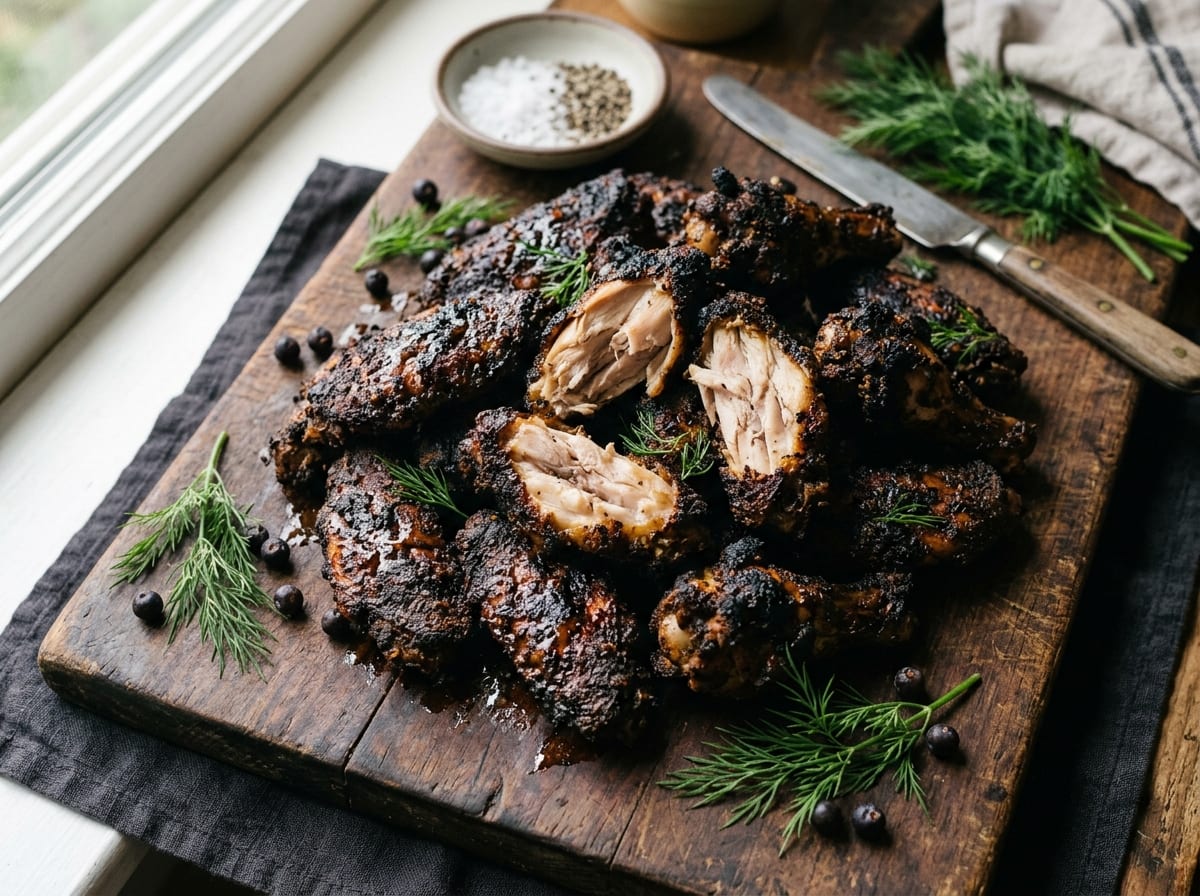
Norse blackened honey chicken wings
Cajun blackening technique with a Nordic pantry, allspice, crushed juniper, dill seed, smoked paprika, white pepper, seared in a screaming-hot skillet until the crust is genuinely dark, then tossed off the heat in a brown-butter honey glaze so the sugar never touches the pan.
Christoph's own recipe, a Nordic take on the Cajun blackening technique, swapping the cayenne-forward Cajun blend for allspice, juniper, dill seed and smoked paprika.
Ingredients
Units
Temperature
Servings
Wings
- 1 1/3 kg chicken wings, whole, or split into flats and drumettes rounded
- 40 g butter, melted, for dipping the wings before they hit the spice rounded
Blackening rub
- 20 g smoked paprika rounded
- 15 g kosher salt rounded
- 10 g ground allspice, the Nordic backbone of the rub; do not swap it for Cajun-style cayenne rounded
- 8 g juniper berries, crushed with the flat of a knife or in a mortar, not ground to powder rounded
- 8 g dill seed, toasted lightly in a dry pan for a minute, then crushed rounded
- 6 g white pepper, ground; sharper and more floral than black pepper here rounded
- 6 g garlic powder rounded
- 4 g onion powder rounded
Brown-butter honey glaze
- 60 g butter rounded
- 90 g honey rounded
- 15 ml cider vinegar, or lemon juice; cuts the sweetness so the glaze reads savoury, not like candy rounded
- 3 garlic cloves, finely grated rounded
Method
- Pat the wings completely dry. Any surface moisture steams instead of searing, and a wet wing will not take a crust no matter how hot the pan gets.
- Crush the juniper and toast the dill seed. Juniper wants to stay coarse rather than powdered, so a mortar or the flat of a knife is better than a spice grinder. Toast the dill seed in a dry pan for about a minute until fragrant, then crush it too. Mix both into the rest of the rub.
- Dip each wing in the melted butter, then coat heavily in the rub. The butter is what makes the spice cling and what blackens, the same principle as classic Cajun blackened fish, just with a different spice mix underneath.
- Get the skillet properly hot. Cast iron, over high heat, until it is very close to smoking. A broiler on its highest setting, wings on a rack about 10 cm from the element, works as well and is easier to do six portions’ worth at once without crowding.
- Sear in batches, about 4 minutes a side. Do not crowd the pan: wings touching each other steam rather than blacken. The crust should darken fast and look properly charred in places by the time you flip.
- Finish to temperature. Move seared wings to a lower-heat area of the pan, or finish under a moderate broiler, until the thickest part reads 74°C to 78°C, another 6 to 10 minutes depending on size.
- Make the glaze while the wings finish. Melt the butter in a small pan over medium heat and keep swirling until the milk solids turn a deep amber and it smells nutty, 3 to 4 minutes. Take it off the heat immediately, since browned butter that keeps cooking becomes burnt butter fast, then whisk in the honey, vinegar and garlic.
- Toss the wings in the glaze off the heat, right before serving. Never in the pan while it is still hot. Honey scorches well below the point at which the spice crust is still fine, so the glaze goes on only once the wings are off direct heat, the same rule as any barbecue sauce with sugar in it.
Notes
- This is blackening, not burning. A genuinely dark, almost black crust in patches is the correct outcome of butter and spice hitting very high heat directly, the same as a proper Cajun blackened dish or a jerk chicken crust. If the wings look pale and orange rather than deeply charred, the pan was not hot enough.
- Why Nordic spices work here. Allspice, juniper and dill seed all hold up to high heat the way the cayenne-and-thyme Cajun blend does, but they land savoury and resinous rather than fiery. Smoked paprika keeps the colour and a little of the char flavour without the raw heat of cayenne.
- The glaze goes on last, always. Honey is mostly sugar, and sugar over direct heat in a hot pan is carbon within a minute. Brown the butter, pull it off, then add the honey, never the other way round.
- Ventilation matters more here than in most recipes. Blackening produces a lot of smoke by design: that is the spice charring on contact with the hot fat. Turn the extractor on, crack a window, or take this one outdoors to a cast-iron skillet over a burner if your kitchen cannot handle it.
- Ahead. The rub keeps for months in a sealed jar and can be mixed well in advance. The glaze can be made a day ahead and rewarmed gently before tossing. The wings themselves are best seared and glazed just before serving.
Ingredient substitutions
- Juniper berries can be left out if you cannot find them, though they are worth seeking out, most spice shops and larger supermarkets carry them for game and sauerkraut. A pinch of ground coriander is the nearest substitute in character, though it is not the same thing.
- Dill seed is not the same as dried dill weed (the herb): it is the seed of the plant and tastes more like caraway with a grassy edge. Caraway seed is the closest stand-in if dill seed is unavailable.
- Honey can be swapped for maple syrup for a different, less floral sweetness, though the glaze will be thinner and set less on the wings.
- No cast iron or broiler. A very hot carbon-steel or stainless pan works the same way; nonstick will not get hot enough to blacken properly and should be avoided here.
Sources consulted
Good with
Sources consulted
From Christoph Mayer