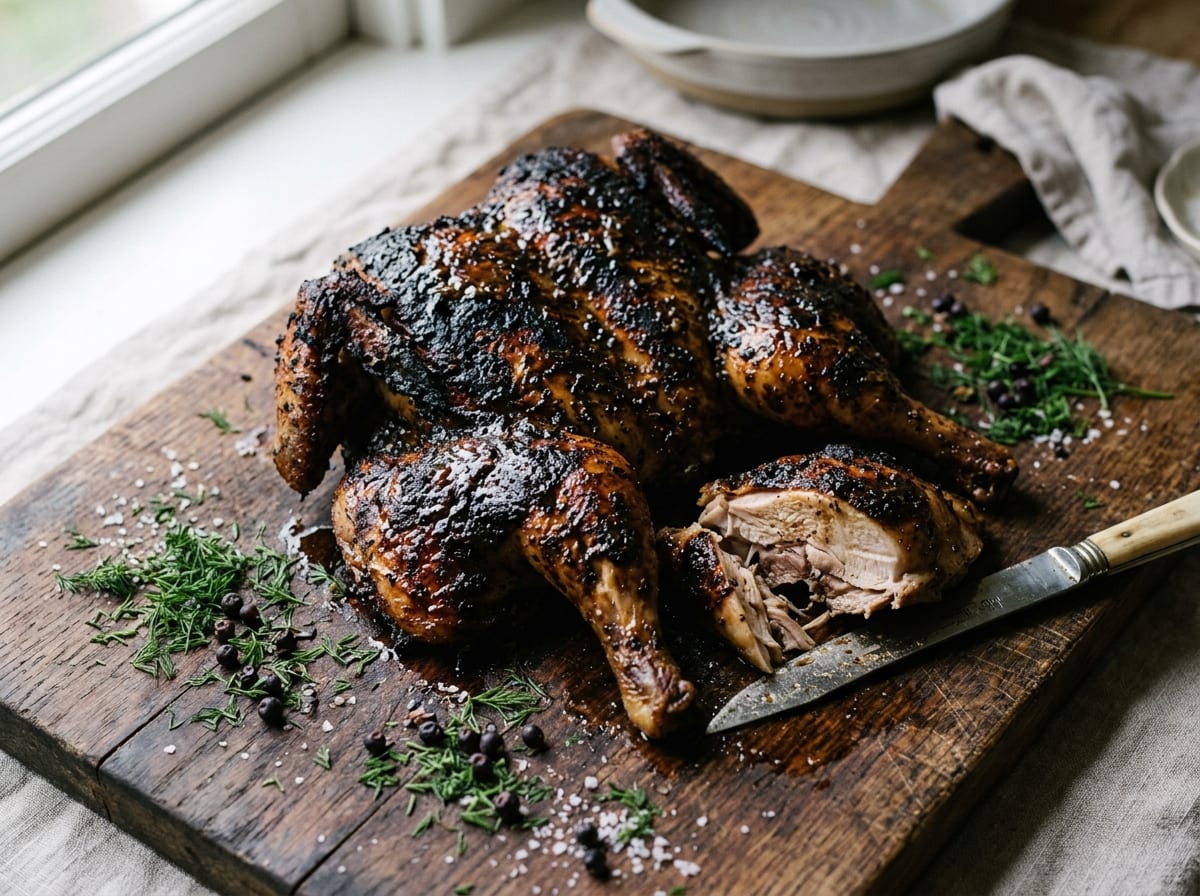
Norse blackened honey chicken
A whole chicken, spatchcocked and butter-basted until the crust runs close to black, the way Cajun blackening demands, but rubbed with allspice, crushed juniper, dill seed and smoked paprika instead of a cayenne-forward Cajun blend. A brown-butter honey glaze goes on only in the last fifteen minutes.
Christoph's own reinterpretation: classic butter-basted Cajun blackening technique, reseasoned with allspice, juniper and dill instead of a cayenne-forward Cajun blend, finished with a brown-butter honey glaze.
Ingredients
Units
Temperature
Servings
Chicken
- 1 whole chicken, about 1.5 kg, spatchcocked rounded
Blackening rub
- 20 g kosher salt rounded
- 12 g smoked paprika rounded
- 10 g ground allspice, the Nordic backbone of the crust, standing in for a Cajun blend's cayenne rounded
- 8 g juniper berries, crushed, crushed with the flat of a knife; whole berries release almost no oil rounded
- 6 g dill seed, crushed, the seed, not dill weed; it reads warm and anise-like rather than herbal rounded
- 6 g ground white pepper, cleaner and less earthy than black pepper; the traditional choice in Nordic cooking rounded
- 6 g garlic powder rounded
- 4 g onion powder rounded
Basting butter
- 80 g butter, melted, for basting partway through the roast; this is what builds the deep crust without a cast-iron skillet rounded
Honey glaze
- 60 g butter, browned first, for a toasted, nutty base to the glaze rounded
- 90 g honey rounded
- 15 ml cider vinegar, cuts the sweetness so the glaze doesn't taste purely of sugar rounded
Dietary labels are a guide, not a guarantee. If you have an allergy, read the ingredients yourself.
Method
- Spatchcock the chicken. Kitchen shears down each side of the backbone, remove it, then press down on the breastbone until the bird lies flat. This is what makes a whole chicken finish evenly instead of drying out the breast before the thighs are done.
- Pat the skin completely dry, then work the rub over and under the skin, right down onto the flesh where the skin will tear. Do not skip drying it: wet skin steams instead of browning, no matter how hot the oven runs.
- Leave it uncovered in the fridge for at least 4 hours, overnight if you can manage it. The salt seasons all the way through and the surface dries further, which matters more here than in a low-and-slow bird, because blackening needs a dry surface to take the char rather than scorch unevenly.
- Heat the oven to 220°C. This is considerably hotter than the barbecue chicken on this site: blackening is a fast, high-heat technique by definition, built around butter and spice charring on the surface rather than smoke working slowly through the meat.
- Roast breast side up for about 30 minutes, then brush all over with the melted basting butter and continue for another 15 to 20 minutes. The butter carries the spices further into a dark crust than dry heat alone manages, which is the whole trick behind blackening a protein that never sees a screaming-hot cast-iron skillet.
- Brown the second batch of butter for the glaze while the chicken is in its last stretch: melt it in a small pan over medium heat until the milk solids turn a deep amber and it smells nutty, then whisk in the honey and vinegar off the heat.
- Brush the glaze on only in the final 10 to 15 minutes, in two light coats. Honey burns readily at this oven temperature, so it goes on last or you get bitter black patches instead of a lacquered crust.
- Pull the breast at 74°C and let the thighs run on to 80°C if they are lagging behind. Rest 15 minutes before carving, so the juices settle rather than run out onto the board.
Notes
- The crust should look almost too dark. Deep mahogany shading toward black at the wing tips and thigh joints is blackening doing its job, the same principle as the jerk chicken on this site, not a sign of a burnt bird, provided the char is even and the meat underneath is not dry.
- Why the higher heat than the barbecue chicken. That recipe is a slow smoke where the skin needs time to render. This one is closer to Cajun blackening’s original logic: a very hot surface, butter, and spices, working fast enough that the outside chars before the inside overcooks.
- Juniper and dill seed are doing the work a Cajun blend leaves to cayenne and thyme. Juniper brings a resinous, gin-adjacent note that is unmistakably Nordic, and dill seed’s warm anise character keeps the rub from tasting like a straight cayenne swap.
- No grill or smoker required, but either works. Set a kettle grill or smoker up for direct-adjacent heat around 220°C, skin side toward but not directly over the coals, and follow the same basting and glazing timing.
- Ahead. Rub and dry-brine the day before. The roast itself does not hold well once glazed; the honey crust is best within the hour it comes out of the oven.
Ingredient substitutions
- Juniper berries can be replaced with 1/4 the amount of gin, added to the basting butter instead of the rub, if you cannot find dried berries.
- Dill seed is not the same as dried dill weed, but if it is genuinely unavailable, caraway seed gives a related warm, slightly anise note rather than a herbal one.
- Smoked paprika can be swapped for sweet paprika if you would rather the smoke come only from a grill or smoker rather than doubled up with the spice.
Sources consulted
Good with
Sources consulted
From Christoph Mayer