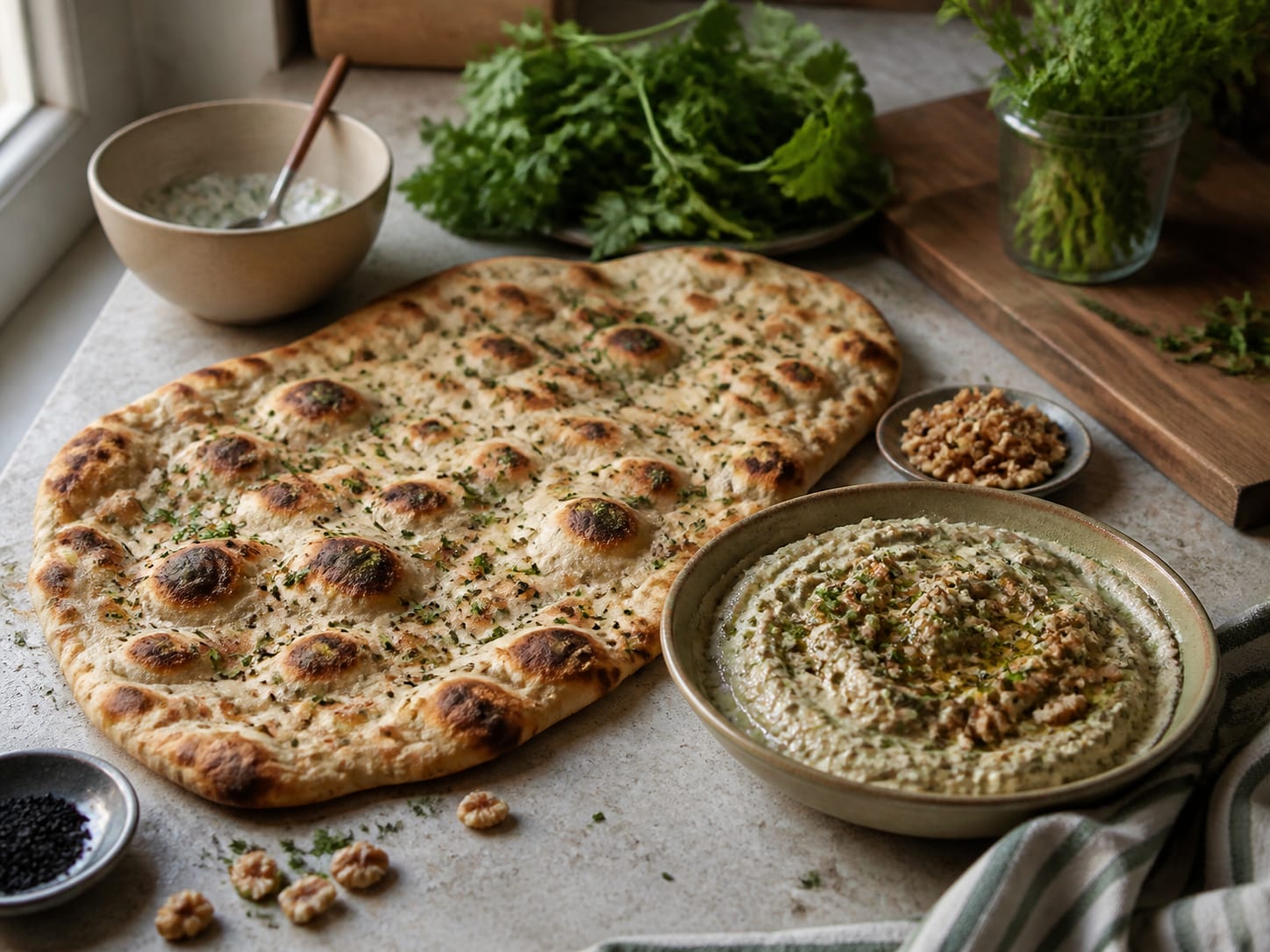
Persisches Fladenbrot mit Kräuter-Walnuss-Dip (Persian flatbread with herb walnut dip)
A stretched, blistered flatbread baked hot and fast, closer to naan than a Western loaf, served with a thick dip of ground walnuts, yoghurt and fresh herbs. The bread wants the hottest oven you have and no proving equipment beyond a warm spot; the dip needs the walnuts genuinely ground, not just chopped, to bind into a spreadable paste.
Christoph's Persian-style flatbread and walnut dip, the walnuts ground properly so they actually bind into a spreadable paste with the yoghurt.
Ingredients
Flatbread
- 350 g flour rounded
- 210 ml warm water rounded
- 5 g instant dried yeast rounded
- 6 g fine salt rounded
- 20 ml olive oil rounded
- 10 g sesame or nigella seeds, for scattering before baking (optional) rounded
Herb walnut dip
- 100 g walnuts rounded
- 250 g full-fat yoghurt rounded
- 30 g mixed fresh herbs, dill, mint and parsley are traditional rounded
- 1 garlic clove rounded
- 15 ml olive oil rounded
- to taste fine salt rounded
Dietary labels are a guide, not a guarantee. If you have an allergy, read the ingredients yourself.
Method
- Whisk the flour and yeast together. Add the warm water, mix to a shaggy dough, then knead in the salt and olive oil, kneading by hand for about 8 minutes, until smooth and elastic.
- Cover and prove in a warm place for 45 to 60 minutes, until roughly doubled.
- Grind the walnuts finely in a food processor or spice grinder, close to a coarse paste rather than fine crumbs.
- Combine the ground walnuts, yoghurt, herbs, garlic and olive oil in a bowl. Season with salt to taste. Chill until serving.
- Heat the oven to its highest setting, at least 250°C, with a baking sheet or pizza stone inside.
- Divide the dough into 4 pieces. Stretch each by hand into a rough oval about 25 cm long and 3 to 4 mm thick, dimpling the surface with your fingertips as you go, the way you would a focaccia. Scatter with sesame or nigella seeds if using.
- Bake one or two at a time, 3 to 4 minutes, until puffed and blistered with dark spots. Watch closely; they go from perfect to burnt quickly at this heat.
- Serve warm, torn by hand, alongside the chilled dip.
Method in the Thermomix
Written for a TM5 or TM6, 2.2 litre bowl. This covers grinding the walnuts and kneading the dough; stretching and baking the flatbreads stay entirely by hand.
- Walnuts into the dry bowl. Grind 10 sec / speed 8, to a coarse paste. Tip out for the dip.
- Flour and yeast into the bowl. Add the warm water. Mix 10 sec / speed 5.
- Add the salt and oil. Knead 3 min / dough mode.
- Tip out, prove and continue by hand from step 3 of the hand method; combine the ground walnuts with the remaining dip ingredients by hand.
Notes
- Grind the walnuts to a genuine paste, not a rough chop. Chopped nuts sit as separate pieces in the yoghurt rather than binding into a cohesive dip.
- Bake the flatbreads as hot and fast as your oven allows. A moderate oven gives a dry, cracker-like result instead of the soft, blistered texture this bread wants.
- Watch the bake closely rather than relying on a timer. At 250°C or hotter, the gap between perfectly blistered and burnt is under a minute.
- The dip keeps for 3 days in the fridge; the bread is best fresh and does not reheat well once fully cooled.
Ingredient substitutions
- Walnuts can be pistachios for a different, slightly sweeter dip.
- Yoghurt should be full-fat for the right body; low-fat yoghurt gives a thinner, wetter dip.
- For a gluten-free flatbread, a good gluten-free bread flour blend works, though the texture will be denser and less stretchy.
From Christoph Mayer