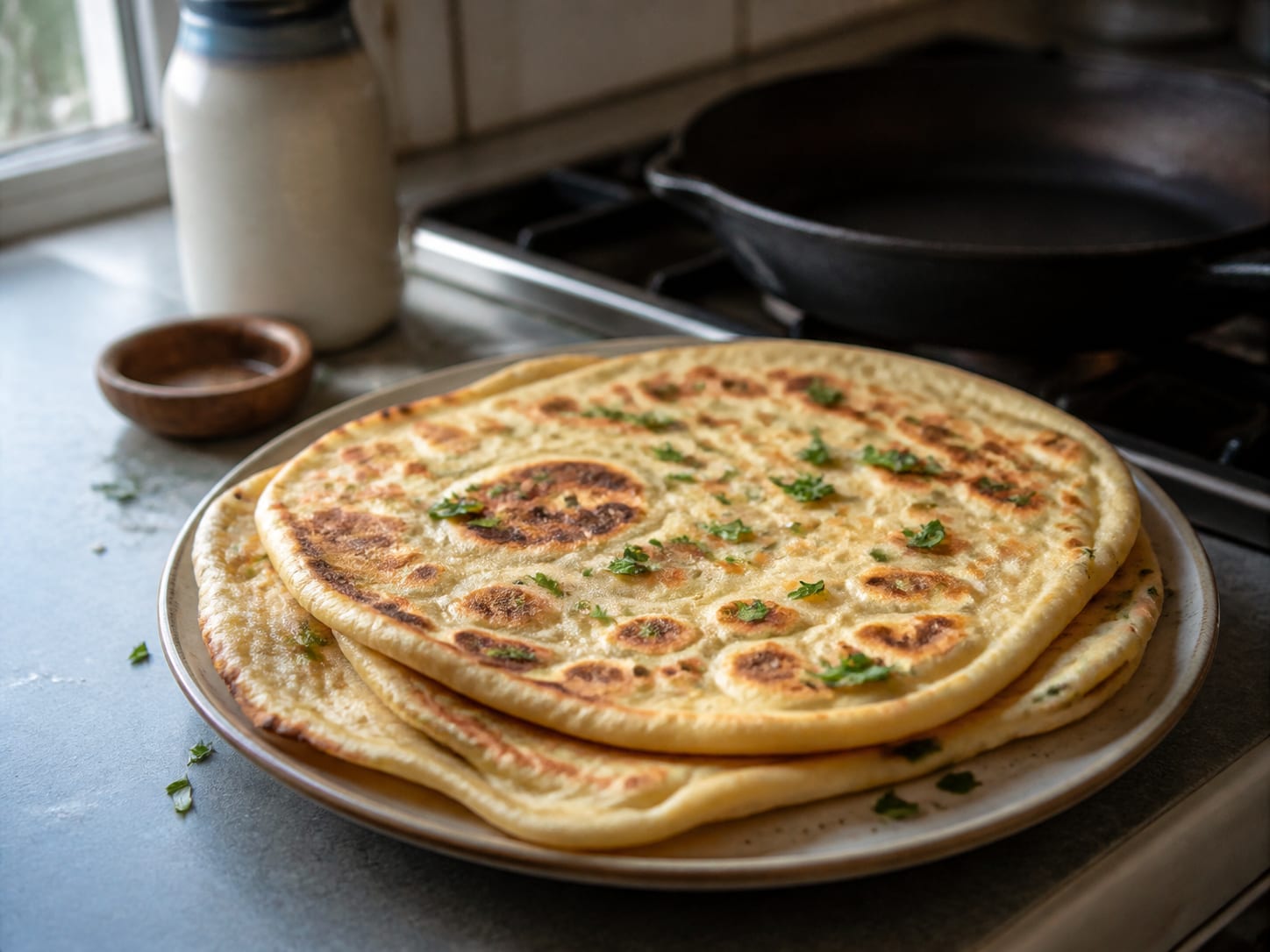
Pfannenbrot (pan-fried flatbread)
A quick yeasted flatbread cooked entirely in a frying pan rather than an oven, ready in about an hour from mixing to eating, useful when the oven is busy with something else or the kitchen is already too hot to run one. The dough is a plain, slightly enriched flatbread dough, rolled thin and cooked in stages like a large pancake.
Prep15 min
Cook20 min
Rest30 min
Servings4
Christoph's stovetop flatbread, useful when the oven is busy or the kitchen too hot to run one.
Ingredients
Units
Temperature
Servings
Dough
- 300 g flour rounded
- 5 g instant dried yeast rounded
- 5 g fine salt rounded
- 180 ml warm water rounded
- 20 ml olive oil rounded
- 20 g butter or oil, for frying rounded
Dietary labels are a guide, not a guarantee. If you have an allergy, read the ingredients yourself.
Method
- Whisk the flour, yeast and salt together. Add the warm water and olive oil, mix to a dough, then knead by hand for 5 minutes, until smooth.
- Cover and prove in a warm place for 30 minutes, until visibly puffy; it does not need to double, this dough is not looking for full loft.
- Divide into 4 pieces and roll each out thin, about 20 cm across and 3 mm thick, on a lightly floured surface.
- Heat a little butter or oil in a large, heavy frying pan over medium-high heat. Cook one flatbread at a time, 2 to 3 minutes per side, until well browned in patches and puffed slightly.
- Wrap the cooked flatbreads in a clean tea towel as you go, to keep them soft and warm while the rest cook.
Method in the Thermomix
Written for a TM5 or TM6, 2.2 litre bowl. This covers only kneading the dough; rolling and pan-frying stay conventional.
- Flour, yeast and salt into the bowl. Mix 5 sec / speed 5. Add the warm water and oil. Knead 2 min / dough mode.
- Tip out, prove and continue by hand from step 3 of the hand method.
Notes
- A heavy pan holds heat more steadily than a thin one, which matters here since you are cooking several flatbreads back to back over the same burner.
- Wrap finished flatbreads in a tea towel as you go. Left uncovered on a rack, they dry out and turn leathery within minutes.
- Roll them thin rather than thick. A thick flatbread cooks unevenly in a pan, browning outside while staying doughy in the centre.
- They are best eaten warm, the same day; reheat briefly in a dry pan rather than a microwave, which turns them tough.
Ingredient substitutions
- Olive oil in the dough can be any neutral oil.
- A little chopped garlic and herbs worked into the dough turns this into a garlic flatbread; fold them in during the initial knead.
- Wholemeal flour can replace up to half the white flour for a nuttier result, though the dough will be slightly less pliable to roll.
From Christoph Mayer