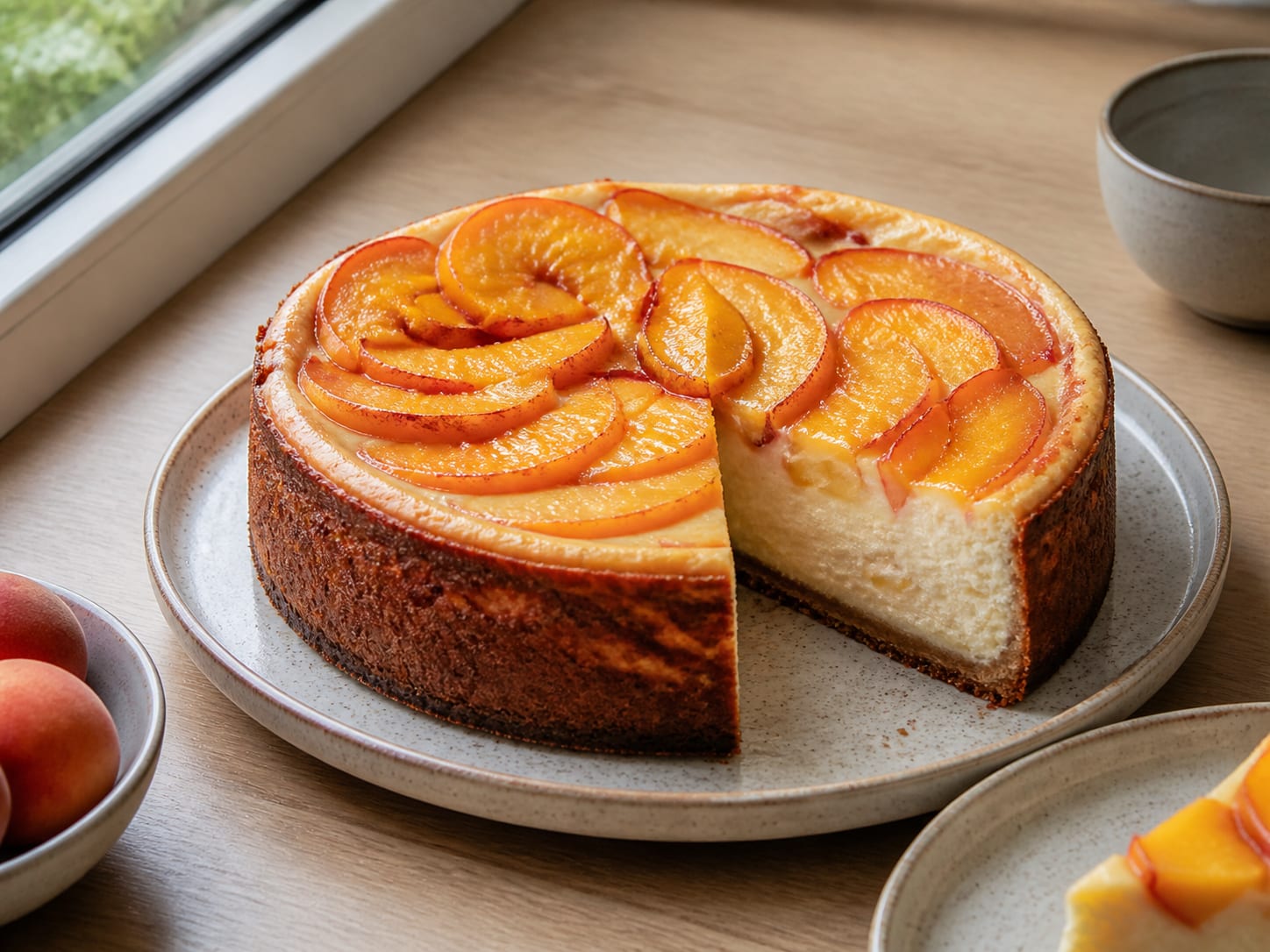
Pfirsich-Cheesecake (peach cheesecake)
A New York-style baked cheesecake, cream cheese rather than quark, set in a water bath so it comes out dense and silky instead of dry at the edges. Peaches go both into the batter and fanned over the top, so the fruit is a real layer, not a decoration.
Christoph's water bath cheesecake, written to put peaches into the batter as well as over the top rather than only as a glazed garnish.
Ingredients
Written for a 22 cm round tin
Units
Temperature
Servings
Base
- 200 g digestive biscuits, or graham crackers rounded
- 80 g butter, melted rounded
Filling
- 750 g full-fat cream cheese, room temperature rounded
- 160 g sugar rounded
- 3 eggs, room temperature rounded
- 150 g sour cream rounded
- 20 g cornstarch rounded
- 5 ml vanilla extract rounded
- 300 g ripe peaches, peeled, half diced small, half sliced for the top rounded
Dietary labels are a guide, not a guarantee. If you have an allergy, read the ingredients yourself.
Method
- Crush the biscuits to fine crumbs and stir in the melted butter until it looks like wet sand. Press firmly into the base of a 22 cm springform, up an inch of the sides, and chill while you make the filling.
- Wrap the outside of the tin in two layers of heavy foil, going right up over the sides, to keep water from a bath from seeping in through the springform seam.
- Beat the cream cheese and sugar together until smooth, scraping the bowl down often; lumps at this stage never fully disappear later. Beat in the eggs one at a time on low speed, just until combined; overbeating adds air that later causes cracking.
- Beat in the sour cream, cornstarch and vanilla, then fold in the diced peaches. Pour into the chilled crust and arrange the peach slices fanned over the top.
- Set the wrapped tin into a larger roasting pan and pour boiling water into the pan to come halfway up the sides of the springform.
- Bake at 150°C for about 70 minutes, until the centre still jiggles softly across an area about the size of a large coin and the edges look matte.
- Turn the oven off, crack the door and leave it for 1 hour, then lift out of the water bath and cool fully at room temperature before chilling at least 5 hours, ideally overnight.
Notes
- The water bath is not a formality. Baked without one, this cheesecake sets unevenly, dries out at the edges long before the centre is done, and is far more likely to crack.
- Room temperature ingredients matter more than usual here. Cold cream cheese and cold eggs refuse to beat smooth and leave lumps that a water bath’s gentle heat will never cook out.
- Do not overbeat once the eggs go in. The extra air that a stand mixer whips into the batter is exactly what expands, then collapses and cracks the surface as the cake cools.
- It keeps for 5 days in the fridge, covered, and slices best when still cold from the fridge with a knife run under hot water between cuts.
Ingredient substitutions
- Peaches can be nectarines with no change, or apricots for a sharper, less sweet result; frozen peach slices work if thawed and well drained first.
- Sour cream can be crème fraîche or full-fat Greek yogurt in the same quantity, all giving a similar tang and body.
- Digestive biscuits can be any plain, not-too-sweet biscuit; shortbread works well and gives a slightly richer base.
- For individual cheesecakes, divide the crust and filling between a lined muffin tin and bake at the same temperature for about 22 minutes, skipping the water bath, which is unnecessary at that size.
From Christoph Mayer