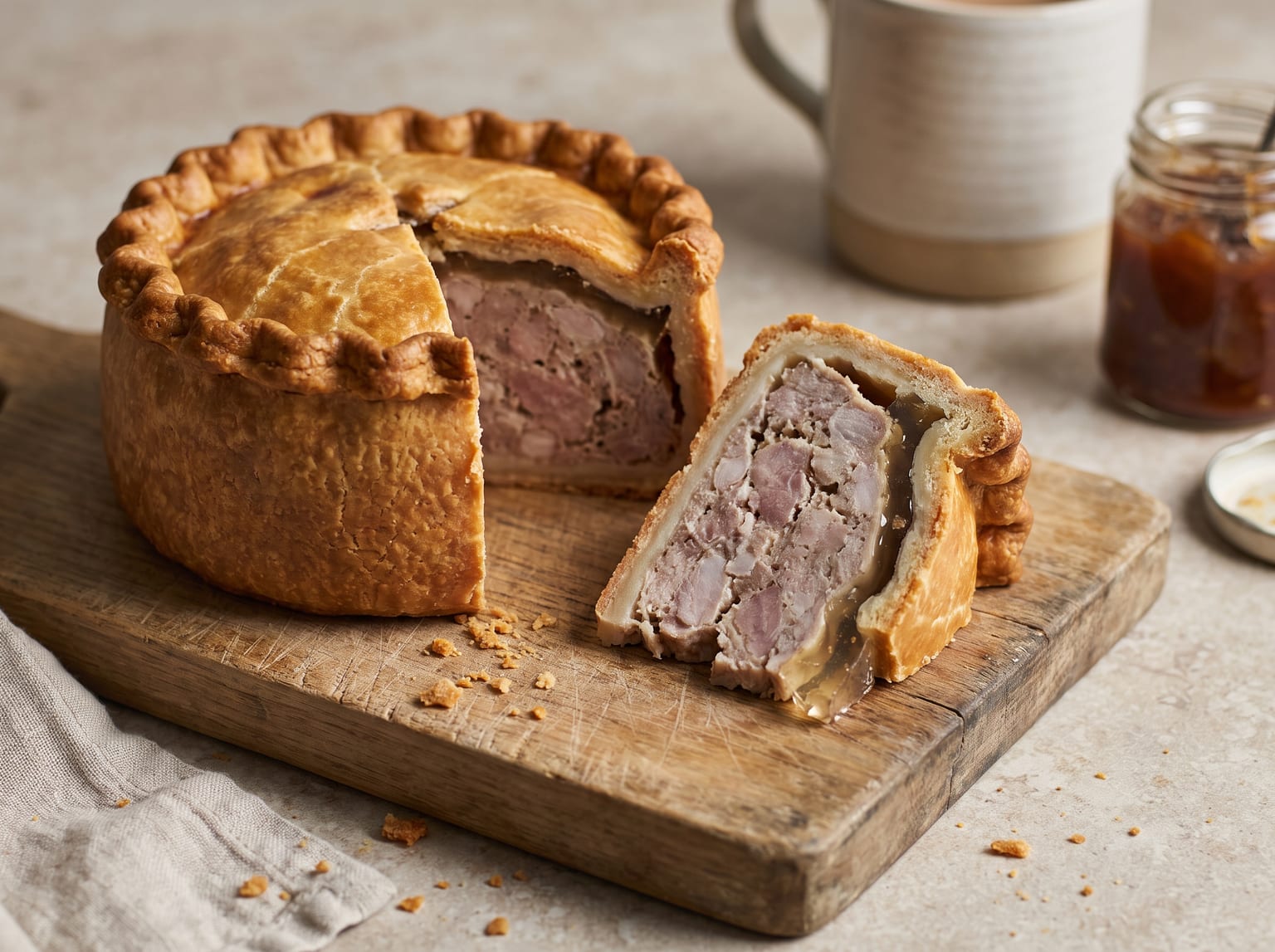
Hand-Raised Pork Pie
An English hot-water-crust pork pie, the pastry mixed and moulded while still hot from the kettle since it turns brittle and impossible to shape the moment it cools, then filled with coarsely chopped rather than minced pork so the finished pie has real texture instead of a dense, uniform paste. A savoury jelly poured in through a hole in the cooled, baked lid is what fills the gap the meat leaves as it shrinks, and what gives a proper pork pie its clean slice.
Christoph's hand-raised pork pie, the crust moulded while still hot and the filling left coarse for real texture.
Ingredients
Written for a 15 cm round tin
Units
Temperature
Servings
Hot-water-crust pastry
- 450 g flour rounded
- 6 g fine salt rounded
- 175 g lard rounded
- 175 ml water rounded
- 1 egg, beaten, for egg wash rounded
Filling
- 800 g pork shoulder, coarsely chopped by hand or pulsed briefly, not minced smooth rounded
- 200 g unsmoked bacon, finely diced rounded
- 10 g fine salt rounded
- 3 g ground white pepper rounded
- 3 g ground mace rounded
- 5 g fresh sage, chopped rounded
Jelly
- 400 ml pork or chicken stock rounded
- 6 g powdered gelatine rounded
Method
- Combine the pork, bacon, salt, pepper, mace and sage in a bowl. Mix well but don’t overwork; the pieces should stay distinct rather than becoming a smooth paste. Chill while you make the pastry.
- Combine the flour and salt in a large bowl. Bring the lard and water to a rolling boil in a small pot. Pour immediately into the flour and mix with a wooden spoon until a dough forms.
- Turn out onto a lightly floured surface and knead briefly while still warm, until smooth. Working the dough while hot is what makes it pliable; it turns brittle and hard to shape within minutes of cooling.
- Reserve one-third of the dough for the lid, keeping it wrapped and warm. Press the remaining dough into and up the sides of a 15 cm springform or a straight-sided pie tin, working it evenly to about 5 mm thick.
- Pack the filling into the lined tin, pressing down firmly to remove air pockets and mounding it slightly in the centre.
- Roll the reserved dough into a lid, place over the filling, and pinch the edges together to seal. Cut a steam vent in the centre.
- Chill for 30 minutes. Preheat the oven to 220°C (fan).
- Brush the pie with beaten egg and bake for 20 minutes at 220°C, then reduce the oven to 160°C and bake for a further 75 to 90 minutes, until the internal temperature reaches 71°C and the pastry is deeply golden brown and firm. Brush with egg again halfway through if the colour is uneven.
- Let cool completely, at least 3 hours, before adding the jelly.
- Sprinkle the gelatine over the stock and let bloom for 5 minutes, then warm gently until fully dissolved. Let cool until just liquid but not hot. Pour slowly through the steam vent, a little at a time, letting it settle and topping up until the pie won’t take any more.
- Chill for at least 4 hours, ideally overnight, before slicing.
Method in the Thermomix
- Place the lard and water in the mixing bowl. Heat 5 min/100°C/speed 1, until at a rolling boil.
- Add the flour and salt. Knead 20 sec/dough mode. Continue with the pastry as in the hand method, from step 3.
Notes
- Mould the pastry while it’s still hot. Hot-water-crust firms up and turns brittle within minutes of cooling; work quickly and keep the reserved lid dough wrapped so it doesn’t cool and crack before it goes on.
- Chop the pork coarsely rather than mincing it smooth. A hand-raised pork pie is defined by visible texture; put it through a mincer and the result is closer to a pâté than a proper pork pie.
- Bake hot first, then low and slow. The initial high heat sets the crust so it holds its shape; the long lower-heat stretch cooks the filling through without the crust burning before it does.
- Add the jelly only once the pie is completely cold, and pour it in gradually. Hot jelly poured into a warm pie just runs straight through the meat instead of setting as a distinct layer.
- It keeps in the fridge for 4 to 5 days, and is meant to be eaten cold, classically with pickle.
Ingredient substitutions
- Butter can replace some or all of the lard, though the crust is less crisp and more like a rich shortcrust.
- A pinch of ground allspice alongside the mace is a traditional addition.
- Serve with piccalilli or a sharp pickle, which cuts through the richness.
From Christoph Mayer