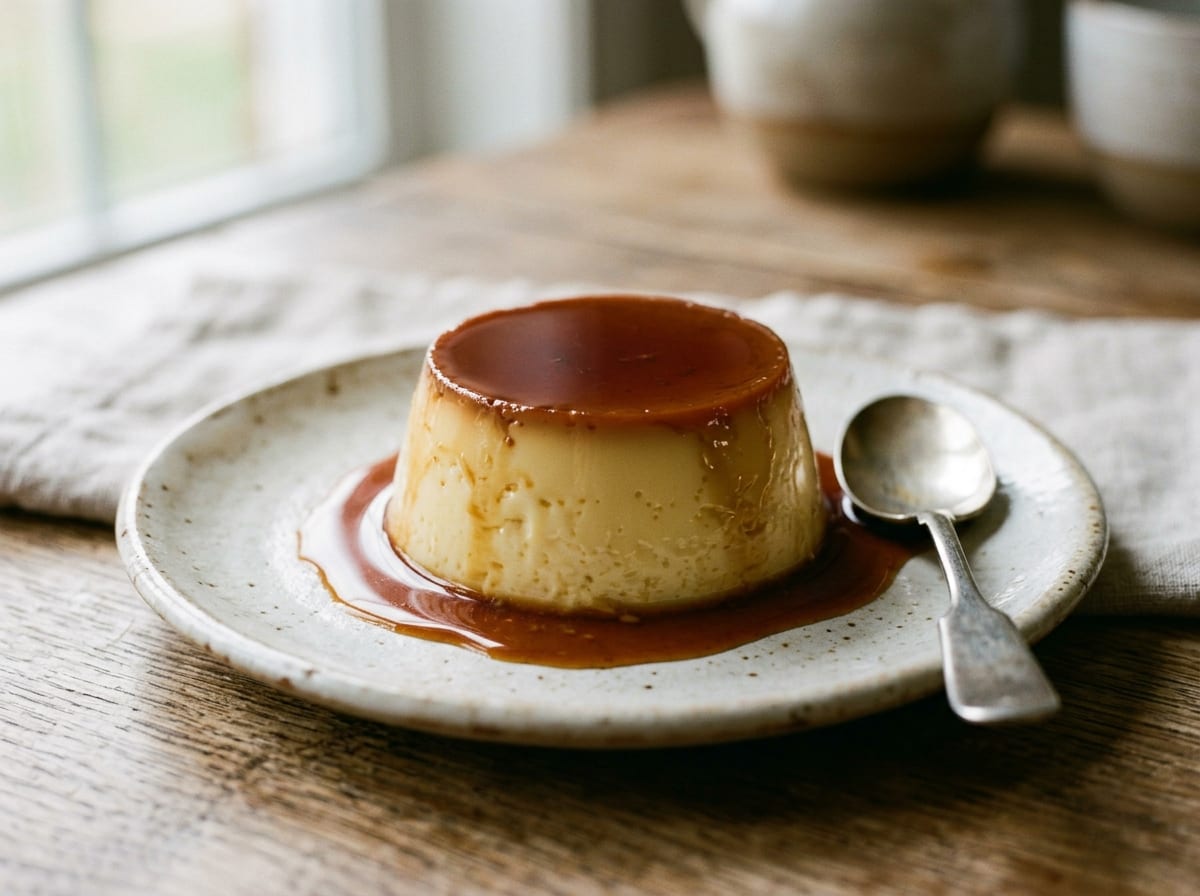
Purin (Japanese custard pudding)
A silky baked egg custard set in a gentle water bath, then unmolded so bittersweet caramel sauce pools over the top, Japan's everyday convenience-store dessert.
Prep20 min
Cook40 min
Rest180 min
Oven150°C
Servings6
Quantities and technique adapted from Just One Cookbook's Purin recipe, scaled up to six individual ramekins; the stovetop-steaming alternative in the Notes follows Chopstick Chronicles.
Ingredients
Units
Temperature
Servings
Caramel
- 100 g granulated sugar rounded
- 15 ml water, room temperature rounded
- 30 ml hot water, to loosen the caramel rounded
Custard
- 500 ml whole milk rounded
- 120 ml heavy cream rounded
- 4 large eggs, about 50 g each without shell rounded
- 90 g granulated sugar rounded
- 5 ml vanilla extract (optional) rounded
Dietary labels are a guide, not a guarantee. If you have an allergy, read the ingredients yourself.
Method
- Make the caramel: in a small, heavy saucepan, heat the 100 g sugar with the 15 ml room-temperature water over medium heat. Swirl the pan gently rather than stirring as the sugar melts and turns a deep amber, 4 to 6 minutes. Watch closely near the end; it goes from amber to burnt within seconds.
- Standing back, carefully pour in the 30 ml hot water (it will spatter and seize into lumps) and swirl until smooth again. Immediately divide the caramel among six 150 ml ramekins, tilting each to coat the base. Set aside to cool and harden while you make the custard.
- Heat the oven to 150°C and put a kettle of water on to boil for the water bath.
- Whisk the 4 eggs in a large bowl just until broken up; do not aerate them. Warm the milk and cream together in a saucepan over medium heat until steaming but not boiling, then whisk in the 90 g sugar until dissolved.
- Pour the warm milk mixture into the eggs in a thin stream, whisking constantly so the eggs don’t scramble. Stir in the vanilla, if using.
- Strain the custard through a fine-mesh sieve into a jug to catch any flecks of scrambled egg and the stringy chalazae, for a silky texture. Skim off any surface bubbles, or pop them with a kitchen torch or lighter.
- Divide the custard among the caramel-lined ramekins. Set the ramekins in a deep baking dish or roasting tin and pour in enough boiling water to come halfway up their sides. Cover the dish loosely with foil.
- Bake for 35 to 45 minutes, until the edges are fully set and only the very centre trembles when you nudge a ramekin. Lift the ramekins out of the water bath and let cool to room temperature.
- Cover and refrigerate for at least 3 hours, or overnight, until fully chilled and firm.
- To unmould, run a thin knife around the inside edge of each ramekin, set a small plate on top, and invert firmly, giving it a sharp downward shake if it resists. The caramel sauce will pool over the top as it comes free.
Notes
- Traditional Japanese home cooks often steam purin on the stovetop instead of baking it: bring a covered pan of water to a boil with the filled cups inside, drop to the lowest heat for 3 to 5 minutes, then turn the heat off entirely and let residual heat finish the custard over about 15 minutes with the lid on. It needs no oven, but the margin for error is narrow, since too much direct heat turns the custard spongy and full of holes. The oven water bath here is the more forgiving route for a first attempt.
- Straining the custard and popping the bubbles are what give convenience-store purin its glass-smooth top. Skip them and the pudding still tastes right, just flecked and slightly foamy on top.
- Make ahead: purin keeps covered in the fridge for 3 to 4 days and is meant to be made at least a few hours ahead, since it needs the chilling time regardless.
- Ramekins vary from about 120 to 180 ml. Smaller ones need a few minutes less in the oven, larger ones a few minutes more; the doneness cue matters more than the clock.
Sources Consulted
- Just One Cookbook, “Purin (Japanese Custard Pudding)”
- Chopstick Chronicles, “Purin Recipe (Japanese Custard Pudding)”
Sources consulted
The oven water-bath method and ingredient ratios follow Just One Cookbook. The traditional stovetop-steamed alternative described in the Notes follows Chopstick Chronicles. Wording and the exact quantities for six ramekins are original.
From Christoph Mayer