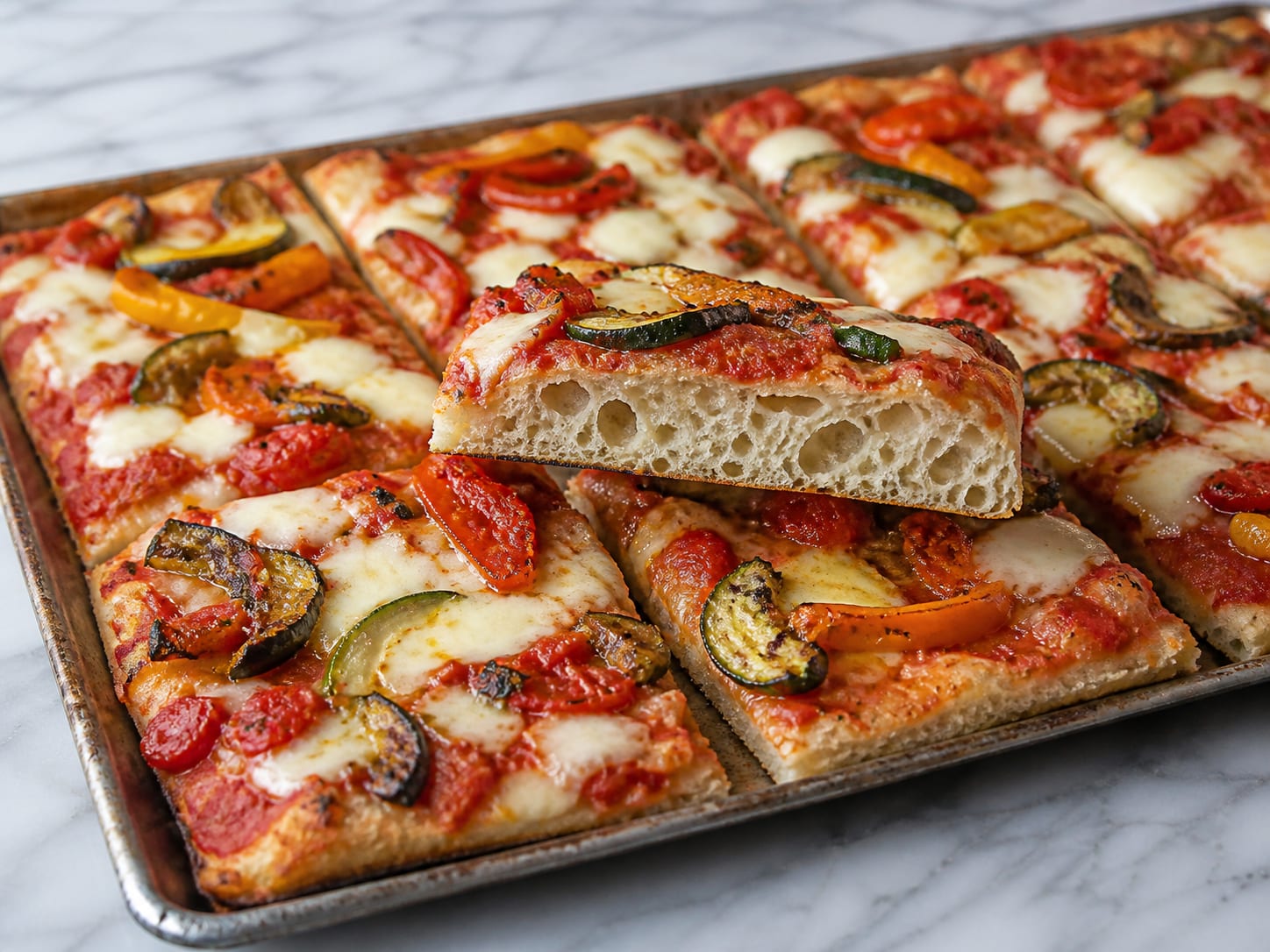
Roman pizza al taglio
A high-hydration Roman tray pizza with hand-built folds, a long cold ferment, an open crumb, and a crisp oil-rich base, baked rectangular and portioned in the Roman cut-by-weight tradition.
Prep35 min
Cook24 min
Rest1085 min
Oven230°C
Servings6
Adapted from America's Test Kitchen's Roman pizza al taglio technique and Pizza Today's professional overview of current pizza dough styles
Ingredients
Written for a 33 × 46 cm dish
Units
Temperature
Servings
Dough
- 400 g strong bread flour rounded
- 330 ml cool water rounded
- 8 g fine salt rounded
- 2 g instant yeast rounded
- 24 g extra virgin olive oil, mixed into the dough rounded
For proofing and the tray
- 30 g extra virgin olive oil, for coating the proofing dish and baking tray rounded
Dietary labels are a guide, not a guarantee. If you have an allergy, read the ingredients yourself.
Method
- Stir the flour, 310 g of the water, yeast, and 24 g oil until no dry flour remains. Cover for 10 minutes. Dissolve the salt in the remaining 18 g water, work it into the dough, and rest for 20 minutes. The dough is deliberately high-hydration and weighs exactly 762 g.
- With wet hands, lift one edge and fold it into the centre. Turn the bowl and repeat from all four sides. Rest for 20 minutes, then complete a second full set of folds. The folds, not continuous mixer kneading, build strength while preserving extensibility.
- Oil a 23 x 33 cm metal proofing dish lightly with part of the measured tray oil. Ease the dough into a rough rectangle, cover tightly, and refrigerate for 16 to 24 hours. This long ferment supplies flavour and lets the wet dough relax.
- On bake day, coat a sturdy dark 33 x 46 cm metal tray with all remaining measured oil. Brush the exposed dough lightly with oil, invert the tray over the proofing dish, then flip both together. Let the dough release onto the tray without scraping away its gas.
- Rest for 15 minutes. With oiled fingertips, dimple and ease the dough toward every corner. Do not press out the large bubbles. Cover and proof for 60 to 90 minutes, until puffy, relaxed, and visibly aerated.
- Heat the home oven to 230°C for at least 45 minutes with a rack in its lowest safe position. Use the topping selector below for exact quantities and before-bake and after-bake steps. Apply the selected al-taglio-compatible topping without crushing the bubbles and keep within its stated tray capacity so the wet crumb can set.
- Bake for 22 to 28 minutes, rotating once, until the surface is deeply golden and the underside is crisp and well browned. If the top finishes first, cover it loosely with foil. If the base is pale, put the tray on a thoroughly preheated steel for the final 3 to 5 minutes.
- Lift the pizza from the tray to a rack immediately and rest for 5 minutes. Cut it into rectangles with scissors or a long knife. Roman shops display long slabs, cut the requested length, and sell the portion by weight; at home, weigh pieces only if you want to recreate that cut-by-weight context.
Notes
- Baker’s percentages: strong bread flour 100%, water 82%, salt 2%, instant yeast 0.5%, and oil in the dough 6%. The exact dough weight is 762 g for one 33 x 46 cm tray.
- High hydration, two rounds of folds, the long ferment, and gentle transfer create the open crumb. Degassing during shaping produces a close, bread-like interior instead.
- The oil-rich base is part of the style. Put the oil on shortly before the final proof so more remains between dough and metal to crisp the underside rather than disappearing into the dough overnight.
- Pizza al taglio means pizza by the cut. Roman counters cut a rectangular slab to the customer’s requested size and commonly price that piece by weight, so the portion is cut by weight in commercial context. It is not defined by one fixed topping.
- The topping selector deliberately supplies that variable finish. This page owns the folded high-hydration dough, long ferment, oil-rich tray bake, and cut-by-weight service logic.
- A home oven cannot reproduce the fierce, even floor heat or recovery of a professional Roman deck oven. The moderate 230°C bake gives the wet crumb time to set; a dark tray and preheated steel improve the base, but the bake remains longer.
- Judge doneness by a rigid browned underside, a springy centre, and irregular open holes at the cut edge. Refrigerate cooled pieces for up to 3 days and reheat directly on a rack at 220°C.
Sources consulted
Good with
Sources consulted
The formula uses the 82% hydration, hand-folded, long-fermented approach in a practical 33 x 46 cm home-oven tray.
From Christoph Mayer