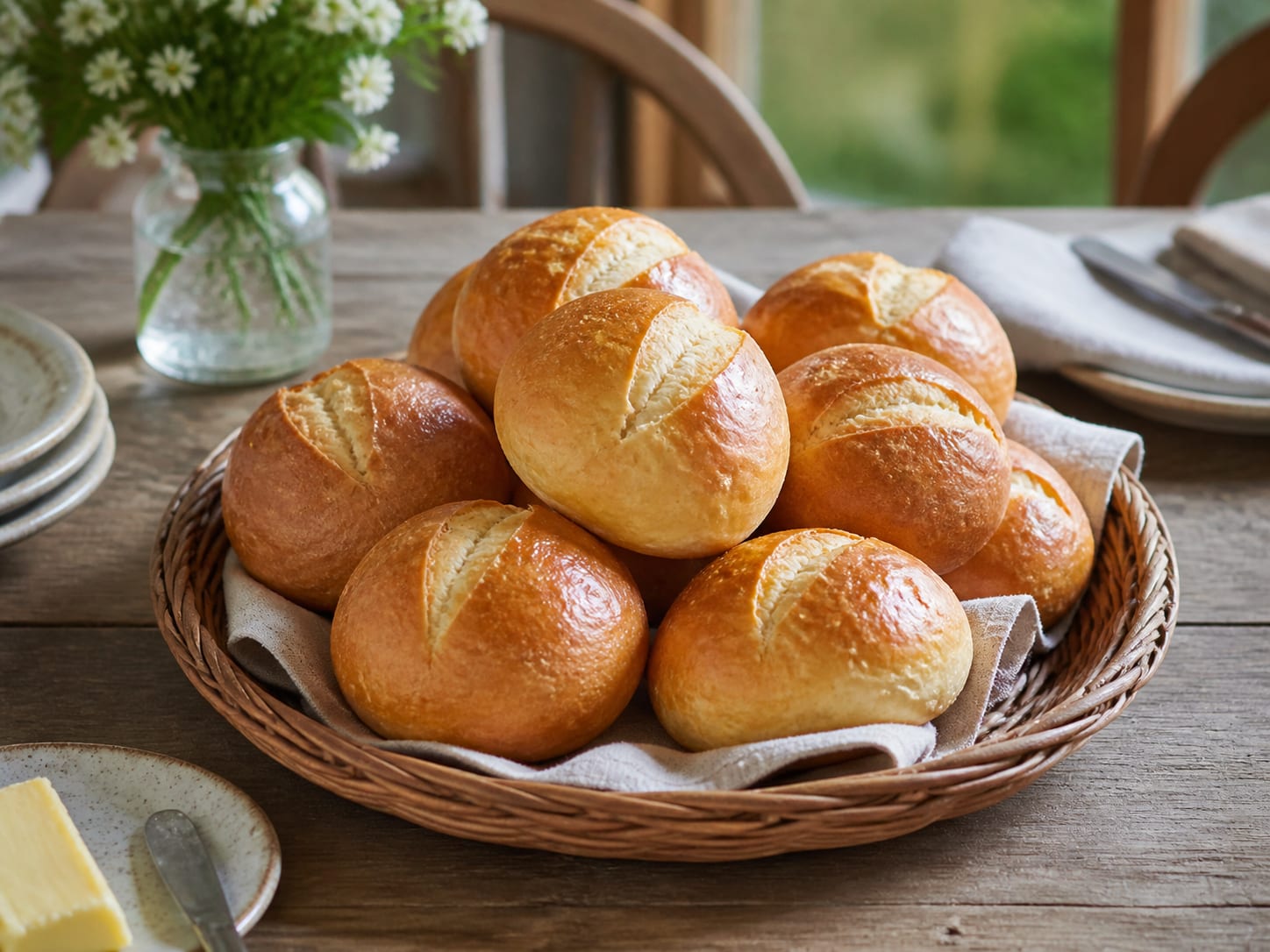
Sachsenbrötchen (Saxon milk rolls)
Soft, enriched milk rolls from Saxony, the dough kept deliberately slack and sticky rather than firmed up with extra flour, since a wetter dough is what gives these rolls their characteristically soft, almost cottony crumb. Cutting a shallow slash into each roll just before baking lets steam escape in a controlled way instead of the rolls splitting randomly along the sides.
Prep25 min
Cook20 min
Rest90 min
Servings4
Christoph's Sachsenbrötchen, the dough kept deliberately slack for a soft, cottony crumb.
Ingredients
Units
Temperature
Servings
Dough
- 500 g flour rounded
- 7 g instant yeast rounded
- 40 g sugar rounded
- 8 g fine salt rounded
- 280 ml milk, lukewarm rounded
- 50 g butter, softened rounded
- 30 ml milk, for brushing rounded
Dietary labels are a guide, not a guarantee. If you have an allergy, read the ingredients yourself.
Method
- Whisk the flour, yeast, sugar and salt together in a large bowl. Add the lukewarm milk and mix to a rough, sticky dough.
- Knead in the softened butter for 8 to 10 minutes, using a stand mixer or wet hands, until smooth but still noticeably soft and slightly sticky. Resist the urge to add more flour.
- Cover and let rise for 60 minutes, until doubled.
- Divide into 10 pieces and shape each into a smooth ball, handling gently. Arrange on a baking sheet, spaced apart.
- Cover and let rise for 30 minutes. Preheat the oven to 190°C (fan).
- Brush the rolls with milk. Cut a shallow slash across the top of each with a sharp blade.
- Bake for 18 to 20 minutes, until pale golden and hollow-sounding when tapped. Let cool on a rack.
Notes
- Keep the dough slack, don’t firm it up with extra flour. A wetter dough is exactly what gives these rolls their soft, almost cottony crumb; adding flour to make it easier to handle firms up the texture and defeats the point.
- Slash each roll shallowly right before baking. This gives escaping steam a controlled path, so the rolls open neatly along the cut rather than splitting randomly along the sides as they expand.
- Bake until pale golden, not deeply browned. These rolls are meant to stay soft-crusted; over-baking dries them out and gives a crust more typical of a crusty artisan loaf.
- Best eaten fresh the day they’re baked, though they freeze well and can be refreshed in a low oven.
Ingredient substitutions
- Milk is essential to the soft texture here; a plant milk substitute will give a slightly different, less rich crumb.
- A little more sugar makes these closer to a sweet breakfast roll if preferred.
- Serve with butter and jam, the traditional way to eat them.
From Christoph Mayer