Main Chinese restaurant-style Chinese Dairy-free Nut-free
Salt and Pepper Prawns
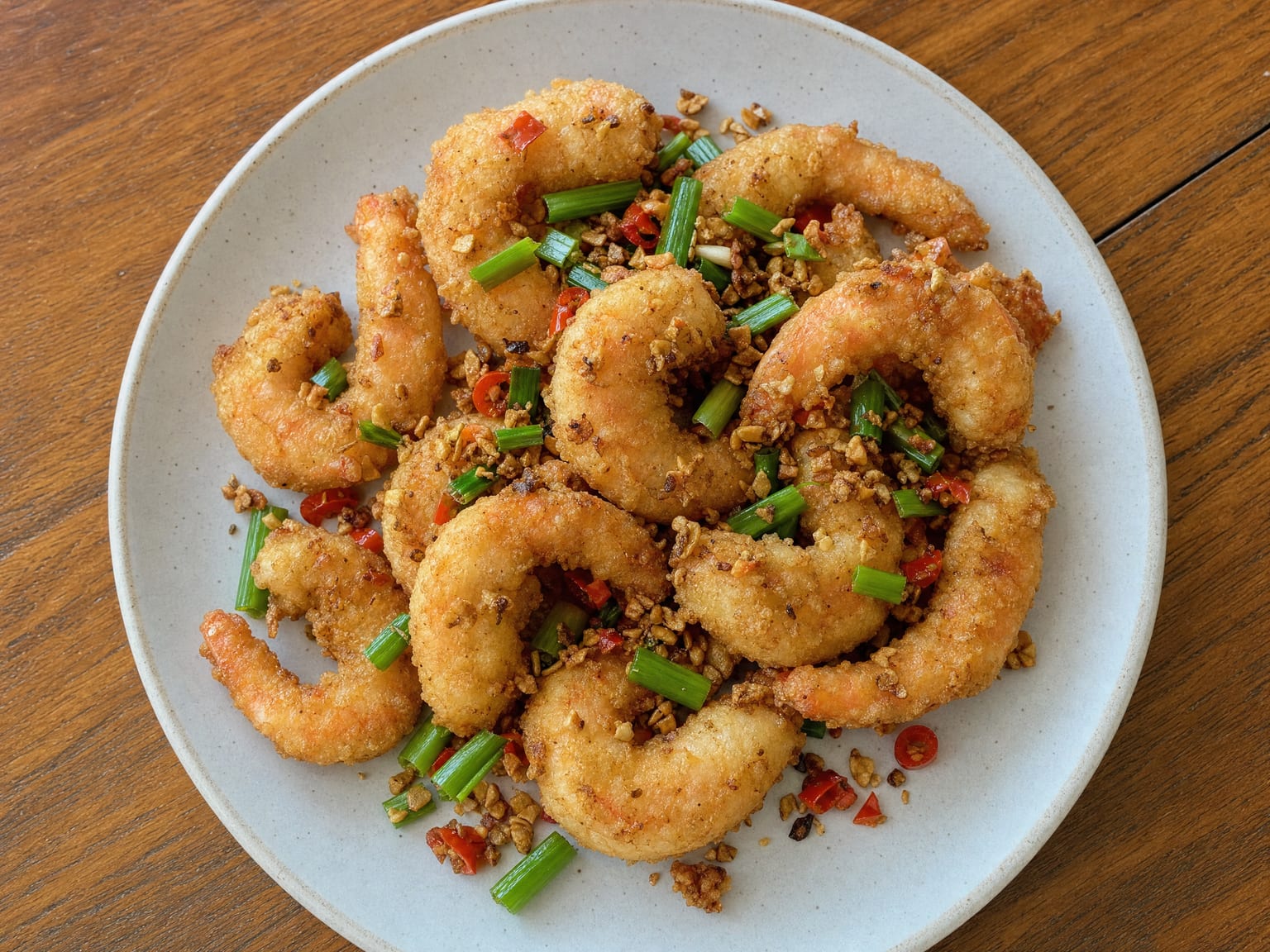
Cantonese jiu yim, where prawns are dredged in starch, fried hard and fast, then tossed through a dry pan of garlic, chilli and scallion with a seasoning powder rather than any sauce. Nothing wet touches the pan at any point, which is the entire technique and the reason this stays crisp on the plate where a sauced dish would go limp in a minute.
Adapted from The Woks of Life, keeping the starch dredge, the shallow fry and the dry seasoning powder tossed through at the end.
Ingredients
Written for a 26 cm pan
Seasoning powder
- 6 g fine salt rounded
- 4 g ground white pepper, the Cantonese choice; see notes rounded
- 2 g Chinese five spice powder rounded
- 3 g sugar rounded
Prawns and coating
- 600 g large raw prawns, shell on and deveined is traditional, peeled is easier rounded
- 60 g potato starch or cornflour rounded
- 250 ml neutral oil, for shallow frying rounded
Dry aromatics
- 4 garlic cloves, finely chopped rounded
- 2 red chillies, finely chopped; a jalapeno or two also works rounded
- 3 scallions, finely sliced rounded
Dietary labels are a guide, not a guarantee. If you have an allergy, read the ingredients yourself.
Method
- Mix the seasoning powder and keep it beside the stove. It goes on at the end and there will be no time to measure then.
- Dry the prawns completely. Rinse and pat them with paper until no moisture is left at all. Wet prawns spit violently in hot oil and the starch slides off instead of clinging.
- Dredge in starch. Toss the prawns in the potato starch or cornflour until evenly coated, then shake off the excess in a sieve. A thick layer goes claggy; you want a thin dry film.
- Shallow fry hot and fast. Heat the oil to 190°C in a wide pan. Fry the prawns in two or three batches, laying them apart with space between, for about 30 to 45 seconds a side until the coating is pale gold and set. Lift onto a rack. They cook astonishingly quickly and a prawn left too long turns to rubber.
- Pour off almost all the oil, leaving about a tablespoon in the pan.
- Fry the aromatics dry. Over medium heat, add the garlic, chilli and the white parts of the scallion and fry 30 to 45 seconds until fragrant and just starting to colour. Nothing liquid goes in the pan at any point.
- Return the prawns, season and toss. Tip the prawns back in, sprinkle the seasoning powder over from a height so it lands evenly, and toss hard for 15 to 20 seconds. Add the green scallion and serve immediately.
Variations
Same powder, same technique, adjusted for what is being fried.
- Salt and pepper squid. 600 g cleaned squid, scored and cut into pieces, dried very thoroughly. Fry 45 to 60 seconds only. Squid is either cooked in a minute or needs half an hour, with nothing usable in between.
- Salt and pepper chicken. 600 g boneless thigh in 3 cm pieces, marinated 15 minutes in a tablespoon of soy and a teaspoon of Shaoxing wine, dried, dredged and fried 4 to 5 minutes until cooked through.
- Salt and pepper seafood. A mix of prawns, squid and scallops, each fried separately for its own time and combined only at the tossing stage.
- Salt and pepper tofu. 500 g firm tofu, pressed hard, cut into cubes, dredged and fried until crisp on all sides. The best vegetarian dish on this shelf by some distance.
Notes
- The pan stays dry from beginning to end. This is not a sauced dish, and the moment liquid appears the coating starts to soften. If it looks dry on the plate, that is correct.
- White pepper is the Cantonese choice and is what a restaurant serving this alongside chow mein will be using. Sichuan peppercorn is used in mainland versions and gives a numbing tingle instead; both are legitimate and taste completely different.
- Shell-on prawns are traditional and the shells go crisp and edible when fried properly, which is where much of the flavour lives. Peeled is easier and perfectly acceptable.
- Fry in batches with space. Crowding drops the oil temperature and the coating goes greasy rather than crisp.
- Serve at once. This is a dish measured in minutes, not hours.
Ingredient substitutions
- Potato starch gives a lighter, crisper coating than cornflour and is what most restaurants use. Both are stocked everywhere in Germany (Kartoffelstärke, Speisestärke) and Canada. Plain flour is a poor substitute here and comes out heavy.
- Five spice powder is available in both countries in ordinary supermarkets. If you have none, a pinch of ground star anise and cinnamon gets close enough.
- Fresh red chilli can be replaced with a good pinch of dried chilli flakes added with the seasoning powder rather than fried.
Sources consulted
Good with
From Christoph Mayer