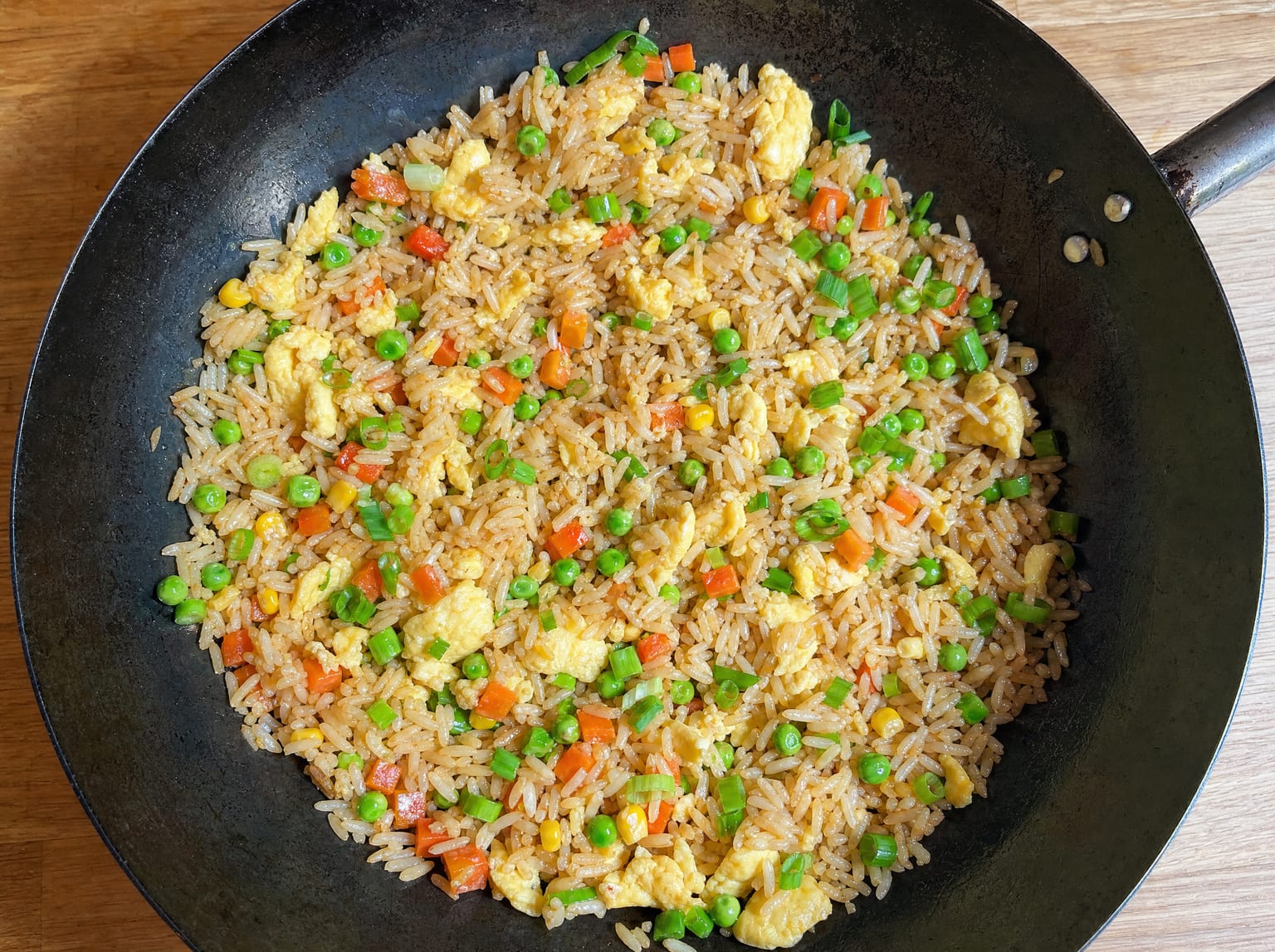
Main Chinese restaurant-style Chinese Dairy-free Nut-free
Chinese Fried Rice
Restaurant fried rice, which depends almost entirely on cold day-old rice and a pan hot enough to fry rather than steam. Freshly cooked rice carries too much surface moisture and clumps into a sticky mass no matter how good the seasoning is, so the rice is cooked the day before and broken up cold, and everything else takes about six minutes.
Adapted from RecipeTin Eats and The Woks of Life, keeping the day-old rice rule and their soy and oyster sauce seasoning ratio.
Ingredients
Written for a 30 cm pan
Base
- 500 g cooked day-old white rice, cold from the fridge, clumps broken up by hand rounded
- 30 ml neutral oil rounded
- 3 eggs, beaten rounded
- 100 g onion, finely chopped rounded
- 2 garlic cloves, minced rounded
- 150 g mixed vegetables, peas, diced carrot and sweetcorn, frozen is fine rounded
- 4 scallions, sliced rounded
Seasoning
- 15 ml light soy sauce rounded
- 15 ml oyster sauce rounded
- 15 ml Shaoxing wine rounded
- 5 ml toasted sesame oil rounded
- 1 g ground white pepper rounded
Dietary labels are a guide, not a guarantee. If you have an allergy, read the ingredients yourself.
Method
- Use cold rice and break it up first. Tip the day-old rice into a bowl and work the clumps apart with wet fingers until every grain is loose. Doing this before the pan is hot is what stops you standing over a wok mashing lumps while everything else overcooks.
- Scramble the eggs and take them out. Heat a third of the oil in a very hot wok, pour in the beaten egg, let it set for a few seconds and then scramble it into large soft curds while still slightly wet. Tip it onto a plate. It finishes cooking later and would go rubbery if left in.
- Fry the aromatics. Add the rest of the oil, then the onion for 2 minutes until translucent, then the garlic for 15 seconds, then the mixed vegetables for 1 to 2 minutes.
- Add the rice and leave it alone. Tip in the cold rice, spread it out, and let it sit for 20 to 30 seconds at a time between tosses so the grains hit hot metal and toast. Keep going for about 3 minutes. You are frying, not stirring.
- Season around the edge. Pour the soy sauce, oyster sauce and Shaoxing wine around the rim of the pan, not into the middle, so it hits hot metal and caramelises for a second before it reaches the rice. Toss to distribute.
- Finish. Return the egg, breaking it into pieces, add the sesame oil, white pepper and scallions, toss once more and serve straight away.
Variations
Add roughly 200 g of protein with the aromatics if it is cooked, or sear it first and return it at the end if raw.
- Chicken, beef or pork fried rice. 200 g, sliced small, velveted with a teaspoon of cornflour and seared first.
- Mushroom or vegetable fried rice. 250 g mushrooms browned dry first, or extra mixed vegetables. Vegetarian oyster sauce.
- Pineapple and BBQ pork fried rice. 150 g diced char siu and 150 g pineapple chunks, patted very dry, added in the last minute so they warm without releasing juice.
- Shrimp fried rice. 200 g small peeled prawns, seared 60 seconds and returned at the end.
- House special fried rice. Char siu, prawn and chicken, about 80 g of each.
- Beef and tomato fried rice. 200 g seared beef plus 200 g tomato wedges added late, with a spoonful of ketchup in the seasoning. It sounds odd and is a genuine Cantonese restaurant staple.
- Curried chicken rice. Add 2 teaspoons of mild curry powder with the aromatics and drop the oyster sauce.
- Kung pao or Szechuan style. Add a tablespoon of kung pao sauce or a teaspoon of chilli bean paste with the seasoning, plus roasted peanuts at the end.
Notes
- Day-old rice is not a superstition. Cold rice has a dry surface and firm grains that separate; fresh rice is wet and soft and turns to porridge. If you must use fresh, spread it on a tray and refrigerate it uncovered for an hour.
- Long grain rice, not short. Jasmine is ideal. Short grain and risotto rices are too starchy and will clump whatever you do.
- Season around the rim of the pan. Sauce poured into the centre soaks straight into the rice and steams it; sauce hitting hot metal at the edge caramelises and coats.
- Do not crowd the pan. Two portions is the practical maximum in a domestic wok. For four, cook two batches.
Ingredient substitutions
- Oyster sauce substitutes with vegetarian mushroom oyster-style sauce, or with an extra splash of soy plus a pinch of sugar.
- Shaoxing wine substitutes with dry sherry, or leave it out; fried rice survives its absence better than most dishes here.
Sources consulted
Good with
From Christoph Mayer