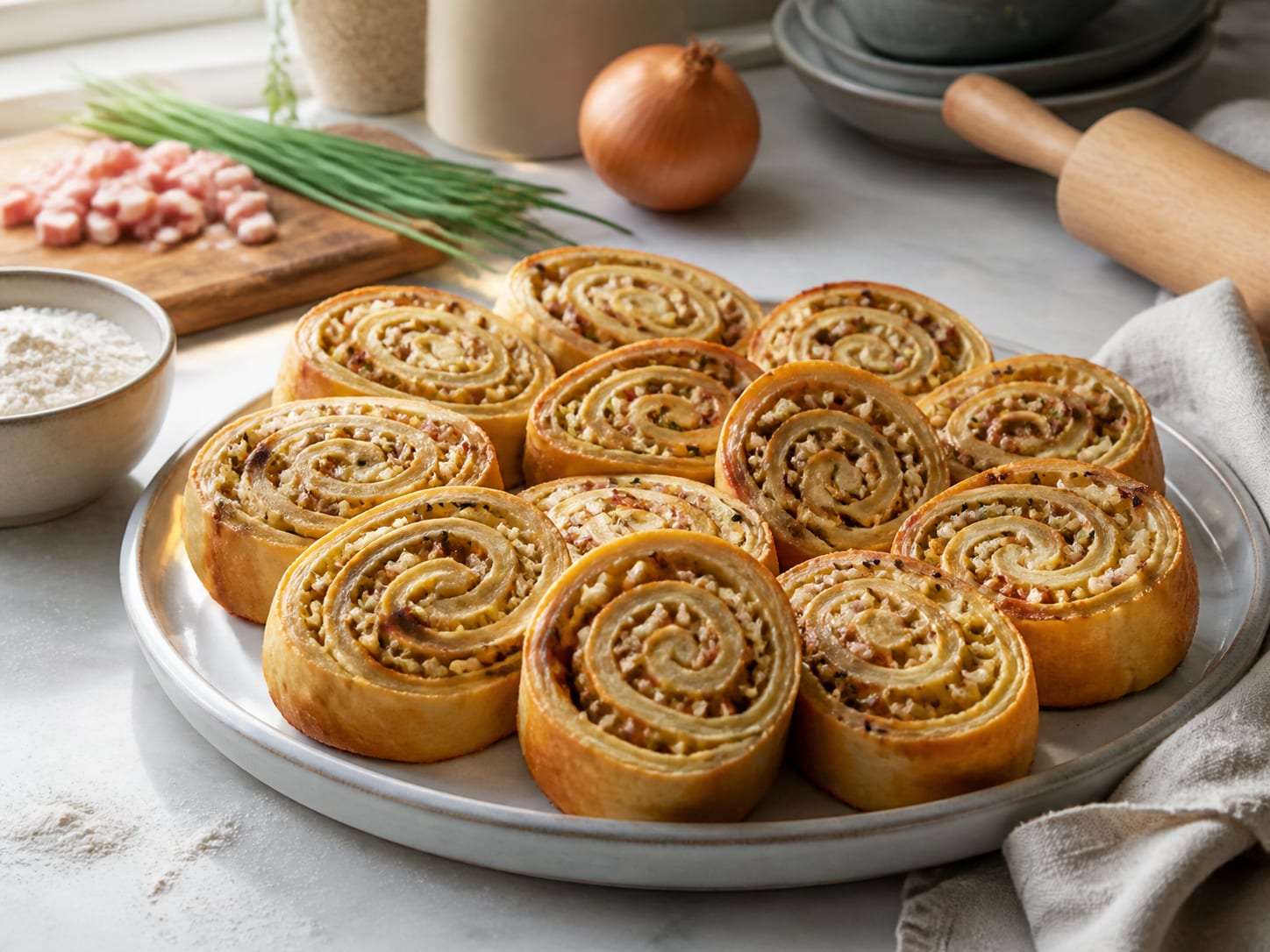
Schwäbische Flachswickel (Swabian filled dough rolls)
Savoury Swabian yeast rolls named for their resemblance to bundled flax, the dough rolled thin and spread edge to edge with a savoury filling before being rolled up tightly and sliced, so every piece carries the same visible spiral rather than the filling pooling in the centre. Sealing the rolled log firmly at the seam before slicing is what keeps the filling from squeezing out during baking.
Prep30 min
Cook25 min
Rest75 min
Servings4
Christoph's Flachswickel, the rolled log sealed firmly at the seam before slicing so the filling doesn't squeeze out.
Ingredients
Units
Temperature
Servings
Dough
- 400 g flour rounded
- 7 g instant yeast rounded
- 220 ml milk, lukewarm rounded
- 8 g fine salt rounded
- 30 g butter, softened rounded
- 30 ml milk, for brushing rounded
Filling
- 200 g onion, finely chopped rounded
- 30 ml neutral oil rounded
- 150 g shredded cheese rounded
- 5 g caraway seeds rounded
- to taste freshly ground black pepper rounded
Dietary labels are a guide, not a guarantee. If you have an allergy, read the ingredients yourself.
Method
- Whisk the flour, yeast and salt together. Add the lukewarm milk and mix to a rough dough. Knead in the butter for 8 minutes, until smooth and elastic. Cover and let rise for 45 minutes, until doubled.
- Meanwhile, sauté the onion in the oil over medium heat for 6 to 8 minutes, until softened and lightly golden. Let cool.
- Roll the dough out into a large rectangle, about 5 mm thick. Scatter the cooled onion, cheese, caraway and pepper evenly over the surface, leaving a small border.
- Roll up tightly from one long edge, sealing the seam firmly by pinching it closed. Slice into 12 pieces.
- Arrange cut-side up on a baking sheet, spaced apart. Cover and let rise for 30 minutes.
- Preheat the oven to 190°C (fan). Brush the rolls with milk. Bake for 20 to 22 minutes, until deeply golden brown and hollow-sounding when tapped.
Notes
- Seal the rolled log firmly at the seam before slicing. A loosely closed seam lets the filling squeeze out during proofing and baking, leaving some rolls with a thin, leaking side.
- Roll the dough thin before adding the filling. A thicker sheet gives you fewer, thicker layers once rolled up; thin dough creates the fine, visible spiral that gives Flachswickel their name.
- Let the onion cool before scattering it over the dough. Warm onion can soften the dough and make it harder to roll up cleanly.
- They’re best fresh but reheat well in a low oven for a few minutes.
Ingredient substitutions
- A few slices of ham or bacon with the onion is a traditional non-vegetarian variation.
- Caraway can be reduced or left out if you don’t care for its flavour.
- Any hard, well-flavoured cheese works in the filling.
From Christoph Mayer